

The release of the Pi-hole 6 project has been presented, which develops a system for centralized ad blocking in local networks, allowing users to avoid installing blockers in browsers and on endpoint devices. The proposed scheme is relevant for combating advertising on devices in home networks, such as smart TVs and media centers, as well as for blocking ads in mobile applications on smartphones. Ad blocking in Pi-hole is implemented at the DNS level — the system applies a blacklist of domains used for displaying ads and redirects requests to these domains to the address 0.0.0.0. The project's developments are distributed under the EUPL 1.2 (European Union Public License).
To install Pi-hole, it is sufficient to run a shell script that automates the download and installation of the necessary components. Installation is supported on Debian, Ubuntu, Fedora, Raspberry Pi OS (Raspbian), Armbian, and CentOS Stream for architectures x86_64, i386, ARM64, ARMv6, ARMv7, and RISC-V. It is assumed that Pi-hole can be installed on boards such as the Raspberry Pi (the performance of a Raspberry Pi Zero is sufficient for operation). Additionally, a pre-configured container image is offered, containing a ready-to-use environment based on Pi-hole.
Pi-hole runs DHCP and DNS servers based on a modified version of dnsmasq. The DHCP server is used for automatic transmission of DNS server settings involved in blocking. The FTLDNS (pihole-FTL) background process is used to manage the DNS server and collect statistics. Management of FTLDNS can be performed through Web API, telnet, or the command line utility pihole. FTLDNS accumulates statistics on the number of blocked and requested DNS queries, domainsad network domain blocks, cached and redirected DNS queries, and the number of clients. The statistics are stored using SQLite.
On top of the API provided by FTLDNS, a web interface has been implemented for monitoring and managing blocks, based on AdminLTE code. The web interface is designed to work both on large-screen computers and mobile devices. Access to detailed logs is supported, as well as summary data (for example, the most popular clients and domains), clear visualizations on charts and graphs, a history selection for a specified period, log filtering, maintenance of separate whitelist and blacklist, blocking via regular expressions, and management of DHCP and DNS settings.
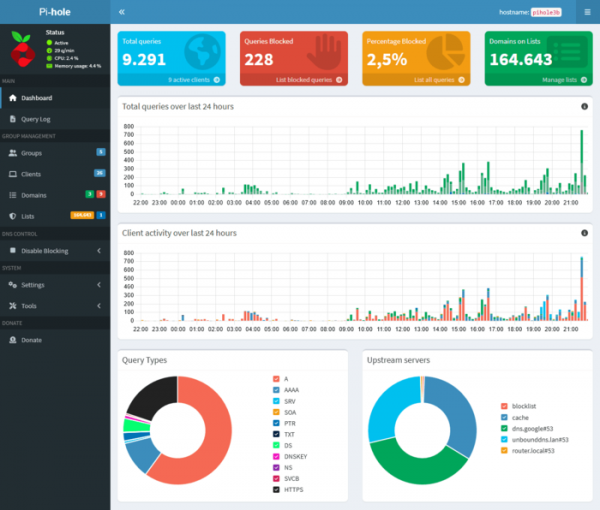
In the new release:
- The background process pihole-FTL has an integrated HTTP server and REST API. The built-in HTTP server implementation is based on the CivetWeb library. Previously, the HTTP server lighttpd was used to organize the web interface. The server handlers for the web interface have been rewritten from PHP to Lua (CivetWeb provides built-in support for Lua, which allowed for the exclusion of PHP from dependencies).
- Domain filtering capabilities have been expanded, and support for connecting external whitelists has been added, which determine domains that will be allowed regardless of being blacklisted.
- Scattered configuration files have been consolidated into a single file in toml format (\/etc\/pihole\/pihole.toml). Configuration can be changed by directly editing the toml file, using the command "pihole-FTL --config", overriding parameters via environment variables, accessing the API, or changing settings through the web interface.
- The web interface has been completely redesigned, featuring a split between normal and expert modes.
- Support for HTTPS has been added, with the option to provide either a self-signed TLS certificate, or automatically generated certificate.
- The Docker container image has been migrated to use Alpine Linux instead of Debian, significantly reducing its size.
Source: opennet.ru
