

Comparison of Two Approaches to Activity Diagram Structuring (Inspired by 'The Squirrel')
In We modeled the processes of a 'fairy tale' domain — lines about the squirrel from 'The Tale of Tsar Saltan, His Glorious and Mighty Son Prince Guidon Saltanovich and the Beautiful Swan Princess' by A.S. Pushkin. We started with the Activity diagram, agreeing to structure the field of the diagram using 'swimming' lanes – Swim lanes. The lane name corresponds to the type of elements in the diagram that are present on that lane: 'Input and Output Artifacts,' 'Process Steps,' 'Participants,' and 'Business Rules.' This approach differs from the standard one, where lanes are designated by the names of process participants, thus assigning them specific areas of responsibility in the process.
In this example, I am using the Enterprise Architect environment from an Australian company. [1].
For more details on the modeling approaches applied, see [2].
Full UML specification can be found. [3].
I will repeat the diagram variant from the previous article (Figure 1) and show a redrawn diagram with 'standard' lanes (Figure 2), trying to outline the pros and cons, perhaps somewhat subjectively.
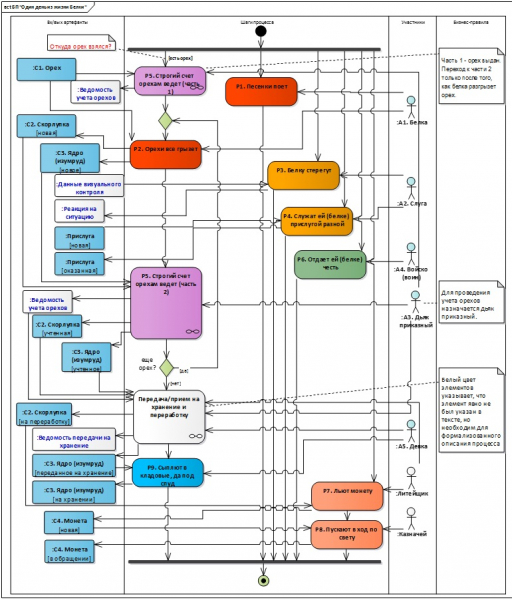
Figure 1. Activity Diagram – overview of the process
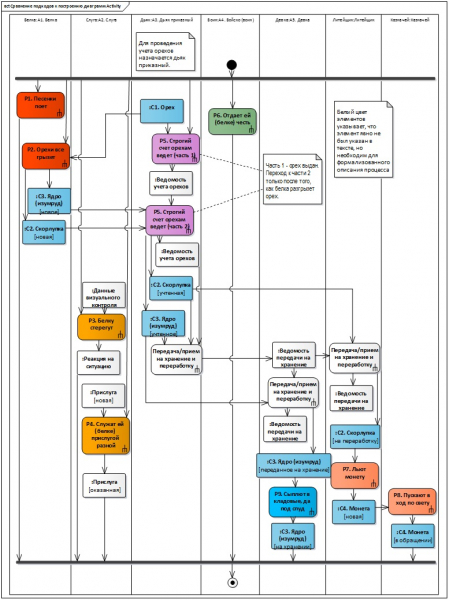
Figure 2. Activity Diagram – standard diagram structuring
- It must be acknowledged that the number of arrows is slightly fewer in the second diagram.
- However, in the second diagram, the objects are 'spread out' across the entire field of the diagram, which, in my opinion, is not very convenient.
- The same story applies to notes — rules. And also, to insert the rule about appointing the deacon, I had to move all the diagram elements down at one point.
- I had to clone the step 'receipt/transmission...' to show that several participants are present at this step.
- In the second variant, I had to give up one branching and one merging of the process; it simply couldn't be arranged 'nicely'! Ideally, there should have been a comment — a rule.
Of course, there are no friends in taste and color, but I find the first option to be more convenient for gathering data about the process.
But I won’t deceive — sometimes both options are better drawn to thoroughly understand the process.
List of sources
- Sparx Systems website. [Electronic resource] Access mode: Internet:
- Zolotukhina E.B., Vishnya A.S., Krasnikova S.A. Modeling Business Processes. — M.: KURS, NITS INFRA-M, EBS Znanium.com. — 2017.
- OMG Unified Modeling Language (OMG UML) Specification. Version 2.5.1. [Electronic resource] Access mode: Internet:
Source: habr.com
