

The release of the mobile platform /e/OS 4.3 has been announced, focused on user data privacy. The platform is founded by Gaël Duval, the creator of the Mandrake Linux distribution. The project supports 287 smartphone models and creates firmware builds for the most popular ones. Custom device editions have been prepared based on OnePlus, Fairphone, Teracube, HIROH, and Pixel smartphones, distributed with pre-installed /e/OS firmware under the brands Murena One, Murena 2, Murena Fairphone 4/5/6, Murena Teracube 2e, Murena Pixel 5/7, and Murena SHIFTphone 8.
/e/OS firmware is developed as a branch of the LineageOS platform (based on Android), freed from ties to Google services and infrastructure to eliminate telemetry transmission to Google servers and enhance privacy. Among other things, it blocks implicit information sending, such as requests to Google servers for network availability checks, DNS resolution, and precise time determination.
The package includes microG, which offers independent analogs of Google services, allowing users to avoid installing proprietary components. For location determination via Wi-Fi and cell towers (without GPS), the UnifiedNlp layer can work through BeaconDB, OpenWlanMap, openBmap, OpenCellID, lacells.db, and other alternative services. Instead of Google’s search engine, the meta-search service Murena Find is offered based on the Qwant search engine.
To synchronize the exact time instead of querying Google's NTP server, requests are sent to servers from the NTP Pool collection, and DNS servers from the current provider are used instead of Google's DNS servers (8.8.8.8). The web browser defaults to having an ad and tracking script blocker enabled. For syncing files and application data, a proprietary service has been developed, compatible with Nextcloud-based infrastructure. The server components are based on open-source software and available for installation on user-controlled systems.
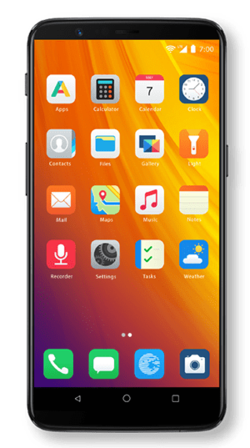
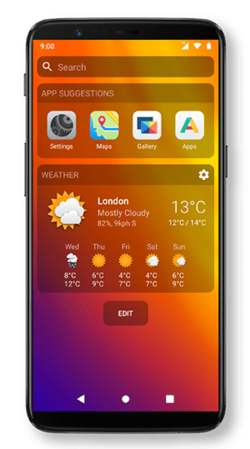
The user interface includes a custom environment for launching applications, BlissLauncher, an improved notification system, a new lock screen, and different styling. BlissLauncher features a set of automatically scalable icons developed for /e/OS and a separate selection of widgets (for example, a widget for showing weather forecasts).
The project also develops its own authentication manager, allowing a single account (user@murena.io) to be used for all services, registered during the initial setup. This account can be used to access your environment from other devices or via the web. Murena Cloud provides 1GB of free storage for your data, application synchronization, and backups.
The included applications are: the Mail client (a fork of K9-Mail), the Cromite web browser (based on Chromium), the OpenCamera application for camera work, QKSMS for instant messaging, nextcloud-notes for note-taking, MJ PDF viewer, opentasks planner, Magic Earth for maps, gallery3d for photo gallery, file manager, and the App Lounge application catalog.
Key changes in /e/OS 4.3:
- Updates and fixes have been ported from LineageOS 23, built on the Android 16 codebase. The /e/OS firmware for the Fairphone 4 smartphone has been updated to Android 16.
- The /e/OS Backup app now includes information about the next scheduled backup. Backup of widget settings for the weather forecast and selected wallpapers is ensured. Optimizations have been added to suspend backups when the battery is low. It now detects the usage of the Seedvault system for creating encrypted backups to continue using it instead of /e/OS Backup.
- The firmware for the Gigaset GS6 smartphone has improved fingerprint authentication, added a handler for selecting actions when holding the Action button, and resolved issues with microG app crashes.
- Firmware updates have been released for the Fairphone 6 and Fairphone 4 smartphone components.
- In the account manager, contact synchronization for the address book has been improved.
- The password manager has stopped auto-filling fields with one-time passwords.
- For OnePlus, Samsung, Xiaomi, and Sony Xperia devices, the assembly of recovery images (recovery.img) has been established.
Source: opennet.ru
