

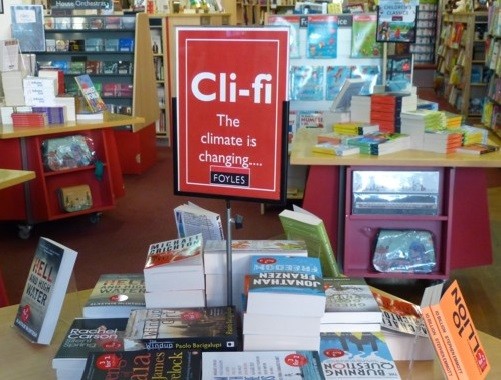
Cli-Fi (climate fiction, derived from Sci-Fi, science fiction) began to gain attention in 2007, although works of fiction addressing ecological issues had been published earlier. Cli-Fi is a very interesting subgenre of science fiction that is based on theoretically possible or already existing technologies and scientific achievements of humanity that could drastically spoil our lives. Ecological fiction raises issues of humanity's complacent attitude towards nature and other people.
You might ask, how are ecology and the cloud provider Cloud4Y related? Well, first of all, the use of cloud technologies helps reduce harmful emissions into the atmosphere. This means that there is an ecological concern. Secondly, it’s a shame not to discuss interesting literature.
Reasons for the popularity of Cli-Fi
Cli-Fi literature is popular. Seriously, even Amazon has dedicated to it. And there are reasons for that.
- The first reason is panic.We are moving towards a future that is hard to predict. It's difficult because we influence it ourselves. Global carbon dioxide emissions have reached record levels, the past four years have seen abnormally high average temperatures (even winter in Africa has become 3°C warmer), coral reefs are dying, and ocean levels are rising. The climate is changing, and this signals that it would be wise to take action to change the situation. To better understand the issue and know possible scenarios for the future, one might read climate fiction.
- The second reason is generational.Young people are actively reflecting on the importance of caring for nature. Their voices are increasingly heard in the media, and this is good; it should be supported. This isn't just about allowing the currently fashionable eco-activist Greta Thunberg to speak out in public where she can vehemently condemn everything. It’s more beneficial for young people to read about the latest project by Boyan Slat, which offers real methods for environmental protection. Inspired by his enthusiasm, the younger generation begins to study the topic more closely, reads books (including Cli-Fi), and draws conclusions.
- The third reason is psychological.The essence of climate fiction is that the writer may not need to exaggerate the bleak future they describe. The fear of nature and the anticipation of possible consequences from its destructive influence have long been ingrained in people, so it only takes a slight prod to bring it to the surface. Cli-Fi taps into our sense of guilt, sparking a desire to read about potential future catastrophes. Post-apocalyptic narratives are currently in vogue, and Cli-Fi capitalizes on this.
Is this a good thing? Probably, yes. Such literature manages to draw people's attention to issues and problems they may not have even considered. No statistical analysis by scientists can be as impactful as a good book. Authors create various plots and astonishing worlds, yet the key question remains the same: 'What awaits us in the future if we don't find the strength to alleviate our destructive impact on the planet?'
Which books should you pay attention to? Let’s talk about them now.
What to Read
Trilogy Margaret Atwood (‘Oryx and Crake’ — ‘The Year of the Flood’ — ‘MaddAddam’). The author shows us life on Earth after the collapse of the ecosystem. The reader finds themselves in a desolate world, where it seems that only one person remains alive, struggling for survival. The story Atwood tells is realistic, frightening, and instructive. Throughout the narrative, readers can notice details hinting at contemporary realities — worsening ecology, political corruption, corporate greed, and the shortsightedness of ordinary people. These are merely hints at how the story of humanity might end. Yet, these hints are alarming.
Lauren Groff and her collection of short stories 'Florida' is also worthy of your attention. The book subtly touches on ecological themes, with the importance of caring for the environment emerging only after reading often heavy and unsettling stories about snakes, storms, and children.
The novel by American author Barbara Kingsolver ‘Flight Behavior’ compels the reader to empathize with the stories of the impact of global warming on monarch butterflies. Although the book seemingly addresses familiar life struggles within families and households.
‘The Water Knife’ Paolo Bacigalupi depicts a world where sudden global climate changes have turned water resources into a valuable commodity. Water scarcity compels some politicians to play their games, dividing spheres of influence. Sectarians are gaining more power, while a young and very spirited journalist seeks trouble in sensitive areas, trying to understand the water distribution system.
The same idea is present in the novel by Erika Brown ‘Phoenix Watch.’ Nature has struck back at humanity. A great drought has gripped the Earth. Few survivors are fighting for sources of water. A small team heads to Africa hoping to find such a source. Will their quest be successful and what will the journey teach them? You will find the answer in the book.
Speaking of journeys, I want to mention another book that left a strong impression on me. It is titled simply ‘The Road,’ authored by Cormac McCarthy. This is not exactly Cli-Fi, although the ecological catastrophe and the accompanying issues are fully present. A father and son are walking towards the sea. They are walking to survive. No one can be trusted, as the surviving people are too bitter. But there remains a glimmer of hope that decency and honesty are still alive. They just need to find them. Will they succeed?
If you are interested in how an ecological catastrophe can lead to class and racial issues, you might want to read the book by Dominican writer Rita Indiana ‘Tentacle.’ It is not the easiest and sometimes excessively tolerant novel (just so you know, I warned you) that tells the story of a near future where a young maid finds herself at the center of a prophecy: only she can time travel and save the ocean and humanity from catastrophe. But first, she must become the person she has always been — with the help of a sacred anemone. The spirit of the book is also captured in the short film ‘» by Saeed Clarke, in which, for the sake of a successful birth of his child, a young man sacrifices… his own skin color.
‘Odds Against Tomorrow’ by Nathaniel Rich describes the life of a young specialist who immerses himself in catastrophe mathematics. He makes calculations on the worst-case scenarios of ecological collapses, military games, and natural disasters. His scenarios are extremely precise and detailed, making them highly sought after by corporations, as they help protect against any future calamities. One day he learns that the worst-case scenario is about to hit Manhattan. The young man realizes he can get rich from this knowledge. But at what cost will this wealth come to him?
Kim Stanley Robinson is sometimes referred to as a genius of science fiction, obsessed with climate change. His series of three standalone books titled "Metropolitan Science" is united by the issues of ecological catastrophes and global warming. The story unfolds in the near future, when global warming leads to massive ice melting and changes in the Gulf Stream, threatening the onset of a new Ice Age. Some people fight for the future of humanity, yet many are only concerned with money and power, even on the brink of civilization's collapse.
The author explains how changes in human society's behavior can be the solution to the climate crisis. Similar thoughts permeate Robinson's recent and most popular work: "New York 2140." In this world, people live ordinary lives, only in unusual conditions. Due to climate changes, the metropolis is almost completely submerged. Every skyscraper has become an island, and people live on the upper floors of buildings. The year 2140 is chosen deliberately. Scientists predict that by this time, sea levels will rise enough to flood many cities.
Whitley Strieber (he is sometimes also called obsessed, but for another reason: he seriously claims to have been abducted by aliens) in the novel "The Coming Global Superstorm" depicts a world after a global cooling. Massive glacier melting leads to a situation where the temperature of the World's Oceans does not rise, but rather sharply decreases. The climate on Earth begins to change. Weather catastrophes follow one after another, making survival increasingly difficult. By the way, a movie titled "The Day After Tomorrow" was made based on this book.
All the books listed above are more or less modern. If you're looking for something more classical, I recommend checking out the British writer James Graham Ballard and his novel "The Wind from Nowhere." It's quite a Cli-Fi story about how civilization falls due to persistent hurricane-force winds. If you enjoy it, there's a sequel: the novels "The Drowned World," which tells of melting ice at the poles and rising sea levels, and "The Burning World," where a surreal dry landscape has formed due to industrial pollution disrupting the precipitation cycle.
It's quite possible that you've also come across Cli-Fi novels that piqued your interest. Share your thoughts in the comments?
What else is useful to read in the blog
→
→
→
→
→
Subscribe to our -channel, so you don't miss our next article! We write no more than twice a week and only when necessary. We also remind you that you can Cloud4Y's cloud solutions.
Source: habr.com
