

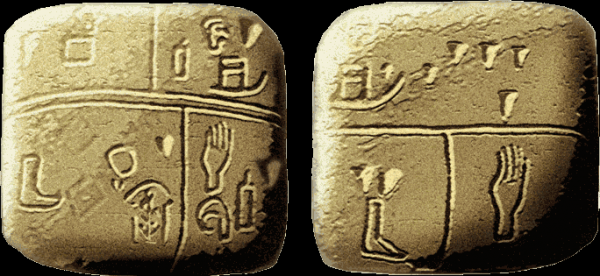
A tablet from Kish (around 3500 BC)
There is no doubt that reading is beneficial. However, answers to the questions “What exactly is the benefit of reading fiction?” and “Which books are preferable to read?” vary depending on the source. The text below is my version of the answer to these questions.
I'll start with the obvious thought that not all literary genres are equally beneficial.
I would highlight three main areas of thinking that literature develops: a base of certain knowledge (facts), thinking techniques (methods of reasoning, including examples), and borrowed experiences (awareness of events, worldview, social practices, etc.). Literature, as such, is very diverse, and the transition from specialized to artistic can be very smooth. There are various types of literature (besides fiction, there is reference, technical, historical-documentary, memoirs, educational) and a large number of intermediate forms that are sometimes difficult to identify unambiguously. In my opinion, what distinguishes them in practical terms is which specific areas of the human mind from the above list they develop the most: facts, methodology, experience.
Naturally, technical and reference literature will develop factual knowledge more strongly, educational literature will advance methodology, while memoirs and other historical literature will foster experience.
Everyone can choose what they need most, like a trainer in a gym.
But what about fictional literature? Она делает возможным объединить это все на абстрактном примере и усвоить. Художественная литература появилась раньше письменности — люди, мышление, язык и истории, которые на нем рассказывали, развивались и эволюционировали вместе. Это взаимосвязанные процессы. Возрастающий объем информации требует появления новых слов и понятий, умение их запомнить и применить стимулирует развитие мыслительного аппарата. И наоборот, усложняющийся мыслительный аппарат позволяет формулировать и генерировать все более сложные концепции. Первые художественные произведения были самыми понятными и эффективными педагогическими приемами. Вероятно, это были охотничьи истории.
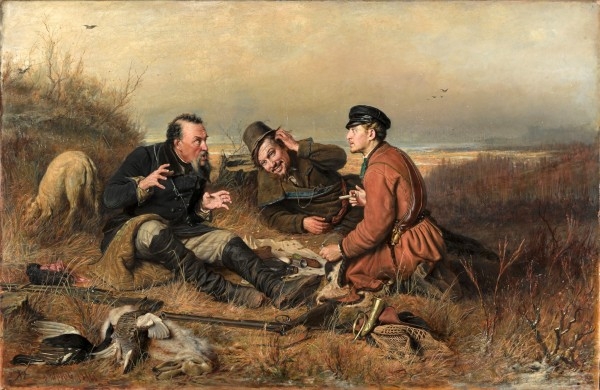
Vasily Perov “Hunters at Rest”. 1871
Once, Eurosy went mushroom picking. He gathered a full basket and heard someone breaking through the bushes. He looked, and it was a bear. Naturally, he dropped the basket and climbed a tree. The bear followed him...
The following is a story about how Eurosy outsmarted the bear and saved himself.
Gradually, these stories began to incorporate techniques that captured the listener's attention and became one of the earliest forms of entertainment, while still retaining their educational functions. Hunting tales evolved into mystical stories, ballads, and sagas. A special profession emerged—the storyteller (bard)—who could memorize large volumes of text. As literacy developed, these texts started to be recorded. Thus, artistic literature came into being, combining various functions while remaining a powerful pedagogical method.
Over time, purely entertaining literature emerged, which at first glance may seem to offer no practical benefits. However, this is only at first glance. Upon closer inspection, even the most trivial romance has a somewhat coherent, albeit predictable, plot, with a dozen or so characters that interact with each other in various ways. There are spatial descriptions, intrigues, relationships, and so on. All this requires some mental effort: we must remember who is who, what characters did and said in previous chapters, and we will automatically try to predict how the plot will develop and what approaches the characters use to achieve their goals. This and much more gradually train and improve brain function. As one reads even such light literature, their vocabulary expands, and they begin to remember and correlate the actions of the characters better, noticing mistakes and inconsistencies in the plot. Familiar techniques and plot twists begin to seem uninteresting, which creates a desire for ever more quality (complex in form and meaning) works.
As a test/example, try to analyze why a particular obviously silly and bad detective story is indeed bad and what specifically makes it that way.
As the reader's library grows, they begin to recognize references to other works and the hidden meanings within them. Following this, their genre preferences also change. Fundamental novels or biographies no longer seem tedious and boring; they are read with pleasure, and ultimately, username might even remember or apply something in practice, albeit quite rarely.
The power of fiction lies in its immense interest. You should read what personally interests you. There’s no need to aim too high and read books whose meaning eludes you almost entirely; that's unlikely to be beneficial. It's advisable to gradually increase the complexity, just as children do. From fairy tales to adventure stories, from adventures to detective novels, from detective stories to epic fantasy or science fiction, etc. This process takes a considerable amount of time (a lifetime), but at the very least, it helps keep the brain in good shape well into old age.
Source: habr.com
