


On a fresh March day in 2016, Stephen Olwain walked into a Wendy's in Minneapolis. Sensing the smell of stale frying oil, he looked for a man in dark jeans and a blue jacket. Olwain, who worked in IT support, was a skinny nerd with wire-rimmed glasses. He had $6000 in cash with him – he had gathered it by pawning silver bars and coins to avoid suspicion about withdrawing money from his bank account. He spotted the right person in one of the booths.
They arranged to meet on LocalBitcoins, a site where people come together to buy or sell cryptocurrency close to their homes. Olwain opened the Bitcoin Wallet app on his phone and handed over the cash, while the man scanned a QR code to transfer the bitcoins. The transaction went smoothly. Then Olwain went back to his car and found that his keys were locked inside.
It was his birthday; he was 43 and was supposed to meet Michelle Woodard for lunch. Olwain had met Woodard online a few months earlier. Their relationship progressed quickly, and for a while, they exchanged dozens of messages daily. Since then, their passion had faded, yet they still occasionally slept together. While waiting for the locksmith to arrive, he texted her that he was at a meeting to buy bitcoins and would be late. When the door was unlocked, he managed to meet Woodard at a burger joint called 'The Blue Door Pub,' intending to enjoy the rest of the day.
That evening, he treated himself to another gift. Using the email address dogdaygod@hmamail.com, he wrote to a person he knew by the name of Yura. "I have the bitcoins," he informed.
Yura ran the website Besa Mafia, which operated in and was only accessible through anonymous browsers like Tor. For Olwain's purposes, it was important that Besa Mafia claimed to have connections to the Albanian mafia and advertised hitman services. The homepage of the site featured a photo of a man with a gun and a marketing slogan: "If you need someone killed or badly beaten, you’ve come to the right place."
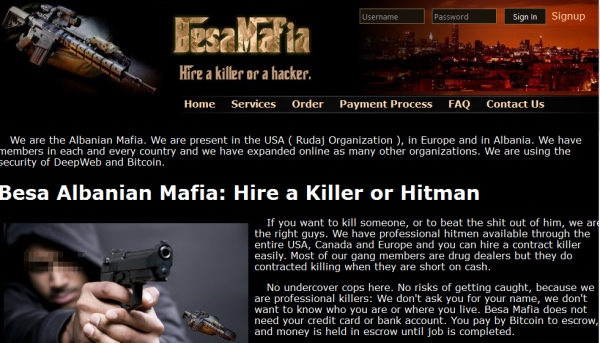
Yura promised that users' money is held in an escrow account and released only upon completion of the work. However, Olwain was concerned that once he sent the money, it would simply end up in someone’s wallet. Yet, he wanted Yura's statements to be true, so despite his instincts, he transferred the bitcoins. "They say Besa means trust, so please justify it," he wrote to Yura. "For personal reasons, the explanation of which would reveal my identity, I need that bitch to be dead."
"That bitch" was Amy Olwain, his wife.
Stephen and Amy Olwain met 24 years earlier at Ambassador University, a religious school in Big Sandy, Texas. Stephen entered the first year with a group of his friends, religious youth from Spokane, Washington. Amy was from Minnesota and not familiar with many people at the school. She quickly became friends with the Washington youth. She was positive and easy to talk to, and she and Stephen began dancing regularly – these activities brought them closer, but not too much. They belonged to the "Worldwide Church of God," which advocated for strict sabbath observance on Saturdays, rejected pagan-origin holidays like Christmas, and opposed too much physical contact on the dance floor.
In 1995, while they were still at university, a splinter group formed from the "Worldwide Church of God" called the "United Church of God." Stephen and Amy joined the new sect, which used the internet to spread its doctrine. For Stephen, who was interested in computer science, it was a logical choice.
After college, they got married and moved to Minnesota to be closer to Amy's family. Amy had a talent for taming even the wildest animals and taught at a dog training school for several years before starting her own business, Active Dog Sports Training. The couple adopted a son and brought him home when he was just a few days old, and in 2011 they moved into a house in Cottage Grove (Minnesota), an enclave of farmers and people who worked elsewhere, located in the Mississippi Valley, near the Minneapolis-St. Paul metropolitan area. Amy converted the large barn on the property into a dog training arena, and their home soon became a cozy mess, with Newfoundlands' and Australian Shepherds' fur covering the furniture and a few unfinished Lego projects in the kitchen.
From the outside, everything seemed normal. Stephen rose to the rank of elder in the United Church of God, while Amy became a deaconess. The church observed the Jewish calendar, and on Fridays the family would have dinner with Amy's parents, whom Stephen called Mom and Dad. On Saturdays, they attended services. Every year they traveled to the church's autumn festival held in various locations around the world. Amy's business was thriving, and she often traveled across the country with friends to attend dog competitions. In their free time, the family maintained the Allwine.net website, where one could find lists of appropriate songs and instructional dance videos showing how to enjoy oneself without getting too close to one's partner. In one of the videos, Amy is seen in khaki pants and hiking boots while Stephen wears a polo shirt and loose jeans, and the couple dances to "We Go Together."
The day after buying Bitcoin, Steven uploaded a photo of Amy on Allwine.net. The photo was taken during their vacation in Hawaii, showing Amy in a blue-green T-shirt and a wide smile on her freckled, tanned face. About 25 minutes after posting the photo, Steven checked his email dogdaygod to send Yura the link. "Her height is just under 1.70 m, weight 91 kg," he wrote. He specified that it would be best to eliminate her during the upcoming trip to Mouline (Illinois). If the killer could make her death look like an accident – say, by crashing her Toyota Sienna minivan from the driver's side – he would add more Bitcoin.
Yura confirmed the deal details shortly after the message, using broken English. "He will wait for her at the airport, follow her in a stolen car, and when the opportunity arises, stage a fatal accident." He added that if the accident didn't go as planned, "the killer would shoot her." Later, he reminded dogdaygod of the need to create an alibi: "Make sure you're surrounded by people most of the time, spend time in stores or other public places with surveillance cameras."
Usually, Steven was not surrounded by people. He and Amy lived on an 11-acre lot located on a dead-end street. The house was a simple single-story portable building set on a foundation. It had four bedrooms, a spacious living room, and an open kitchen. Steven equipped the roof with solar panels and boasted that they generated so much energy he could feed it back into the grid. He spent most of his time in a home office in the basement, troubleshooting glitches in the call center system. At home, he could work two jobs at once – one at the IT service company Optanix, the other at the insurance company Cigna. Employees often turned to him with particularly difficult issues.
The pastor that the Olwains attended preached abstinence from fleshly desires, and Stephen himself counseled couples from his congregation who were having marital issues. However, while remaining alone, he allowed himself to daydream and visited sites like Naughtydates.com and LonelyMILFs.com. On the closed site Backpage, he found himself a girl from an escort service and traveled to Iowa twice to have sex with her. During his counseling sessions, he learned about a dating site , designed for people who are married. That’s where he met Michelle Woodard.
On their first date, Stephen accompanied Woodard during her visit to the doctor. Over the next few weeks, she traveled with him on business trips. Woodard liked how unusually calm Stephen was. Once, their connecting flight from Philadelphia was canceled. Stephen had a meeting in Hartford (Connecticut) at 8 AM and without any fuss, he rented a car, and they drove the remaining 130 miles.
A month before Stephen 'ordered' his wife, he told Woodard that he would try to work things out with Amy. In reality, his affair only intensified his desire for a new life.
Theoretically, with his discipline and knowledge of computers, Stephen was the perfect criminal for the dark web. He covered his tracks using anonymous remailers that removed identification information from messages and Tor, which masked his IP address by routing data randomly through a network of anonymous nodes. He crafted a complex backstory: supposedly, dogdaygod was a rival dog trainer who wanted to kill Amy because she slept with her husband. To create his virtual identity on the dark web, he transferred his infidelity onto his wife.
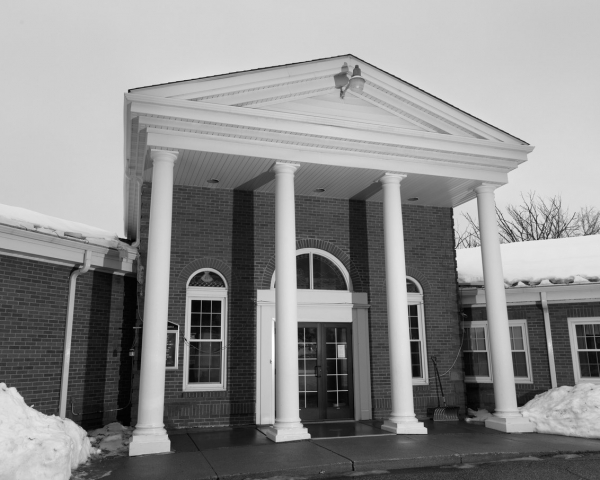
Members of the United Church of God met at the local Methodist church.
Stephen scheduled the murder for the weekend of March 19, when Amy was supposed to be in Moline for a dressage competition. But by the end of the weekend, he wrote Yura a letter complaining that he hadn't received any news regarding her death. Yura explained that the killer had yet to find the right moment: "He needs to arrange everything so that he strikes her car from the driver's side, executing a side collision to ensure her death." The administrator of Besa Mafia seemed to understand that it was important for dogdaygod that Amy be killed on the road. "We are not interested in why people are killed," he wrote. "But if she is your wife or a family member, we can do it in your city," he said, adding that the client could leave town on the appointed day. He suggested killing Amy at home and agreed that afterward, the house could be burned down—for an additional 10 bitcoins or $4,100.
"Not a wife," Stephen replied, "but the same thought crossed my mind." The next day he gathered some money. When he sent bitcoins to Besa Mafia, the page refreshed and he did not recognize the 34-character code that appeared. In a panic, he worried that the cryptocurrency, which he had worked so hard to acquire, would vanish without a trace. He quickly copied the code and saved it in notes on his iPhone, then sent the code to Yura in an email with the subject "HELP!" Less than a minute later, he deleted the code from his notes.
A few hours later, Yura replied, assuring him that the transaction had been successful, but days passed and nothing happened. In the following weeks, Stephen's messages to Yura ranged from tersely disappointed to very detailed instructions. "I know her husband has a big tractor, so there must be gas cans in her garage," he wrote. "But just take her out, don't touch the father and child." Yura, as if a friendly devil, responded with messages that bolstered the client’s resolve. "Yes, she really is a bitch and deserves death," he wrote. An hour and a half later, he added: "Keep in mind that 80% of our killers are gang members involved in drug trafficking, beating people, and sometimes murder." For an extra fee, dogdaygod could hire a more experienced killer—a former Chechen sniper.
Steven spent no less than $12,000 on the plan involving a killer. Instead of surrendering or contemplating his sin, he became even more determined. He registered on the dark web site Dream Market, better known for drug trafficking, where he could choose different methods of murder. Common sense suggested using different usernames, yet he again used the name dogdaygod, as if he had already become the character he invented. He needed to recoup his expenses: Amy's insurance payout was $700,000.
In April 2016, about two months after Steven first 'ordered' a wife, and Yura's correspondence with clients – including dogdaygod – was uploaded to pastebin. The data revealed that users with nicknames like Killerman and kkkcolsia were paid tens of thousands of dollars in bitcoins for killing people in Australia, Canada, Turkey, and the USA. Soon these orders reached the FBI, and the agency issued directives for local divisions to contact the potential victims. FBI Special Agent Asher Silky, working out of the Minneapolis office, learned that someone going by the name dogdaygod wished for Amy Olwynn's death. He was tasked with warning her of the threat.
On Tuesday, right after Silky enlisted the help of Terry Raymond, a local police officer, and they drove to the Olwyne's home together. Cottage Grove is a quiet suburb for affluent people, but, as across the country, local police were increasingly receiving reports of online threats. Raymond, a reserved man with angular facial features highlighted by a trimmed beard, had served in the police for 13 years and was a specialist in computer crimes.
When Silky and Raymond arrived, Steven Olwynn invited them in. He informed the two law enforcement officers that Amy was not at home, and they stood silently in the room while he called her on the phone. Steven appeared to Raymond as someone awkward in the presence of others, but he thought little of it. In his line of work, he had encountered all kinds.
The police returned to the station, and soon Amy arrived. They met in the lobby, where a painting of the department's service dog, Blitz, hung on the wall, and took her to the interrogation room, which had very little furniture. Since the investigation was led by the FBI, Raymond mostly listened while Silky explained to Amy that someone who knew her travel schedule and daily habits wanted her dead. Amy was stunned. She became even more confused when Silky mentioned accusations that she had slept with the dog trainer's husband. She couldn't figure out who could consider her an enemy. "If you notice anything suspicious, call us," Raymond told her as they said goodbye.
A few weeks later, the Olwains set up a home surveillance system with motion detectors and installed cameras at various entrances. Stephen bought a Springfield XDS 9mm pistol. He and Amy decided to keep it on her side of the bed and went to the shooting range as a date.
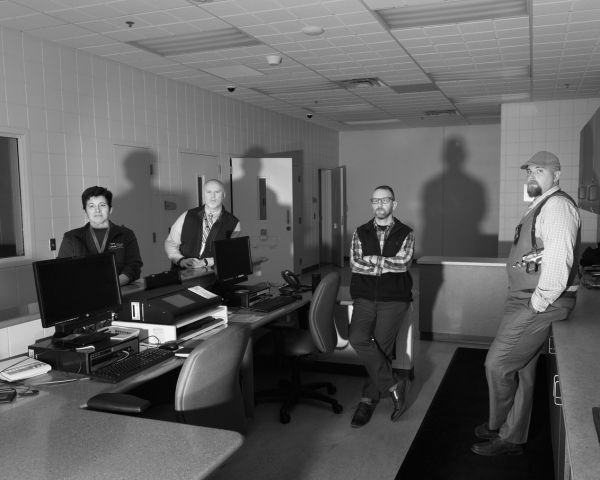
Cottage Grove police officers, left to right: Captain Gwen Martin, Captain Rande McAllister, Detectives Terry Raymond and Jared Landkamer.
On July 31, Amy called Silky in distress: over the past week, she had received two anonymous threats via email. Silky came to the Olwains' house, where Stephen printed out those emails and listened as Amy explained to the agents what had happened.
The first letter came from an anonymous remailer in Austria. It contained, among other things, the following:
Amy, I still blame you for ruining my life. I see that you've set up a security system, and people online have informed me that the police have been interested in my previous letters. I was assured that the letters couldn't be traced, and that I wouldn't be found, but I can't attack you directly while you're being watched.
And here's what will happen next. Since I can't get to you, I will get to everything you hold dear.
The email listed contacts of Amy's relatives based on information available through Radaris.com, which provides subscribers with contact information about individuals and organizations. The author also noted details known only to close family members of Amy – the location of the gas meter at the Olwain's house, the fact that they changed the place where they park their SUV, and the color of the t-shirt their son wore two days ago. "This is how you can save your family," the letter stated. "Commit suicide." The author then listed various suitable methods.
A week later, a second anonymous letter arrived scolding her for not following the recommendations. "Are you so selfish that you're willing to put your families at risk?"
Amy handed her computer over to the police, hoping that its contents would help agents track down her potential killer. Stephen gave agents his laptop and smartphone. The FBI made copies of the devices, including apps, processes, and files, and returned them a couple of days later.
Amy provided Silky with the names of people who trained in her arena, the animal owners she worked with, and her best friend. An agent interviewed four of them and examined the credit histories of several. Very few had a motive for Amy's death; however, since dogdaygod paid several thousand dollars to have her killed, there was a personal motive involved. Moreover, the client instructed Yuri not to kill her husband. It made sense to investigate the spouse as a result. Silky interrogated Stephen, but it is unclear if he did anything else besides that and copying his computer and phone. The FBI declined to comment on the case, and the Cottage Grove police knew little about the bureau's operations. Moreover, apart from bringing Raymond in for the initial interrogation and sending him copies of the threatening emails, the bureau did not further involve the local police.
Meanwhile, Amy was trying to cope with the terrible threats. She enrolled in the 'Civic Academy,' where citizens are taught in detail about the workings of the police department. In her application, she stated that she "wants to learn about the police department's operations, what they do, and how everything works." Sergeant Gwen Martin, the course leader, was unaware of the life threats Amy had received, and Amy did not share this with any of the other participants while they practiced at the shooting range and took fingerprints from a soda can. Amy requested to be assigned to a K-9 officer [working with service dogs; due to the homophony K-9 / canine — dog-related / note from the translator.] during his patrols and enthusiastically shared how the officer offered her advice on dog training and tracking. At the end of the program, she celebrated this with the other group members at a small party.
However, Amy still felt helpless. Her periodic headaches became more frequent, and she started having memory problems. In her teaching, she appeared confident, but she worried that her aggressor might be among her students.
One summer evening, she sat in the yard with her sister and pondered about who was responsible for the gloomy atmosphere that enveloped her life. Many years ago, when her sister started college, Amy sent her postcards every week to keep her from missing home. Now her sister, as a kind gesture, was doing the same and quoting the Bible in every postcard.
One Saturday afternoon in November, Steven and Amy went to church with their son. The road went through the bottomland east of the Mississippi, across yellowing farmland, lots filled with car parts, and hollows overgrown with trees that had already shed their leaves. The United Church of God rented a space in a red-brick building from the local Methodist congregation. There was something fitting about the moment in the surrounding starkness, as if merely through architectural minimalism, the devil could be kept at bay.
In the chapel, the family sat together with men in suits, women in modest dresses, and children with freshly styled hair. Pastor Brian Shaw, standing under the daylight streaming through the glass roof, recited a warning from the New Testament about people whose "eyes are filled with lust and constant sin." He spoke of Job, who practiced not looking at women with desire. The consequences of not following Job's example are serious: "When we do not control our sinful nature, it controls us."
On Sunday, Stephen woke up just before 6 a.m., as usual, and went down to his basement office, where he logged into the Optanix system to start working. At noon, he went upstairs to have lunch with Amy and their son. As an avid cook, Amy had roasted some leftover pumpkin in the slow cooker from a dessert she had made a couple of days ago. Soon after that, she felt weak and dizzy.
Amy's father came over to install a dog door in the garage. Stephen told him that Amy was unwell and resting in the bedroom. Her father left without seeing her. Five minutes after he left, Stephen called him and asked him to come back to take their grandson, as he allegedly wanted to take Amy to the clinic.
As sunset approached, Stephen went to fill up with gas, picked up the boy from his wife's parents, and took him to the chain family restaurant 'Culver's'. It was their Sunday tradition to have dinner at 'Culver's' while Amy taught at her training classes. They sat in a brightly lit dining area, eating chicken and smoked cheese.
Upon returning home, the boy jumped out of the minivan and ran into the house, to his parents' bedroom. There, in an unnatural position, lay Amy's body, with a puddle of blood around her head. The Springfield XDS 9 mm lay nearby.
Stephen called 911. "I think my wife shot herself," he said. "There's a lot of blood here."
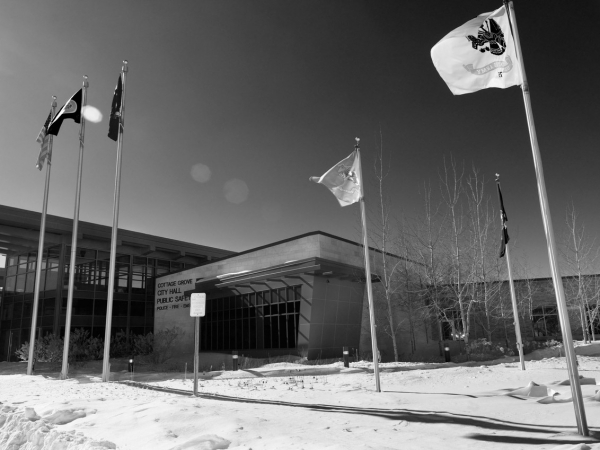
The Cottage Grove City Hall, where the police department is also located.
Sergeant Gwen Martin arrived at the house a few minutes after the 911 call. When she saw Amy's body on the floor, she remembered training her in the 'Citizens Academy' program and broke down in tears. Another sergeant took over the case, while Martin returned to her car. Regaining her composure, she turned to the laptop on the dashboard and initiated a search for police calls to this address. She was astonished to find a report in which Terry Raymond described threats to Amy's life coming from the dark web. Martin picked up her phone and called Detective Randy McAlister, who was in charge of investigations in Cottage Grove.
McAlister was a 47-year-old Harley-Davidson owner with a very youthful face. He often participated in office pranks. His coffee mug had the inscription 'Due to the confidentiality of my job, I have no idea what I’m doing.' However, his cheerful demeanor masked a meticulous nature. About ten years ago, McAlister was involved in a murder investigation in a nearby city; a former partner of the wife killed a couple in their home while their children hid inside. Shortly before that, the woman had informed the police that her jealous ex was contacting her in violation of a restraining order. McAlister was disheartened that the system could not help that woman and started his own program to protect potential victims from stalking and targeted violence. Hearing Raymond mention the threats Amy received from the dark web, he suggested cross-referencing them with a threat database maintained by the FBI's Behavioral Analysis Unit; this could help them profile a potential perpetrator. However, he did not have jurisdiction in this case.
Now, he was hurrying to the Olwine's house. Entering through the garage, he immediately caught the smell of pumpkin cooking in a slow cooker. This struck him as odd; usually, people don’t start preparing food before they take their own lives. There were other inconsistencies as well: bloodstains on both sides of the bedroom door. And while the hallway floor was strewn with dog fur, the adjoining hall was clean.
While McAllister waited for the arrival of the coroner and criminal investigators, the police officer took Stephen and his son to the station. Raymond led Stephen to the same interrogation room where he had met with Amy five months ago, while his colleague watched over the boy in the break room. Raymond took out a pair of latex gloves and obtained a swab from Stephen's mouth for a DNA test. "Are you going to take this from the wife's parents too?" Stephen asked. "No, just from you and your son," Raymond replied. He asked Stephen to recount how he spent the day.
Stephen cooperated with the officer, but Raymond felt he was acting rather strangely for someone who had just lost a wife. He reminded the detective that there was a file on Amy at the FBI; he mentioned that her computer had been acting oddly. "As a representative of the IT industry, this annoys me, as I know how everything is supposed to work in the legal world," he said, adding, "I know nothing about hacking or anything like that."
Over the next three days, investigators combed through the crime scene. Technicians sprayed luminol on the floor and turned off the lights. Where luminol interacted with blood or cleansers, it glowed bright blue. The glow indicated that the corridor had been cleaned. It also highlighted several traces leading from the laundry room into the bedroom and back.
The Cottage Grove police executed a search warrant at the house. McAllister sat down at the dining room table, recording evidence. Raymond went down to Stephen's office in the basement. Upon entering, he saw that all surfaces were cluttered with junk: folders, tangled wires, external drives, SD cards, as well as a recorder and a Fitbit. There were hard drives of a type that hadn't been used in over ten years. On Stephen's desk were three monitors and a MacBook Pro – this was not the computer he had handed over to the FBI.
The police pulled the haul upstairs, then handed it over to McAllister for documentation one by one. "Damn," he thought, watching the equipment pile up. And then, "Oh God, how much more can there be?" However, the devices kept coming in. There turned out to be sixty-six in total.
Since the crime was connected to a death within the city, the investigation was conducted under the management of the Cottage Grove police. Two and a half weeks after Amy's death, the FBI sent her file. Upon opening the documents, Macalister and Raymond saw - for the first time - the complete correspondence with Besa Mafia. It was then that they learned the nickname of the person wishing Amy dead was dogdaygod.
By that time, Steven was already among the suspects, but there was no evidence linking him to the murder. The presence of his DNA everywhere was hardly surprising: it was his home. There was nothing unusual in the security footage, although the recordings were incomplete. Steven explained that he and Amy did not turn on the camera above the sliding glass door because their dogs constantly passed through it. Macalister hoped to find answers in the devices that Raymond had brought from the Olwin basement.
As soon as the Besa Mafia files appeared on pastebin, bloggers immediately assumed that the site was fraudulent. One by one, Yuri's clients complained that the murders they ordered were not carried out. However, Macalister did not want to take anything at face value. He and Detective Jared Landkamer identified ten other targets from the Besa Mafia orders in the U.S. and contacted local police departments where they lived. This could provide them with new leads in their case or possibly save other lives.
Macalister assigned the electronic work. He sent the computers to a forensic specialist at a neighboring police station. Landkamer obtained a court order to access the Olwins' emails and spent many days reading them. Raymond started by extracting data from Steven's phones. In a windowless room lined with monitors, he ran software sorting the data – apps here, call history there – and reconstructing the timeline of the devices. On the phone that Steven had given to the FBI for a copy, Raymond found Orfox and Orbot, needed to access the Tor network. He also found text messages containing confirmation codes from the LocalBitcoins website. Either the FBI missed them or did not attach significance to them.
Checking Amy's phone, he saw that on the day of her death, her consciousness was becoming increasingly disoriented. At 1:48 PM, she visited the Wikipedia page about dizziness. At 1:49 PM, she typed the word DUY into the search engine. A minute later, EYE. Then DIY VWHH. It seemed that she was desperately trying to understand why the room around her was spinning, but couldn't type the words into the search bar.
During questioning by the state investigator, Stephen confessed to his affair with Woodard. Raymond found the contact 'Michelle' in Stephen's phone, and when the investigators interviewed Woodard, she told them about the lunch on his birthday, when Stephen messaged her that he had locked his keys in the car while buying bitcoins. Stephen's call history confirmed that he called for roadside assistance that day from a Wendy's in Minneapolis. Detectives used text messages with confirmation codes to locate his account on LocalBitcoins. This led them to communications with a seller about an exchange for $6000.
On Stephen's devices, Landkamer found additional emails that revealed the usernames he used to log into Backpage and LonelyMILFS.com. This in itself was not a crime, but indicated a possible motive.
While concealing much of his criminal activity, Stephen did not delete his search history. On February 16, just minutes before the first message from dogdaygod suggesting killing Amy in Molina, Stephen searched for 'moline il' on his MacBook Pro. The next day, he examined their insurance. In July, shortly before Amy received the first email with threats listing contacts from the Radaris site, he visited pages on that site related to her family members.
In Cottage Grove, murders were rare, and the detectives, faced with circumstantial evidence and the elusive nature of the dark web, became deeply engrossed in the case. One evening, lying in bed after reading an FBI file on Amy, Landkamer Googled dogdaygod. Seeing the results, he called his wife. The search engine indexed several pages from Dream Market, a dark web drug store.
Landkamer immediately sent a message about his findings to McCallister. McCallister launched Tor and opened the correspondence with Dream Market. In one thread, dogdaygod asked if anyone had any for sale , a powerful drug. McAllister worked as a paramedic, so he knew that scopolamine was prescribed for motion sickness, but it could also make people compliant and cause amnesia, earning it the nickname 'Devil's Breath.' Flipping through the pages, he came across a user's comment who assumed that dogdaygod wanted to use scopolamine for personal amusement. 'There's a seller,' he wrote, 'but better to forget that crap, buddy. It’s incredibly dangerous, and you could kill someone.'
Later, upon analyzing Amy's stomach contents, the presence of scopolamine was confirmed. However, the most valuable evidence was obtained thanks to the way Apple devices create backup copies. A forensic IT specialist from a neighboring district discovered on Stephen's MacBook Pro an archived message containing a Bitcoin address, which had appeared on his iPhone in March 2016. This happened 23 seconds before dogdaygod sent the same 34-digit wallet code to Yura. Forty seconds after sending the message to Yura, the message from Stephen's phone was deleted. But a deleted file doesn’t disappear until its space is overwritten by other files. Several months later, when Stephen backed up his phone via iTunes, the important story was preserved on the laptop.
McAllister was elated. Detectives connected Stephen's offline identity as a church elder concerned about the acceptability of dance moves with his online personas - a womanizer and a failed potential killer. The alluring anonymity of the dark web, which drove Stephen to crime, gave him a sense of omnipotence. He couldn't understand that this ability did not transfer to the ordinary web and the real world.

Stephen Olwain is currently incarcerated in a Minnesota prison in Oak Park Heights.
The trial of Stephen Olwain lasted eight days. County prosecutors presented a number of vivid witnesses: a pawn shop manager where Stephen sold silver, an escort employee from Iowa from Backpage, and Woodard. McAllister displayed the murder weapon in court, while Jared Landkamer explained to the jury the meaning of the acronym MILF, which subsequently became an endless source of jokes at the police station.
Prosecutors Fred Fink and Jamie Krauser used the testimony to build a theory: Stephen poisoned Amy with a large dose of scopolamine to either kill her or incapacitate her. However, although she felt dizzy and unwell, she did not die. Therefore, Stephen shot her with their gun in the hallway. He then moved the body to the bedroom and cleaned up the blood. When he went to the gas station and took his son to 'Culver's', he kept the receipts just in case.
The jury deliberated for six hours before finding Stephen guilty. On February 2, he was brought into the courtroom for sentencing. Each of his family members and friends present told the judge how much Amy meant to them. Then Stephen stood up to address the court.
Breathing heavily, he tried to dismiss the technical evidence related to file backups and Bitcoin wallets. Then he shifted to his spiritual credentials. In the jail where he was held during the proceedings, he preached to drug addicts and juvenile offenders. He claimed to have converted at least three nonbelievers to faith.
“Mr. Olwain,” the judge said, after listening to his speech, “my feelings will not change the verdict in this case. But I must say, you are an incredible actor. You can evoke tears and stop them. You are a hypocrite and a cold person.” The judge sentenced him to life in prison without the possibility of parole (the case is now going to the appeals court). From the adjacent room, Macalister watched Raymond and Landkamer through the window, listening with satisfaction to the judge's reprimand of the defendant. However, his feelings were clouded. Macalister understood why, during the FBI investigation into the dark web, Steven might not have raised any suspicions. Steven’s relationship with Amy seemed happy; they had no history of violence or substance abuse. He knew that hindsight judgments could influence investigator conclusions, but he also felt that Amy's death could have been prevented. Threat assessment experts use a four-point checklist to evaluate the likelihood that an anonymous villain is someone close to the victim. In Amy's case, all four were present: the person was tracking her movements, obviously lived nearby, knew her habits and future plans, and spoke of her with disgust or contempt.
In the months following the trial, Macalister was promoted to captain. He periodically consults police departments on dark web-related crimes. There were no other deaths linked to Besa Mafia clients, but it was reported that Yura opened other fraudulent sites allegedly related to contract killings: Crime Bay, Sicilian Hitmen, Cosa Nostra. It seemed that Yura was a devil watching from a distance, smirking at how the seeds he had sown sprouted and turned into full-blown evil.
Source: habr.com
