

The world’s only developer of discrete MRAM memory chips, Everspin Technologies, continues to refine manufacturing technologies. Today, Everspin and GlobalFoundries to jointly develop STT-MRAM chip technology with 12 nm standards and FinFET transistors.
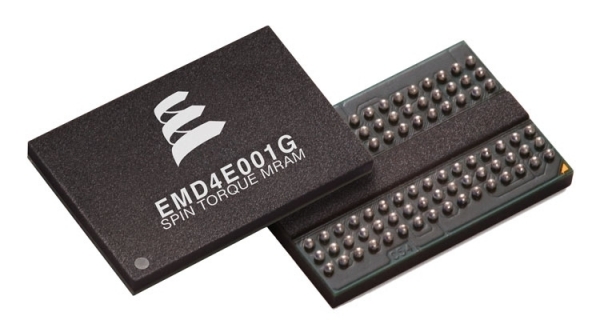
Everspin holds over 650 patents and applications related to MRAM. This memory type writes data to cells similarly to how information is stored on a magnetic platter of a hard drive. However, in chips, each cell has its own (conditionally) magnetic head. The STT-MRAM memory, which has replaced it, operates with even lower energy costs as it uses smaller currents for write and read modes based on the spin-transfer torque effect.
Initially, MRAM was produced at the request of Everspin by NXP at its facility in the USA. In 2014, Everspin signed a collaboration agreement with GlobalFoundries. Together, they began developing manufacturing processes for discrete and embedded MRAM (STT-MRAM) using more advanced technologies.
Over time, GlobalFoundries established the production of 40-nm and 28-nm STT-MRAM chips (culminating in the new 1-Gbit discrete STT-MRAM chip), as well as prepared a 22FDX process for integrating STT-MRAM arrays into controllers using 22-nm technology on FD-SOI wafers. The new agreement between Everspin and GlobalFoundries will lead to the transfer of STT-MRAM chip production to the 12-nm process.
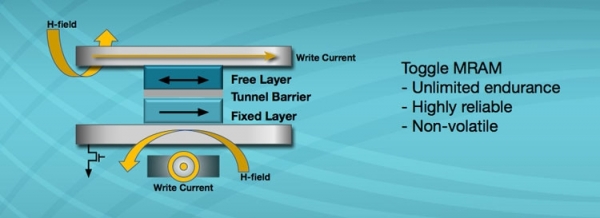
The performance of MRAM approaches that of SRAM and could potentially replace it in Internet of Things controllers. Additionally, it is non-volatile and significantly more durable than conventional NAND memory. Transitioning to 12-nm standards will increase the density of MRAM, which is its main drawback.
Source: 3dnews.ru
