

The idea of writing code without writing code (yes, writing — a participle of the present tense of the verb 'to write', now live with that) has crossed the minds of both smart people and just lazy ones more than once. The dream of a graphical interface, within which you can throw one cube on top of another, draw mutual connections, and select object properties from cute dropdown menus, and then, at the press of a magic 'Compile' button, obtain working code equivalent to that of another (not so bright, of course) programmer using the old-fashioned method of manual typing, has always lingered in the minds of corporate bosses dreaming of involving every recent graduate, whose intellect allowed them not to miss the toilet, into programming, as well as startups wishing to make the whole world happy at a reasonable price. Today, we present to you:
Crowdfunding project: Ezblock Pi.
The essence of the project: a graphical programming environment for Raspberry Pi in tandem with an expansion board.
Platform: Kickstarter.
Project address: .
Authors: Georgiann Chang, Reggie Lau.
Location: USA, Delaware, Wilmington.
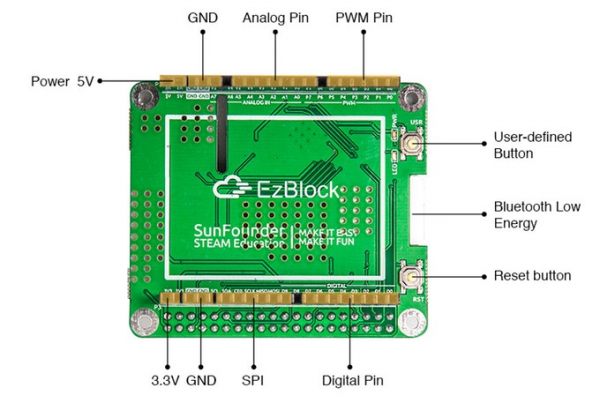
Attempts to develop serious graphical programming environments have gradually faded away; even the top bosses realized that the programming process is too complicated to fit into the Procrustean bed of colorful cubes. Fortunately, there are still hobbyist programmers, in the case of this crowdfunding project — Raspberry Pi enthusiasts. To avoid promoting bare software, the authors supplement the graphical development environment with an expansion board, which is designed to simplify the process of connecting to external devices.
On the project's page, in the title video, we are introduced to two robotic programmers, Robert and Emily. Robert, as every self-respecting wearer of a tie and glasses, codes in Python the old-fashioned way, using a monitor and keyboard. However, Emily has caring hands that fly in from the edge of the frame, taking away the keyboard, monitor, and even the mouse, replacing everything with a beautiful white tablet. On the tablet, a program called Ezblock Studio is running, which allows you to code for the currently trendy IoT in a Drag-n-Drop-n-be-happy style.
Naturally, while Robert fails attempt after attempt (perhaps due to using a gaming keyboard), Emily's robot successfully waters the plant with a cup, and the girl receives notifications from the robot directly on her phone, even dictating response instructions using voice control.
Since the squares need to be glued together logically, support for programming languages finally shows up closer to the end of the video: Python and Swift (the main character in the video, the tablet, bears the Apple logo). Only now Emily has to poke at the on-screen keyboard, as no one has returned the normal one to her. Ezblock Studio is said to support iOS, Android, Linux, Windows, and macOS. Everyone's happy. Well, maybe except for Robert, who vanished midway through the video; perhaps he went on a bender or quit.
Alright, I think that's enough of the literary stuff. Let’s take a serious look at what the developers are offering us for $35.
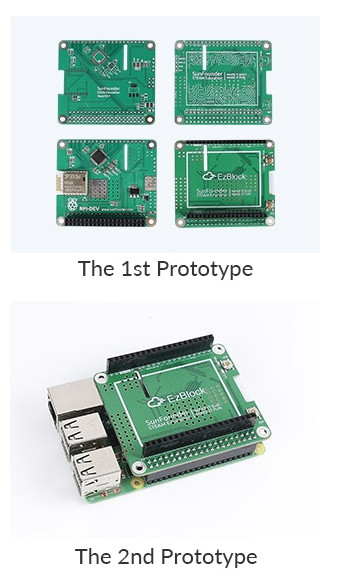 The Ezblock Pi project in its minimal configuration consists of three parts:
- the Ezblock Pi board itself, which is used as an expansion board for Raspberry Pi;
- a basic set of 15 modules (there's also an IoT module set sold in a more expensive package for $74, more on that later);
- access to Ezblock Studio, which allows for software creation for Raspberry Pi through drag-and-drop manipulations;
- a plastic case for assembling Raspberry Pi + Ezblock Pi;
- instructions.
With the case and instructions, I think everything is clear; let’s take a closer look at the first three points.
The internals of the Ezblock Pi board can only be inferred from the mention of 'supported by STM32 controller' and from a blurry photograph of the first prototype. Apparently, the board features an STM32 microcontroller in a TQFP32 package. The cheapest microcontroller in this package, STM32L010K4T6 (ARM Cortex-M0+), costs €0.737 in batches of 100; the most expensive, STM32F334K8T6 (ARM Cortex-M4), costs €2.79 (according to Mouser). Power is supplied by a linear regulator of 3.3 V in a SOT-223 package, Bluetooth is powered by a ready-made module, which appears to be something like the ESP12E. Interaction with the outside world is handled by two 20-pin connectors and a prototyping area in the center of the board.
The composition of the basic set, consisting of 15 modules, has honestly remained a mystery to me even after closely examining the project's illustrations. While the module set for IoT is honestly photographed and labeled, the basic set included in the initial configuration is more secretive than the design of a new car before a major automotive exhibition. The basic set claims to allow for '15 different projects,' but the illustrations show 10 cardboard boxes that seem to contain some electronic components, yet the complete contents of the basic set are not disclosed anywhere.
As for Ezblock Studio, I have already shared my skepticism at the beginning of the news. In my opinion, a system that can truly handle all the stated options (let me remind you: (block programming + Python + Swift) * (iOS + macOS + Android + Linux + Windows)) could certainly be developed, but I would estimate about 5 person-years or one year of work for a team of five (how much would you estimate?), even with some multitool like Electron. Given that the developers are targeting just $10,000 (the project looks quite lively, and so far it has already raised 400% of that amount), it is completely unclear what this team will be living on during the entire duration of the development. To the authors' credit, it should be noted that the first version of Ezblock Studio is already available on Google Play.
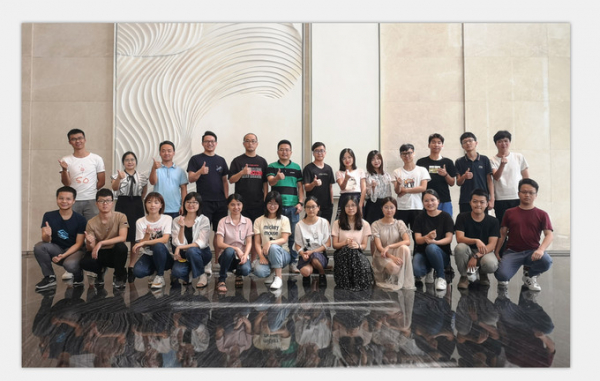
The presentation text contains typos that are typical for Chinese manufacturers; in this case, the vibration motor included in the IoT module set is referred to as 'Vabration Module' instead of 'Vibration Module.' However, this time the actual developers are not trying to hide; please find attached a group photo of the residents of Wilmington, Delaware:
Understand me correctly, I am not at all against developers from China. This is, after all, a fact — first, Chinese programmers captured a significant share of the app stores of Google Play and Apple App Store, and now they are finding their place in the sun through crowdfunding platforms. Crowdfunding is great because it allows almost any person on Earth with internet access and a bank card to present their development to the world and sometimes make a good profit from it. Negative feelings can only be evoked by an excessive shift of focus from the technical component of the project to colorful marketing, where [potential] design flaws are overlooked, and the emotionally joyful side is overly exaggerated. Just look at another illustration from the Ezblock Pi presentation:

Saved, as the video blogger Evgeny Bazhenov aka BadComedian says, "author's editing." Do you have any thoughts on how, being in a sound mind and memory, to construct THIS using Raspberry Pi and the "Vibration Module"? Or is this, after all, a call to our collective unconscious: "Look how cool this is, buy it faster!"?
To buy or not to buy? First of all, I would like to remind you that 509 people have already contributed a total of $41,000 (against the requested $10,000), and there are still almost 3 weeks until the campaign ends. People like it. Perhaps, if you are a fan of Raspberry Pi, you will also see the positive aspects of the proposed design outweighing the reluctance to part with an amount from $35 to $179. Maybe, like Robert from the promotional video, you are tired of "writing repetitive lines of code." Or perhaps you simply think that the team is moving in the right direction and want to support them with your financial contribution. Just remember that for an equivalent amount of $35, the Raspberry Pi itself is on sale (I won't even delicately mention the prices of Raspberry Pi Zero and Raspberry Pi Zero W here), upon which the engineering team had to really work hard, and which features an ARM Cortex-A53 at a clock rate of 1.4 GHz, 1000 Mbps Ethernet, Wi-Fi 802.11n, and Bluetooth 4.2.
I am conducting a small , from which I took this article. If you have an interesting crowdfunding project in the DIY or open source hardware area, please share the link, and we can discuss that as well. Crowdfunding campaigns are short-lived and heavily reliant on community support, and perhaps even a small number of orders from 'Habr' can help a lone enthusiast bring their campaign to a successful conclusion.
Source: habr.com
