

The release of the Firefox 155 web browser has taken place, along with updates to previous long-term support branches — 153.2.0, 140.15.0, and 115.40.0. Firefox 155 is the first release developed under the new two-week release cycle, which will allow for more frequent delivery of new features to users, provide a more predictable release process, and reduce the burden on developers before releases. The Firefox 156 branch has entered the beta testing stage, with a release scheduled for September 15.
Key innovations in Firefox 155 (1, 2, 3):
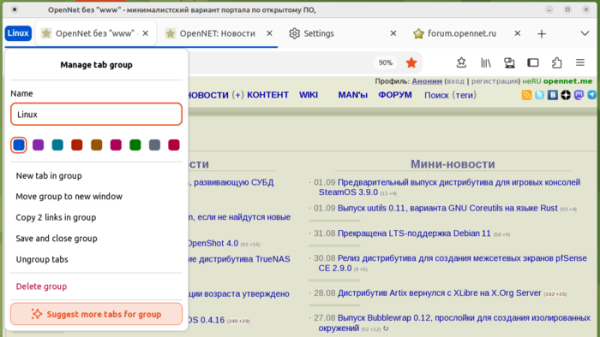
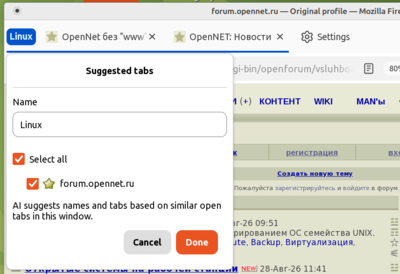
- For all users in the USA, Canada, and France, the 'Smart Window' mode has been activated, providing a separate interaction space with AI, supplementing the existing standard web navigation mode and private browsing mode. The new version includes personalized prompts for quickly starting a chat with AI on previously covered topics, significantly accelerate the citation of sources when searching through the exa.ai service, improves recommendations for grouping related tabs, and auto-assigning names to tab groups.


- In the address bar, next to the shield icon, the number of trackers blocked on the viewed site is displayed. This feature is currently activated only for a portion of users; to enable it on the page about:config, the parameter 'browser.urlbar.trackerCount.featureGate' can be set.

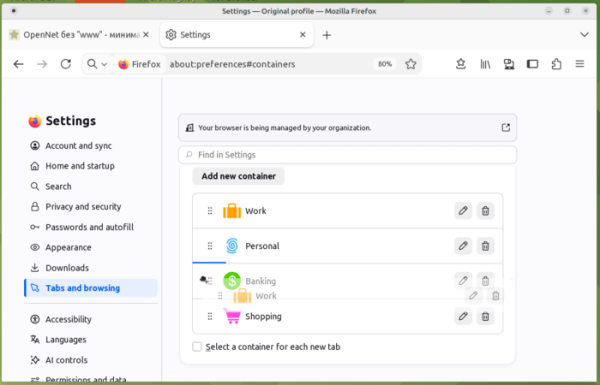
- The settings now allow changing the order of the containers displayed in the lists.

- In builds for the Windows platform, the use of game controllers compatible with Nintendo Switch Pro has been added in web games.
- The nesting of CSS blocks and functions is limited to 75 levels to protect against crashes when processing constructs with excessive nesting.
- The domain for checking network availability and detecting the presence of a captive portal has changed from detectportal.firefox.com to firefox-portal-detection.com.
- The handling of 'mailto:' links without explicit user action has been discontinued (the web page can no longer automatically initiate the opening of the email client).
- When printing PDF files, content smaller than the print page can now be scaled to fill the entire sheet.
- In the web development tools, options for simulating CSS capabilities have been moved to a new panel that appears when the '@' button is pressed in the Rules window. An option has been added to simulate the media query 'prefers-reduced-motion'. A keyboard shortcut Ctrl+Alt+B has been implemented in the JavaScript debugger to enable or disable all breakpoints at once.
- The JSON viewer now supports displaying documents in 'JSON Lines' format (JSONL and NDJSON), where each line contains a separate JSON object.
- The CSS function progress() has been implemented to calculate the position of a value relative to specified minimum and maximum values ('progress(5, 0, 10)' will return 0.5).
- The CSS function alpha() has been added, allowing modification of the alpha channel (transparency level) for a specified color.
- Support for the new syntax of the CSS function attr(attr-name attr-type, fallback-value) has been added, allowing it to work with HTML attribute values of any type, not just strings.
- Support for the methods Promise.allKeyed and Promise.allSettledKeyed has been implemented, which are similar to Promise.all() and Promise.allSettled(), except that they take and return objects instead of arrays.
- Support for the binary format extension for WebAssembly has been added, enabling reduction in the size of WebAssembly modules with a large number of imported elements.
- Support for 128-bit arithmetic instructions i64.add128, i64.sub128, i64.mul_wide_s, and i64.mul_wide_u has been added in WebAssembly.
- The ability to use the second version of the QUIC protocol (RFC 9369) in HTTP/3 has been provided.
- For the SVG element <a> the JavaScript interface SVGAElement provides the same set of URL properties that are available for links in HTML.
- The CSS property 'font-width', similar to the previously available property 'font-stretch', has been added.
- Support for sending groups in the WebTransport API has been implemented to manage bandwidth distribution between streams (createSendGroup()), sending datagrams (createWritable()), and generating keys tied to TLS sessions (exportKeyingMaterial()).
- In the Android version, switching to edit the toolbar has been implemented after a long press on any button on the panel. The exclusion of tabs from a group has been simplified. The sensitivity of the page summary feature activation by shaking the smartphone has been modified.

In addition to new features and bug fixes, Firefox 155 has addressed 109 vulnerabilities, most of which are related to memory management issues such as buffer overflows and accessing already freed memory areas. These issues could potentially allow attackers to execute malicious code when opening specially crafted pages.
Source: opennet.ru
