Available Firefox 78.
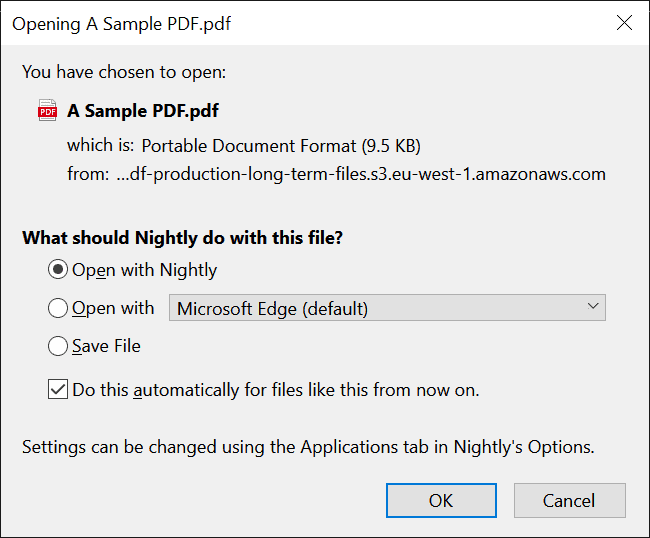
- In the PDF file download dialog an 'Open in Firefox' option has been added.
- The ability to disable the display of top sites when clicking the address bar (browser.urlbar.suggest.topsites) has been added.
- The 'Close Tabs to the Right' and 'Close Other Tabs' menu items have been moved to a separate submenu. If a user closes multiple tabs at once (for example, using 'Close Other Tabs'), the 'Restore Closed Tab' menu item will restore all of them, not just one. Previously, users who accidentally closed many tabs had to restore them one by one.
- The appearance of the reading mode has been redesigned. The sidebar has been replaced with a compact floating toolbar whose design better integrates into the browser interface.
- Firefox will prevent the screensaver from starting if a call is being made via WebRTC at that moment.
- A long-standing issue has been resolved where a user tries to paste a long text (such as a password generated by a password manager) into a field with a length limit (maxlength). Previous versions of Firefox silently truncated the password to the specified length, which led to the server receiving a 'shortened' password during registration, while the user believed their password was longer. Consequently, the user could not log in with the long password afterwards. Now, Firefox will visually highlight the field where excessively long text has been pasted and warn the user that they need to enter a shorter string.
- When typing in the address bar, suggestions will include not only search engine suggestions but also past search queries (browser.urlbar.maxHistoricalSearchSuggestions). For example, if a user previously searched 'hello bear' via the address bar, when they type 'hello', they will be suggested to search for 'hello bear'.
- If a user pastes a domain into the address bar without specifying the protocol, Firefox will attempt to connect to it not only via HTTP, as before, but also via HTTPS (in case the server does not support HTTP).
- Addresses ending with .example, .internal, .invalid, .local, .localhost, ,test, will no longer redirect to the search engine; instead, the browser will attempt to open them (these suffixes are often used during development).
- Security and Privacy:
- The page about:protections has been updated with information on how many passwords exposed in leaks the user has changed to secure ones, as well as which specific password has been leaked and needs to be changed.
- Added The layout.css.font-visibility.level setting allows specifying which available fonts in the system the browser will report to web pages (fonts are divided into three groups: basic system fonts only, basic + fonts from language packs, all fonts). Further tests are planned to determine the optimal option that does not spoil the display of pages but does not reveal too much information about all installed fonts.
- When a user types a single word into the address bar, Firefox heuristically determines whether it could be a domain name on the local network and sends a DNS server query to check if such a domain exists in the network (to suggest going to this domain as the first item in the drop-down list). For paranoid users, has added there is a setting that controls this behavior (browser.urlbar.dnsResolveSingleWordsAfterSearch).
- A patch from TorBrowser developers has been accepted to completely disable DNS use (network.dns.disabled).
- Repeatedly disabled support for TLS 1.0 and 1.1 (it was disabled in Firefox 74 but re-enabled due to the importance of web resource availability during the pandemic). If the server does not support TLS 1.2, the user will see an error message indicating a failure to establish a secure connection and a button to enable support for outdated protocols (support for them will be completely removed in the future). Chrome and Edgium will also disable support for old protocols in July (TLS 1.0 was introduced in 1999, and TLS 1.1 in 2006) since they do not support modern fast and reliable algorithms (ECDHE, AEAD) but require support for older and weaker ones (TLS_DHE_DSS_WITH_3DES_EDE_CBC_SHA, SHA1, MD5). Support for TLS 1.0/1.1 will be removed from Internet Explorer and Edge. will be removed in September.
- support for inactive support for the TLS_DHE_RSA_WITH_AES_128_CBC_SHA and TLS_DHE_RSA_WITH_AES_256_CBC_SHA ciphers. Firefox remained the last browser to support them.
- The minimum system requirements have been raised. From now on, this is GNU libc 2.17, libstdc++ 4.8.1, and GTK+ 3.14.From now on, this is GNU libc 2.17, libstdc++ 4.8.1, and GTK+ 3.14.
- This is the last major release supporting macOS 10.9, 10.10, and 10.11. Users of these operating systems are advised to switch to Firefox ESR 78.x, where support for the specified versions of macOS will continue for a year.
- Numerous improvements for people with disabilities:
- Using JAWS, pressing the down arrow in an HTML input element containing a data list no longer incorrectly moves the cursor to the next element.
- Screen readers no longer lag or freeze when focusing on the microphone/camera/screen sharing indicator.
- Loading tables containing thousands of rows has been significantly accelerated.
- Input elements with custom styles now correctly display the focus outline.
- When opening developer tools, screen readers no longer mistakenly switch to document view mode.
- The number of animations (when hovering over a tab, expanding the search bar, etc.) has been reduced to make it easier for people with migraines and epilepsy.
- All users from the UK will receive recommendations from Pocket on the new tab page.
- CSS:
- Enabled support for pseudo-classes :where() and are now less strict regarding the list of selectors — an invalid selector does not invalidate the whole list..
- Support for pseudo-classes has been implemented :read-only and :read-write without a prefix.
- Styles :read-write can no longer be applied to inaccessible elements does not support and