

Mathy Vanhoef, the author of the KRACK attack on wireless networks, revealed information about 12 vulnerabilities affecting various wireless devices. The identified issues are presented under the code name FragAttacks and cover nearly all commonly used wireless chips and access points — out of 75 tested devices, each was vulnerable to at least one of the proposed attack methods.
The issues are divided into two categories: 3 vulnerabilities are identified in the Wi-Fi standards and affect all devices supporting current IEEE 802.11 standards (the issues date back to 1997). 9 vulnerabilities pertain to errors and shortcomings in specific implementations of wireless stacks. The second category poses a greater danger, as orchestrating attacks on standard shortcomings requires specific configurations or the victim performing certain actions. All vulnerabilities manifest regardless of the security protocols used for Wi-Fi, including those using WPA3.
Most of the identified attack methods allow an attacker to substitute L2 frames in a protected network, enabling them to intercept the victim's traffic. A particularly realistic attack scenario involves spoofing DNS responses to redirect a user to the attacker's host. There is also an example of using vulnerabilities to bypass the address translator on a wireless router, granting direct access to a device on the local network or ignoring firewall restrictions. The second part of the vulnerabilities, related to the processing of fragmented packets, allows for extracting traffic data over a wireless network and intercepting user data transmitted without encryption.
The researcher prepared a demonstration showing how vulnerabilities can be exploited to intercept passwords transmitted when accessing a website over unencrypted HTTP. It also demonstrates how to attack a smart socket controlled via Wi-Fi and use it as a launchpad for further attacks on unpatched devices on the local network that have unresolved vulnerabilities (for example, it was possible to attack an unpatched Windows 7 computer on the internal network via NAT bypass).
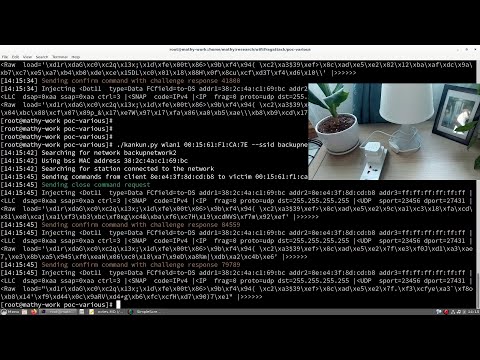
To exploit vulnerabilities, the attacker must be within range of the target wireless device to send the victim a specially crafted frame set. The issues affect both client devices and wireless cards, as well as access points and Wi-Fi routers. Generally, as a workaround, it is sufficient to use HTTPS combined with DNS traffic encryption via DNS over TLS or DNS over HTTPS. Additionally, applying VPN.
The four vulnerabilities in the implementations of wireless devices are considered the most dangerous, allowing trivial methods to achieve the substitution of their unencrypted frames:
- The vulnerabilities CVE-2020-26140 and CVE-2020-26143 allow frame substitution on some access points and wireless cards in Linux, Windows, and FreeBSD.
- The vulnerability VE-2020-26145 allows processing of broadcast unencrypted fragments as full frames in macOS, iOS, FreeBSD, and NetBSD.
- The vulnerability CVE-2020-26144 allows the processing of unencrypted reassembled A-MSDU frames with EtherType EAPOL in Huawei Y6, Nexus 5X, FreeBSD, and LANCOM AP.
Other vulnerabilities in implementations are mainly related to issues that arise when processing fragmented frames:
- CVE-2020-26139: allows redirecting frames with the EAPOL flag sent by an unauthenticated sender (affects 2/4 verified access points, as well as solutions based on NetBSD and FreeBSD).
- CVE-2020-26146: allows reassembling encrypted fragments without checking the order of sequence numbers.
- CVE-2020-26147: allows reassembling mixed encrypted and unencrypted fragments.
- CVE-2020-26142: allows processing fragmented frames as full frames (affects OpenBSD and the ESP12-F wireless module).
- CVE-2020-26141: missing TKIP MIC check for fragmented frames.
Issues in specifications:
- CVE-2020-24588 — attack on aggregated frames (the 'is aggregated' flag is unprotected and can be modified by an attacker in A-MSDU frames in WPA, WPA2, WPA3, and WEP). An example of an attack application includes redirecting the user to a malicious DNS server or bypassing NAT.

- CVE-2020-245870 — key mixing attack (reassembly of fragments encrypted with different keys in WPA, WPA2, WPA3, and WEP is allowed). This attack can reveal data sent by the client, for example, to determine the contents of cookies when accessing via HTTP.

- CVE-2020-24586 — fragment cache attack (standards covering WPA, WPA2, WPA3, and WEP do not require the removal of fragments already in the cache after rejoining the network). This allows the attacker to determine data sent by the client and substitute their own data.

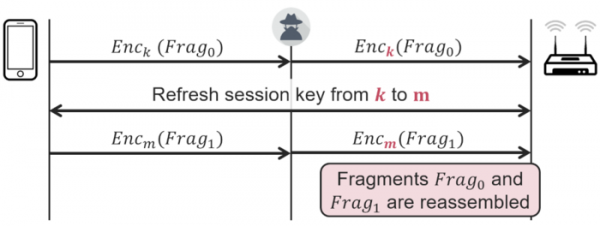
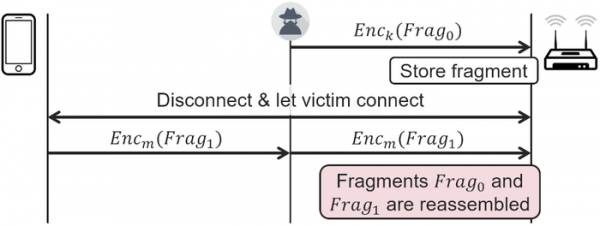
A special toolkit and ready-made Live image have been prepared to test devices' susceptibility to these issues, allowing for the creation of a bootable USB drive. In Linux, issues manifest in the mac80211 wireless network, certain wireless drivers, and firmware uploaded to wireless cards. A set of patches has been proposed to address vulnerabilities, covering the mac80211 stack and ath10k/ath11k drivers. For some devices, such as Intel wireless cards, a firmware update is additionally required.
Standard device tests:
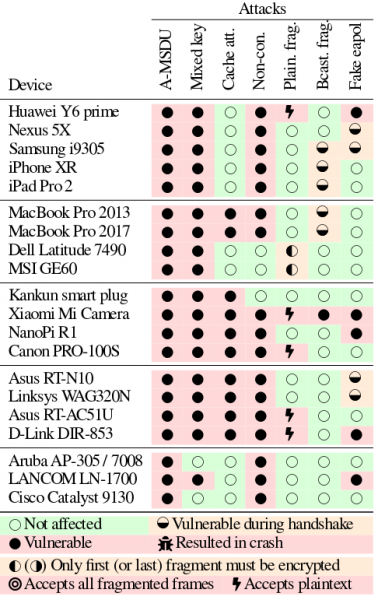
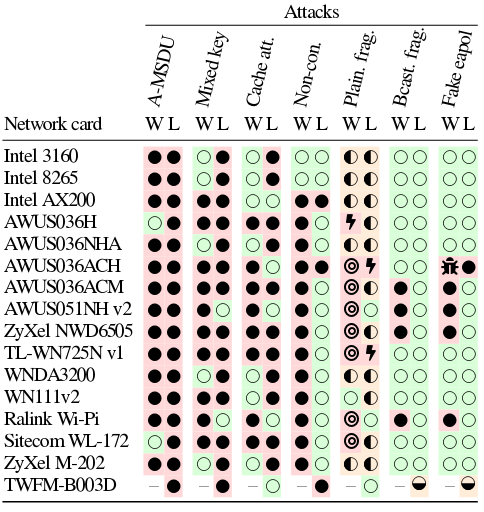
Wireless card tests in Linux and Windows:
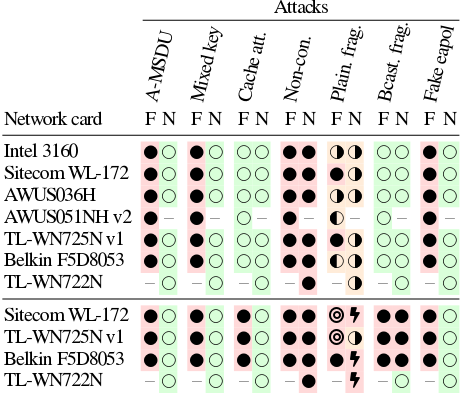
Wireless card tests in FreeBSD and NetBSD:
Manufacturers were notified of the issues nine months ago. This prolonged embargo period is explained by the coordinated preparation of updates and delays in updating specifications by the ICASI and Wi-Fi Alliance organizations. It was initially planned to disclose information on March 9, but after weighing the risks, it was decided to postpone the publication for another two months to provide more time for patch preparation, considering the nontrivial nature of the changes and difficulties arising from the COVID-19 pandemic.
Notably, despite the embargo, Microsoft mitigated certain vulnerabilities ahead of schedule in the March Windows update. The information disclosure was postponed by a week from the originally planned date, and Microsoft either could not or chose not to implement changes in the release-ready scheduled update, thereby exposing users of other systems to threats, as attackers could acquire information about the vulnerabilities through reverse engineering of the update contents.
Source: opennet.ru
