

We have dissected AI technologies from 2019 and shamelessly compared them to the projections from 2017.

First of all, what is the Gartner Hype Cycle? It is a sort of technology maturity cycle, specifically the transition from the hype stage to its productive use. Now there will be a graph with a translation for clarity. . Below are the explanations.
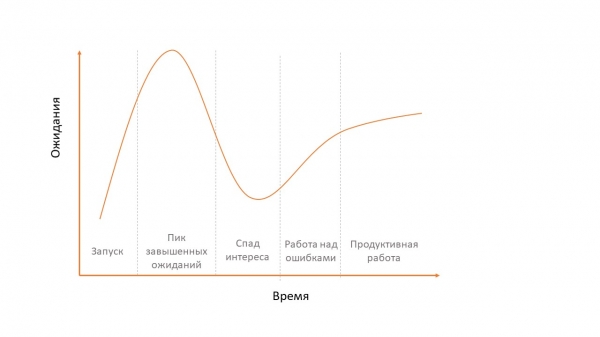
First stage. ̶A̶n̶g̶e̶r̶. Launch. The technology emerges, initially discussed by enlightened nerds, followed by an enthusiastic public; excitement gradually builds.
Second stage. ̶B̶a̶r̶g̶a̶i̶n̶. Peak of inflated expectations. At some point, everyone is talking about the technology, trying to implement it, and the most clever are looking to sell it at exorbitant prices.
Third stage. ̶D̶e̶p̶r̶e̶s̶s̶i̶o̶n̶. Decline in interest. The technology is actively implemented but often fails due to flaws and limitations. "This is all nonsense!" — is heard here and there. Excitement sharply drops (prices usually do too).
Fourth stage. ̶D̶e̶n̶i̶a̶l̶. Working through mistakes. The technology is refined, problems are solved. Gradually, companies cautiously try to implement the technology, and, hurrah, everything works wonderfully.
Fifth stage. ̶A̶c̶q̶u̶i̶s̶i̶t̶i̶o̶n̶. Productive work. The technology secures its well-deserved place in the market and works smoothly, develops, and is appreciated.
What’s trending?
Returning to the hype cycle of 2019. Gartner will release a report in September on which artificial intelligence technologies are at which stage and when they will begin to work productively. The graph is below, with comments under it.
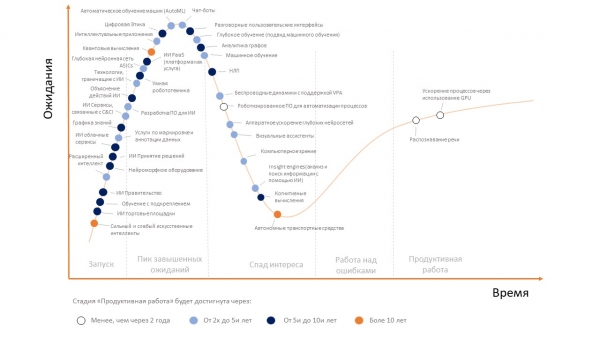
With a significant lead, technologies like "Speech Recognition" and "Process Acceleration using GPU" are already at the "Productive Work" stage. This means they should be applied promptly, as they already provide a competitive advantage to their owners.
Automated Machine Learning (AutoML) and chatbots are currently at the peak of hype. This means everyone is talking about them, and many are implementing them, but it will take 2 to 5 years to refine these technologies to the necessary condition.
The familiar machines are also very much in trend now. The technology of "autonomous vehicles" is nearly probing the bottom. In this case, it is good, as productive work lies ahead. However, according to Gartner's estimates, at least 10 years will be needed for development and adaptation.
Where are the once-hyped drones and virtual reality today? Everything is in place – Gartner has included drones in the Edge AI sphere (categories bordering on AI), and virtual reality has become a part of Augmented Intelligence. Both topics, by the way, are currently in the launch phase and have a positive outlook: 2 to 5 years until productive market activity.
Prospects
Among promising features: Robotic Process Automation software – it sounds frightening, but in reality, it's when robots replace routine tasks. A nightmarish scenario for low-skilled personnel; however, Harvard Business Review asserts: there won't be layoffs, but productivity will increase. There are to believe. The technology will pass its peak unpopularity and widespread disdain in 2 years, and then it will spread everywhere.
Among the technologies that evangelists and info-marketers of all kinds will widely discuss only in the future, "neuromorphic hardware" particularly intrigued me. These are electrical devices (chips) that the natural biological structures of our nervous system in terms of energy efficiency. To simplify greatly, it's about super performance due to division of labor (asynchronous updating of neurons). Giants like IBM and Intel are already actively creating neuromorphic chips. But John Connor's army has time to prepare for the loan day – Gartner has allocated a full 10 years for the technology's maturity.
Interestingly, a lot is said about Digital Ethics, but implementation is slow. This direction has been highlighted as a separate category in the AI sphere: it suggests that we need to establish some ethical principles, norms, and standards for data collection, and implementing AI in life, basically, to have it like . After all, one can take a cue from Asimov.
2017 vs 2019
Funny, but in 2017, everything was , even a separate hype cycle for AI was not allocated: AI technologies were part of the emerging technologies locomotive along with blockchain and augmented reality.
Machine learning and deep learning were at the hype summit in 2017, but by 2019 they continued their path towards decline, meaning .
By the way, drones fluctuated from peak to trough for a year, and in 2019, they moved back toward the peak approach. Such things happen.
In 2019, 8 new technologies entered the cycle. These include AI Cloud Services, AI Marketplaces, and Quantum Computing with AI. Overall, these are well-known tools (in niche circles) that are beginning to be geared towards AI.
Source: habr.com
