

There are quite a few stories about moving to Germany. However, most of them are rather superficial, as they are usually written in the first few months after the move and reveal only the simplest things.
This article will not contain information about how much a dozen eggs costs in Germany, going to a restaurant, how to open a bank account, or obtain a residence permit. The goal of this article is to reveal many subtle nuances of life in Germany that are rarely covered in relocation reviews.
My story will primarily interest established IT professionals who feel quite comfortable in Russia and are questioning whether they should move somewhere. Those who are very uncomfortable in Russia usually leave without deep analysis of the immigration country 🙂
Since any opinion is subjective, even if the author wants to be unbiased, I’ll say a few words about myself. Before moving to Germany, I worked in St. Petersburg as a development department head with a salary of over 200K. I had a decent apartment with a view of the Gulf of Finland. However, I was not completely satisfied with either my work or life. Having worked in both Moscow and St. Petersburg in many companies from startups to international corporations, I no longer saw ways to significantly increase my satisfaction in the country. I was also somewhat unsettled by the mass exodus of developers and other IT specialists from Russia, and given my age of over 40, I didn’t want to miss the last train. After living in Germany for just over a year, I moved to Switzerland. My story will clarify why.
Since I lived in Munich, my experience is naturally based on life in this city. Considering that Munich is regarded as one of the most comfortable cities in Germany, one might assume that I have seen the best of Germany.
Before moving, I conducted a comparative analysis of different countries, which may be interesting for those who are just starting to think about relocating. Therefore, as a prelude, I will first share the main relocation directions and my personal view on them.
The main relocation directions can be categorized as follows:
- Scandinavia
- Eastern Europe
- The Baltics
- Netherlands
- Germany
- Switzerland
- Other central Europe (France, Spain, Portugal)
- The USA
- England
- Ireland
- UAE
- Resorts (Thailand, Bali, etc.)
- Australia + New Zealand
- Canada
Scandinavia. Cold climate and complex languages (except for Swedish). The proximity of Finland to St. Petersburg is diminished by meager wages, very localized Finnish culture in companies, and excessive promotion of non-traditional love in schools. Norway's high GDP, which is often highlighted, is only visible on paper since all the money goes into some fund rather than into the country’s development. In my opinion, Scandinavian countries may be interesting if you really want to be closer to Russia.
Eastern Europe accessible to beginner and intermediate developers. Those who are not inclined to deal with tedious bureaucracy during relocation can be guided there. Many move there to take their first step but end up staying for a long time. Most countries in this group do not accept refugees, but there are plenty of local disadvantaged elements (perhaps that’s why they don’t accept them).
The Baltics offers very low salaries but promises a comfortable family life. I don't know, I haven't checked :)
Netherlands offers reasonable salaries, but I’m very tired of the rain in St. Petersburg, so I didn’t want to go to Amsterdam. The other cities seem very provincial.
Switzerland – a closed country, very hard to get into. Luck must happen even if you are a Java development guru. Everything there is very expensive, with very little social support. But it's nice and beautiful.
The rest of Central Europe has deteriorated significantly recently. The IT market is not developing, and the quality of life is declining. I'm not sure that the comfort level there is now higher than in Eastern Europe.
The USA. A country for enthusiasts. Everyone already knows about it, there's no point in writing.
England is not what it used to be. Many are fleeing due to terrible healthcare and the 'takeover' of London by Indian and Muslim representatives. The opportunity to live knowing only English is attractive, but it’s also appealing to a billion other people on the planet.
Ireland a bit cold and gloomy, probably more suitable for startups due to tax incentives. People also say that housing prices have risen significantly there. In general, English-speaking countries are already rather overheated.
UAE allows you to earn a lot of money as there is no income tax and the gross salaries are somewhat higher than in Germany. It's unclear how to live there in the summer with +40 degrees. Also, due to the absence of a permanent residency and citizenship program, it's not clear where to go with this money later.
Resorts suitable only for those without children or as a short-term experiment. Not my case.
Australia + New Zealand are interesting, but very far away. I have a couple of acquaintances who wanted to move there, mainly because of the climate.
Canada is similar to Scandinavia but with more accessible languages. The rationale for moving there isn’t very clear. Maybe it’s an option for those who really love the USA but haven’t been able to get there yet.
Now finally about Germany. Germany looks quite attractive compared to the options above. Good climate, widely spoken language, easy way to obtain a work permit (Blue Card), and supposedly a developed economy and healthcare. This is why every year tens of thousands of qualified specialists from different countries try to find their fortune there. I will try to describe some interesting aspects of life in this country below.
Housing. The first surprise awaits you right at the beginning when, after receiving a job contract, you start looking for housing. You might already be aware that finding housing in good German cities is not easy, but the phrase 'not easy' doesn't reflect the situation accurately. In Munich, the search for housing will become your daily routine, just like brushing your teeth in the morning. Even if you find something, you won't like it, and you will continue to look for other housing again.
The crux of the problem is that renting property is popular in Germany instead of buying. This is supposed to provide some flexibility with relocations and not burden individuals with mortgage loans. However, that's what they say on television. The television in Germany isn't much different from our first channel. In practice, renting property means constant payments to landlords, which is naturally more profitable than a one-time sale. I wouldn't be too far off in assuming that 80% of all rental properties are owned by corporations that, of course, want to earn more money. They are assisted by refugees, whose housing costs are covered by your taxes, as well as a semi-free labor market that creates increased demand for housing. A large number of refugees are placed in nice apartments in the city center (likely owned by those same corporations). Thus, the German apartment oligarchs take your money twice. Once when you pay for housing for refugees from your taxes, and a second time when you pay for housing for yourself at an overheated market price, giving away 2000 euros for a simple three-room apartment. Our dealers trying to profit from expensive cabbage or street tiles nervously smoke off to the side in envy.
Interestingly, this housing situation, along with the 100% occupancy of all migration centers in Munich, 100 people per spot in kindergartens, and overcrowded hospitals, does not lead to any political protests. Everyone endures, pays, and waits for their turn. Attempts to point out problems stemming from refugees will lead to accusations of fascism. For those in the know, compare the phrase 'You don't want it to be like in Paris' to the phrase 'You don't want it to be like under Hitler.' Elderly people are protected by the court, long-time residents are afraid to move lest they lose the housing they rented years ago at old prices. New families are paying 50% of their salaries for housing and are left wondering why they need all this. 'Singles' live in 'barracks' for 1000 euros. Girls are looking for local spouses with housing, while young men hope to get rich by some miracle.
Medicine Germany is vividly described in legends and parables. It is true that there are unique medical centers in Germany, particularly in Munich, equipped with state-of-the-art technology. However, you will never see this. Insurance-based healthcare in Germany is very different from what is typically reported about medicine in Germany.
With the salary of an IT developer in St. Petersburg, you hardly need insurance, except for the most severe cases. You can comfortably buy virtually any medical service. Even most complex procedures cost less than a month's salary. In Germany, on the salary of an IT specialist, it would be difficult to call a doctor to your home for 300 euros or get an MRI for 500-1000 euros. There is no paid healthcare for the general population in Germany. Everyone must be equal. Only very wealthy oligarchs can be unequal. Therefore, you will have to wait in line with elderly ladies and, if you have a child, with dozens of other sick children. If you suddenly want private insurance, you will have to pay for it for all family members, even after losing your job for some time. Private insurance may allow you to avoid queues and potentially provide some small benefits in the quality of medical services, but when moving with your family, it will leave you without money to enjoy your health. It is also interesting that not everyone can obtain private insurance; only those deemed worthy by the German bureaucracy (based on salary or type of employment) can, even if you have a million rubles in a Russian bank account.
Acquiring State Services. You have probably already decided that the MFC and the state services portal are something self-evident. Since it has been around for a hundred years in Russia, it should exist there as well. But it doesn't.
If you need something from the government, the algorithm is roughly as follows:
- Search in Google or on a forum for the name of the service that provides the service.
- Find the website of the office that provides the service and find out how to get an appointment ticket.
- Get an appointment ticket on the website. In some cases, such as for obtaining a Blue Card, there are no tickets. They are thrown onto the site in small quantities every morning. You have to get up at 7 a.m. and refresh the website every minute to be quick enough to click on the ticket that appears.
- Collect 100,500 documents required to obtain the service.
- Arrive at the scheduled time. Bring cash for payment of the service.
- Bonus. If you already have a good knowledge of German, some services can be obtained by sending the correct package of documents by mail.
Food Dining out in Germany is generally okay. The only issue is that it can feel quite uniform. You won’t find extensive menus in restaurants, as they will only be a couple of pages long. Additionally, there’s no such thing as a children’s playroom in restaurants in Munich; any space would rather be filled with more tables. If you ask about the types of beer available, the response will be — white, dark, and light. The situation is similar in stores. There are just a couple of boutiques throughout Munich where you can buy non-German beer. To be fair, Munich does have many Asian restaurants that add some variety to the food scene. The food quality is average; better than in Russia, but noticeably worse than in Switzerland.
Smoking. Germany has a strong smoking culture. About 80% of tables on outdoor restaurant patios will have people smoking. If you enjoy sitting outside and breathing fresh air, then restaurants may not be for you. They seem unaware of the 15-meter rule from stops and building entrances. If you like swimming in open pools, you’ll also have to tolerate tobacco smoke. One unpleasant surprise for me was the constant lack of wind in Munich. On still days, tobacco smoke can be detected from as far as 30 meters away, essentially anywhere there are people. I’ve been many places in Europe, but I’ve never encountered such a high percentage of smokers anywhere. I can't explain it. Perhaps it's stress and hopelessness? 🙂
Children. Attitudes towards children in Munich are somewhat strange. On one hand, all politicians scream about a demographic crisis in the country; on the other hand, none of the loud proponents suggests building more kindergartens, playgrounds, children's hospitals, etc. Private kindergartens, demanding around 800 euros a month, resemble the makeshift shelters in Indian slums. Worn-out furniture, faded carpets on the floor, threadbare sofas. To get in, one has to wait in line. Public kindergartens consist of a single room for 60 children with a few caregivers. Recently, politicians proposed making kindergartens free. Apparently, it has become embarrassing to charge for such a disgrace. According to those same politicians, Germany's future is tied to migration, but not in any way to the birthrate of its own children. Indeed, to give birth to one's child, you need healthcare, a children's goods and food market, kindergartens, and new quality housing. It's much easier to take a ready-made sample from the incoming boat. Well, whether that sample will do anything other than trade in drugs is no longer important. One can prohibit criticizing refugees, and everything will be fine.
Another living legend is the happy German retirees, traveling the world. The problem here is that Germany's funds for high pensions are running out. Raising the retirement age is unlikely to work, as it is already 67 years. Forcing homeowners to rent to retirees for 300 euros instead of 2000 is also not sustainable for long. Germany had plans to solve the problem through migration. Those plans have failed, as migrants, after a short period in jobs, also do not want to do anything but want to live well. No one knows how Germany will get out of this situation. For now, Germany is willing to pay current pensions until 2025. They haven't committed to larger guarantees.
Munich has a very interesting bicycle "infrastructure". The city is known to be the most bicycle-friendly. Bicycle paths are mostly separated from sidewalks by either a white line or different pavement, which is more expensive, but serves the same purpose. One careless step from a pedestrian, and they can be hit by a cyclist and end up being blamed. When cyclists feel cramped on their paths, they ride onto the sidewalks. Sidewalks are also used by cyclists going against the flow. Accidents between cyclists and pedestrians are not uncommon. Naturally, there are also incidents involving children, especially in parks where paths are not even separated. For example, if a thousand migrants were gathered in St. Petersburg and each was given a bucket of paint to divide the sidewalk into two equal parts, the city would wake up as the cycling capital of the world within a day. That’s more or less what was done in Munich. Interestingly, in Switzerland, cyclists ride on the roadway in the absence of a bike lane. Cyclists separately, people separately ((c) Planet of the Apes).
Munich has a well-thought-out layout practically everywhere. city development. There’s no point in searching for neighborhoods with shops, schools, or parks. They will be everywhere. However, when choosing where to live, in addition to your personal preferences, it makes sense to consider three factors that are usually not mentioned in reviews.
- Church bells ring early in the morning and late in the evening every single day without weekends. Within the city, there are no places where they can’t be heard at all, but there are areas where it can be quite "noisy".
- Fire trucks, ambulances, and maintenance services drive with sirens blaring even on empty streets at night. The volume of sirens in Munich is such that if you die at the wheel, you will still hear them. If your windows face the main roads of the city, you won't be able to sleep with the windows open. In summer, this will be a major issue as there are no air conditioners in the city. None at all.
- The S-Bahn (subway to the nearest suburbs) is not very reliable. If you commute to work by it, be prepared to sometimes wait an extra 30 minutes or, during winter, to work from home.
Now, a bit about work. There are various scenarios, but working in Munich is generally pleasant. No one is in a hurry, and people don't stay late in the evenings. Most likely in Germany, most managers become managers if they have any competencies at all. I haven't heard of any reviews about managers who operate on the principle of 'I'm the boss, you're the fool.' Also, IT companies tend to hire smart migrants rather than dull Germans, which creates a pleasant atmosphere in the team. The flip side is that Germans would sooner hire a less qualified, cheap Indian than raise salaries.
Since everyone works and earns roughly the same, there's no point in weaving complicated intrigues for some position. You can get the position, but money isn't always guaranteed. As a result of similar salaries, there is no market for premium services in Munich and Germany as a whole, because there's no one to consume them. Either you work like everyone else for a similar salary, or you have a successful business and earn significantly more. It’s unclear what kind of shops, restaurants, and entertainment venues successful people in Germany frequent. Apparently, there are so few of them that only a select few know about them. The most modern cinema in the center of Munich reminded me of the Crystal Palace from the 90s on Nevsky in St. Petersburg.
In Germany, you can be sick for up to 6 weeks a year at 100% salary without any cap. It’s surprising that people still come to work with sniffles and coughs. Although many in Munich get sick often, if you stay home for every cold, 6 weeks might not be enough.
Despite what has been said, you certainly shouldn't exclude Germany from your list of favorite countries. Each country has its own 'peculiarities.' It's better to learn about them in advance and plan your move properly.
Considering all the above, I would highlight the following strategies for moving to Germany.
Freelancing. Two years after working for someone on a Blue Card, you will have the legal opportunity to become a freelancer. This is a typical work mode for Germans themselves. It will allow you to approximate a salary of up to 150K euros per year. You can live in Munich somewhat as you would in St. Petersburg with 200K rubles a month. The difficulty lies in the fact that freelancing usually requires a good command of German, which is hard to acquire in just two years. Therefore, realistically, you will be able to work freelance a bit later.
Starting your own business after obtaining permanent residency. In 2-3 years, depending on your knowledge of German, you will obtain permanent residency. This allows you to reside permanently in the country regardless of your financial status. You can take the risk and launch your own project.
Remote work. Germans have a relaxed attitude toward remote work, but it's better to prove your worth in an office setting first and become a resident of Germany. You should aim for a startup, as remote work is unlikely in larger companies. Once you transition to remote work, you can settle in a cozy German village or travel the world, adhering to the rule of residing in Germany for at least 6 months a year.
Strategies for addressing housing issues may include the following. If you have some savings or property in Russia that you are willing to exchange for German property, expect that cozy modest housing for a family (a three-room apartment or a small house) in Munich starts at a million euros. Currently, there’s a strategy of purchasing housing in nearby suburbs, but over time, prices there will only rise as more people want to do it. Additionally, due to the influx of poor migrants, the main suburbs of Munich resemble refugee camps more than cozy places for comfortable living.
In southern and southwestern Germany, there are several decent small towns for living, such as Karlsruhe or Freiburg. There is a theoretical possibility of buying property with a mortgage for 30 years and enjoying life. However, there are very few IT jobs in these towns. In Munich, as soon as your non-IT partner learns German, you will be able to live on two salaries, which may not allow you to buy property in the city but will enable you to start enjoying life.
As I mentioned earlier, I no longer live in Germany, so I can't implement any of these strategies. I found a job in Switzerland. Switzerland is also not an ideal country. However, while you can hear various opinions about Germany, I haven't encountered any negative stories about moving to Switzerland so far. Therefore, when I drew my lucky ticket, considering my family and my age, I decided to take a bird in the hand rather than chase a crane in Germany. Switzerland, in some sense, is a boutique country with a personalized approach. Here you are an individual; in Germany, you are just one of millions. I can't say much else about Switzerland for now.
For those interested in Switzerland as a country to move to, join .
There I will write about my experiences living and working (especially in comparison to Germany) and share job vacancies that offer sponsorship support.
For timely information about Munich, I recommend .
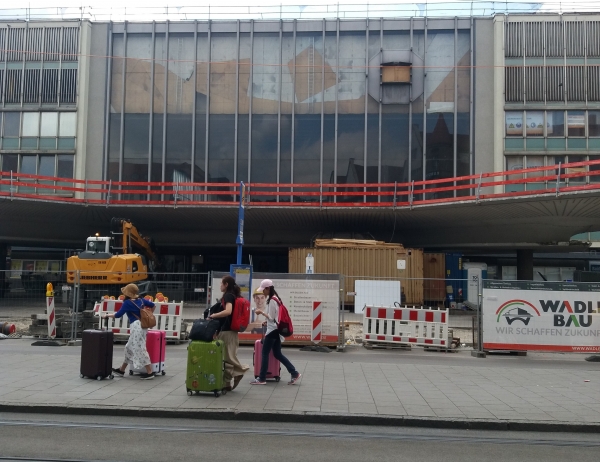
P.S.: In the picture, the main entrance to the central train station in Munich. The photo was taken on June 13, 2019.
Source: habr.com
