

The release of the git-bug 0.11.0 project has been published, developing a bug tracking system that stores information about issues and comments as objects in a Git repository. Similar to changes in the source code, the git-bug toolkit allows you to place information about tracked bugs into external repositories using the push operation, as well as retrieve data from external to local repositories with the pull operation. The project's code is written in Go and is distributed under the GPLv3 license.
The git-bug project uses a standard Git repository to store problem descriptions, user bases, and comments in a versioned manner. The decentralized architecture of Git allows for offline operation with periodic synchronization of changes. Highlights include support for working with error messages via command line, console interface, or web interface, and very fast execution of searching and navigating through error messages. Layers are provided for synchronization with bug tracking services GitHub, GitLab, Jira, and Launchpad.
Key innovations:
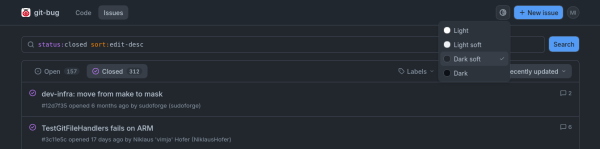
- A new web interface has been implemented for navigating through issue messages. Features include searching and filtering content, creating new issue reports, adding and editing comments, changing labels and statuses, and viewing user profiles. Two options for light and dark themes are available. Support for working with different repositories is provided.

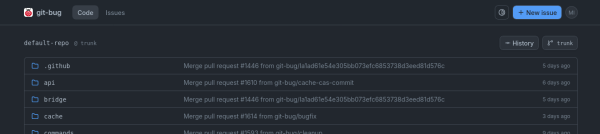
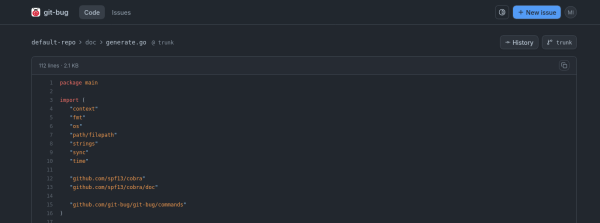
The web interface includes a code navigation system that allows you to manage files, view code with syntax highlighting, display documents in markdown format, track commit history, and assess changes. Future plans include implementing capabilities for code review and opening public access for content viewing by participants without an account.


- Issues in the cache implementation that led to race conditions, data inconsistencies, and non-atomic handling of commits have been resolved.
- Support for event subscriptions via GraphQL has been added to the API, allowing for changes to be received without periodic polling of the state.
- The release builds are created using the GoReleaser tool, which allows packaging in deb, rpm, apk, and pkg (Arch Linux) formats, as well as performing download verification via digital signatures.
Source: opennet.ru
