

It may seem that Homer and his poems are something distant, archaic, hard to read, and naive. But that's not the case. We are all permeated by Homer and the ancient Greek culture from which all of Europe emerged: our language is filled with words and quotes from ancient Greek literature. Take expressions like "Homeric laughter," "the battle of the gods," "Achille's heel," "the apple of discord," and our own: "the Trojan horse." All of this, in one way or another, comes from Homer. And the influence of Hellenistic culture, the language of the Hellenes (the Greeks did not know the word "Greece" and did not call themselves that; this ethnonym came to us from the Romans), is undeniable. School, academy, gymnasium, philosophy, physics (metaphysics), and mathematics, technique... choir, stage, guitar, mediator — there are so many that cannot be listed — all of these are ancient Greek words. Did you not know?
…
It is also claimed that the Greeks were the first to invent money in the form of minted coins... The alphabet as we know it. The first coins were minted from a natural alloy of silver and gold, which they called electrum (hello to electronic money from the past). The alphabet with vowels, thus allowing for the representation of all sounds of words in writing, is certainly a Greek invention, although many consider the enterprising Phoenicians (the Semitic people who lived in what is now Syria and Israel) to be the pioneers as they had no vowel letters. Interestingly, the Latin alphabet came directly from the Greek, as did the Slavic one. Later alphabets of Western European countries are derived from the Latin. In this sense, our Cyrillic stands on equal footing with the Latin... And how much Greek is there in science and literature? Iamb, trochee, muse, lyre, verses, stanzas, Pegasus with Parnassus. The very words "poet," "poetry," and so on — it is now obvious where they come from. One cannot list everyone! But the title of my text reveals the pathos (an ancient Greek word) of my "discovery." So, I will hold my horses and move on to asserting that the first open source (I will concede that) with Git appeared long ago: in ancient Greece (more precisely, in archaic ancient Greece), and the most prominent representative of this event is the well-known great Homer.
Well, the introduction is done, now let's go in order. Disclaimer: I will provide the original meanings of the aforementioned Greek words at the end of the text (some of which are surprising) — this is for those who read this text to the very end. So, here we go!
Homer.
The poems of the great Homer are traditionally dated to the end of the 9th to the beginning of the 8th century BC, although these texts likely began to emerge immediately after the events they describe, that is, somewhere in the 13th century BC. In other words, they are about 3,000 years old. Homer is directly credited with the "Iliad" and the "Odyssey," the "Homeric Hymns," and a number of other works, such as the poems "Margit" and "Battle of the Frogs and Mice" (a satirical parody of the "Iliad," which literally translates to "The War of Mice and Frogs" (machia — fight, strike; mys — mouse). According to scholars, only the first two works belong to Homer, while the others, like many others, are attributed to him (why I will explain below); according to others, only the "Iliad" belongs to Homer... in short, debates continue, but one thing is indisputable — Homer definitely existed and the events he described at the walls of Troy (also known as Ilium, hence "Iliad") certainly took place.
How do we know this? In the late 19th century, Heinrich Schliemann, a German who made a fortune in Russia, fulfilled his long-held childhood dream: he discovered and excavated Troy in modern-day Turkey, completely overturning previous notions about those times and the texts related to them. It was previously believed that the Trojan events, which began with the flight of the beautiful Helen with the Trojan prince Paris (Alexander) to Troy, were mere myths, as even for the ancient Greeks, the events described in the poems seemed to be from a distant past. However, not only were the walls of Troy excavated, but the oldest gold ornaments from that time were also found (which are on public display at the Tretyakov Gallery). Later, clay tablets from the ancient Hittite state — a neighbor of Troy — were discovered, containing well-known names such as Agamemnon, Menelaus, and Alexander... Thus, literary characters became historical figures, as these tablets reflected the diplomatic and tax realities of the once-powerful Hittite state. Interestingly, there was no writing in either the Troad or Hellas (funny enough, that word didn't exist in those distant times) at that time. This is what oddly sparked the development of our theme.
So, Homer. Homer was an aed — that is, a wandering performer of his own songs (aed means singer). Where he was born and how he died is not known for certain. This is partly because, for the right to be called the birthplace of Homer, as well as the place of his death, no less than seven cities on both sides of the Aegean Sea competed in antiquity: Smyrna, Chios, Pylos, Samos, Athens, and others. Homer is actually not a proper name but a nickname. It means something like 'hostage' from ancient times. It is presumed that the name given to him at birth was Melisigen, meaning 'born of Melisius', but this is not certain. In antiquity, Homer was often referred to as: the Poet (Poetess). With a capital letter, indicated by the appropriate article. And everyone understood who was being talked about. Poetess means 'creator' — yet another ancient Greek word added to our collection.
It is commonly believed that Homer (or Omir in Old Russian) was blind and old, but there is no evidence to support this. Homer himself did not describe himself in his poems, nor is he depicted by contemporary figures (such as the poet Hesiod). Much of this perception is based on the portrayal of bards in his "Odyssey": old, blind, gray-haired elders in their twilight years, as well as the widespread notion that blind individuals of that time often became itinerant singers since a blind person could hardly work, and pensions had not yet been invented.
As mentioned earlier, the Greeks did not have writing at that time, and if we assume that most bards were blind or partially sighted (glasses had not yet been invented), then writing would have been of no use to them. Therefore, the bard sang his songs purely from memory.
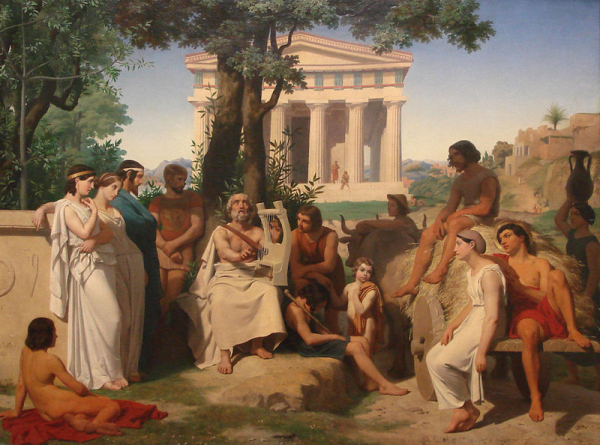
It looked something like this. The wandering elder, either alone or with a disciple (guide), would travel from one city to another, where he was warmly welcomed by local residents: often the king (basileus) himself or a wealthy aristocrat in their homes. In the evening, during the usual dinner or at a special event—a symposium (symposion—a feast, a party, a celebration)—the bard would begin to sing his songs and would do so until deep into the night. He sang accompanied by a four-stringed formingo (the ancestor of the lyre and the later kithara), singing about the gods and their lives, about heroes and their feats, about ancient kings and events directly relevant to the listeners, for they all considered themselves direct descendants of those mentioned in these very songs. And there were many such songs. We have the complete "Iliad" and "Odyssey," but it is known that there existed an entire epic cycle concerning the events in Troy (the epic cycle) consisting of more than 12 poems. You might be surprised, dear reader, but there is no description of the "Trojan Horse" in the "Iliad"; the poem ends somewhat before the fall of Ilium. We learn about the horse from the "Odyssey" and other poems of the cyclic cycle, particularly from the poem "The Fall of Ilium" by Arctinus. This is all very interesting, but it strays from the main topic, so I only mention it in passing.
Yes, we call the 'Iliad' an epic, but it was a song (its chapters are still referred to as songs). The bard did not read, but sang melodiously to the sounds of strings made from bull sinews, using a crafted bone — a plectrum as a mediator (another nod to antiquity), while enchanted listeners, well aware of the storyline, savored the details.
'Iliad' and 'Odyssey' are very large epics. More than 15,000 and over 12,000 lines respectively. Therefore, they were sung over many evenings. It was very much like modern series. In the evenings, listeners gathered around the bard again, their hearts pounding, sometimes with tears and laughter, listening to the continuations of the stories sung the previous day. The longer and more interesting the series, the longer people remained attached to it. Thus, the bards lived and thrived on their listeners while they enjoyed their lengthy songs.
The thighs were burned for the gatherer Zeus Kronides, the lord of all,
And then they sat down for the richest feast... and enjoyed themselves.
The divine singer sang while performing, — honored by all men, Demodocus.
Homer. 'Odyssey'
So, it is time to get directly to the point. We have the craft of the bards, the bards themselves, very long epic-songs, and a lack of literacy. How did these epics reach us from the 13th century B.C.?
But before that, one more important detail. We say 'epics' because their text was poetic, verse (verse — another ancient Greek word meaning 'structure').
According to the ancient historian, RAN academic Igor Evgenievich Surikov: poetry is much better memorized and passed down from generation to generation. 'Try to memorize prose, especially a long piece, while poetry — I can readily reproduce a number of verses learned back in school' — he told us. And that's true. Each of us remembers at least a few lines of poetry (if not whole poems), while very few can recall even a complete paragraph taken from prose.
The ancient Greeks did not use rhymes, although they were aware of it. The foundation of poetry was rhythm, where a specific alternation of long and short syllables formed metrical patterns: iamb, trochee, dactyl, amphibrach, and others (this is almost a complete list of metrical patterns in modern poetry). The Greeks had a vast number of these patterns. They knew of rhyme but did not use it. However, the rhythmic variety allowed for a variety of styles: trochaic, spondee, sapphic verse, Alcaic stanza, and of course the famous hexameter. My favorite meter is the iambic trimeter. (just a joke) Meter means measure. Another word for our collection.
The hexameter was the poetic meter for hymns (hymnos - prayers to the gods) and epic poems, similar to those of Homer. One could talk about it at length; I will only say that many, much later, including Roman poets, wrote in hexameter, for example, Virgil in his 'Aeneid' — a poem imitating the 'Odyssey,' where the main character Aeneas flees from the destroyed Troy to his new homeland — Italy.
"He spoke — and it became bitter for the son of Peleus: a mighty heart,
In the hero's chest throbbed two thoughts:
Either, drawing his sharp sword from the sheath at once,
To scatter and kill the lord of the Atridae;
Or to calm the fury, subduing his aggrieved soul…"
Homer. 'Iliad' (translated by Gnedich)
As I seem to have already said, the bards began to sing of the events of the Trojan War almost immediately after its conclusion. Thus, in the 'Odyssey,' the titular hero, being far from home, hears a bard's song about himself after ten years of wandering and begins to weep, hiding his tears from everyone under his cloak.
So, it turns out that songs appeared in the 13th century, and Homer sang his "Iliad" in the 8th century. Its canonical text was recorded 200 years later, in the 6th century BC, in Athens under the tyrant Pisistratus. How did these texts originate and reach us? The answer is as follows: Each subsequent bard modified the original works of previous authors, often 'forking' others' songs, considering it a given, as this was viewed as the norm. Copyright did not exist at that time, and very often even much later, with the emergence of writing, "reverse copyright" was in play: when an obscure author signed their works with a famous name, as they reasonably believed it would ensure success for their composition.
The students and listeners of the bards served as Git for disseminating the source material, becoming singers themselves later on, as well as the bard competitions that were held periodically where they could hear each other. For instance, it was believed that once Homer and Hesiod advanced to the finals of a poetry contest, and, strangely enough, the first place was awarded to Hesiod according to numerous judges. (I will omit why here)
Each performance of a bard's song was not only a performing act but also a creative one: they would reconstruct their song anew each time from a whole array of ready-made blocks and phrases—formulas—with a measure of improvisation and borrowing, refining and altering pieces of the 'code' 'on the fly'. Since the events and characters were well known to the listeners, they did this based on some 'core', and importantly, in a special poetic dialect—a programming language, as we would say today. Just imagine how similar it is to modern code: input variables, condition blocks, and loops, events, formulas, all in a special dialect different from the conversational language! Adherence to the dialect was very strict, and centuries later, different poetic works were written in their own distinct dialects (Ionic, Aeolic, Dorian), regardless of where the author came from! They simply followed the requirements for the 'code'!
Thus, from borrowing from one another, the canonical text was born. Clearly, Homer borrowed as well, but unlike those who faded into oblivion (lethe — one of the rivers of the underworld of Hades, threatening forgetfulness), he did it brilliantly, compiling one song out of many, creating a cohesive, vibrant, imaginative, and unparalleled version in form and content. Otherwise, his name would also have remained unknown and replaced by other authors. It is precisely the genius of his ‘text’, memorized by generations of singers after him (it undoubtedly underwent revisions, but to a much lesser extent), that secured him a place in history. In this regard, Homer became such an unreachable pinnacle, a benchmark, metaphorically speaking, a monolithic ‘core’ of the entire ecosystem of songs, that, according to scholars, he reached written canonization in a version closest to the original. And this seems true. It is remarkable how beautiful his text is! And how it is perceived by a prepared reader. No wonder, Pushkin and Tolstoy admired Homer; indeed, what of Tolstoy, Alexander the Great himself never parted with a scroll of the ‘Iliad’ for a single day — simply a historically documented act.
I mentioned earlier the Trojan cycle, composed of a series of works reflecting certain episodes of the Trojan War. In part, these were unique 'fragments' of Homer's ‘Iliad’, written in hexameter and filling in the reflections that were not found in the ‘Iliad’. Almost all of them have either not survived to the present day or only exist in fragments. Such is the judgment of history — evidently, they fell far short of Homer and did not become as widespread among the populace.
To summarize. A certain strict language of songs, the formulas from which they were composed, the freedom of dissemination, and, most importantly, their openness to constant modifications by others — this is what we now call open source — emerged at the dawn of our culture. In the realm of authorship and collective creativity. This is a fact. In general, much of what we consider ultra-modern can be found through the centuries. And what we think is new may have existed before. In this regard, the words from the Bible, from ‘Ecclesiastes’ (attributed to King Solomon), come to mind:
There are things that people say: “Look, this is new,” but it has existed for centuries, long before us. There is no memory of the past; and those who come after will not remember what will be...
end of Ch. 1
School (scholē) — entertainment, free time.
Academy — a grove near Athens, the location of Plato's philosophical school.
Gymnasium (gymnós — naked) — gymnasiums referred to the sports halls for body training. Boys trained naked there. Hence the related words: gymnastics, gymnast.
Philosophy (philos — to love, sophia — wisdom) — the queen of the sciences.
Physics (phusis — nature) — the study of the material world, nature.
Metaphysics — literally 'Beyond nature'. Aristotle did not know where to classify the divine and named his work so: 'Not Nature'.
Mathematics (mathema — lesson) — lessons.
Technology (tēchnē — craft) in Greece — artists and sculptors, as well as producers of clay jugs, were technicians, craftsmen. Hence 'the craft of the artist'.
Chorus — originally dances (hence choreography). Later, as dances were performed with singing by many, the chorus — polyphonic singing.
Scene (skēnē) — a tent for changing actors. It stood in the center of the amphitheater.
Guitar — from the ancient Greek 'kithara', a string musical instrument.
Source: habr.com
