

According to The Wall Street Journal, Google is collaborating with one of the largest healthcare systems in the U.S. on a project to collect and analyze detailed personal health information for millions of people in 21 states. The initiative, codenamed Project Nightingale, appears to be the biggest effort by the search giant to establish a foothold in the healthcare industry through the processing of patient medical data. Amazon, Apple, and Microsoft are also actively promoting healthcare-related features, though they have not yet secured deals of this magnitude in the field.
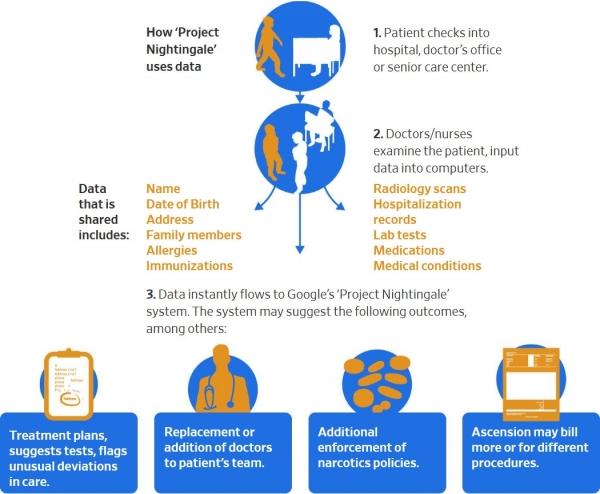
Google secretly launched Project Nightingale last year in partnership with St. Louis-based Ascension, a Catholic network of 2,600 hospitals, physician offices, and other facilities. According to internal documents obtained by journalists, data sharing with the tech giant has rapidly increased since the summer of this year. The information included in the initiative comprises lab results, doctors' diagnoses, and hospitalization records, along with other categories—essentially a complete medical history along with patient names and birth dates. The tech giant is collaborating with Ascension on an ambitious project to acquire data on patients for treatment and information management.
Neither patients nor doctors were notified about such extensive medical data sharing. According to a WSJ whistleblower, at least 150 Google employees already have access to much of the data on tens of millions of patients. In a press release issued after The Wall Street Journal reported on Project Nightingale on Monday, both companies stated that this initiative complies with federal healthcare laws and includes robust patient data protections.
According to sources, some employees of Ascension are puzzled about the methods of data collection and transmission from both a technical and ethical perspective. However, privacy experts stated that such practices are indeed permissible under federal law. This refers to the Health Insurance Portability and Accountability Act of 1996, which allows hospitals to share data with business partners without notifying patients, provided that the information is used solely to assist organizations in fulfilling their healthcare functions.
In this case, Google is partially using the data to develop new software based on machine learning, which promises a personalized approach and could advise individual patients to make changes to their treatment process. Internal documents indicate that employees of Alphabet (Google's parent company) have access to patient information, including some employees of Google Brain, the research division credited with the company's most significant achievements.
Tariq Shaukat, President of Google Cloud, stated that the company's goal in healthcare is ultimately to improve outcomes, reduce costs, and save lives. Eduardo Conrado, Executive Vice President of Ascension, added, "As the healthcare field continues to evolve quickly, we must adapt to better meet the needs and expectations of those we serve, as well as our physicians and healthcare providers."
Documents show that Google's ultimate goal is to create a universal search tool for aggregating fragmented patient data and presenting it in one place. The project is being developed within Google's cloud division, which lags behind competitors like Amazon and Microsoft in market share. Ascension, in turn, aims not only to improve patient care: documents indicate that the company hopes to obtain data that will signal the need for additional tests or enable other means of increasing revenue from patients. Ascension also seeks to establish a system that operates faster than the existing decentralized electronic record-keeping.
This month, Google for $2.1 billion of Fitbit, a company that produces watches and bracelets that track health information (such as heart rate). The company stated it would be transparent regarding any data collected from Fitbit. In September, Google announced a 10-year deal with Mayo Clinic to obtain genetic, medical, and financial documentation from this network of medical facilities. At that time, Mayo officials stated that any personal data would be deleted before it could be used for new software development within Google.
Source: 3dnews.ru
