

There is a viewpoint that I often encounter—that it is impossible to learn independently and that one needs professionals to guide them along this challenging path—explaining, checking, and controlling. I will try to refute this assertion, and to do so, as is well known, it's enough to provide at least one counterexample. History has examples of great autodidacts (or self-taught individuals in simpler terms): the archaeologist Heinrich Schliemann (1822–1890) or Georgia's pride—artist Niko Pirosmani (1862–1918). Yes, these individuals lived, studied, and created mostly in the 19th century and were far removed from the world of information technology. However, as Aristotle said, 'the most important goal of education is to learn how to learn.' In this article, I will share practical examples that allow for effective organization of the self-education process.

It is still possible to learn independently. Moreover, it is absolutely realistic to achieve high results in doing so. You might be surprised: how can a person from the field of commercial education (I work at the training center "") talk about this while cutting off the branch they are sitting on? However, let's take it step by step.
I am a person who has spent my entire professional life (more than 17 years) in the field of education: I am IN education and I am FOR education. I want to share practical examples that allow for an effective organization of the self-education process. These techniques are a summary of my personal experience. Of course, I do not claim to have the ultimate truth. But if each of you finds at least one technique that you would like to use in your personal practice, I will consider my task accomplished.
My first piece of advice is—if you have decided to engage in self-education (regardless of how much time you are willing to dedicate: 10 minutes, an hour, a day…), try to avoid other tasks during this time to maximize its effectiveness.
Professor Hal Pashler from the University of California said: 'Even the brain of a Harvard graduate will turn into that of an eight-year-old child if forced to do two things at once.'
Abandon multitasking when studying, and you will gain the maximum benefit from education.
But I promised to share some practical tips. I will illustrate these self-education techniques using the topic of front-end development. First, this topic has always fascinated me (ever since my time as a school computer science teacher, teaching it to kids). Second, front-end development is one of the most in-demand and rapidly evolving fields.). And third, even if we are not front-end developers, we are consumers of their work.
So, we need to acquire new knowledge and gain practical skills on our own. Where do you source them from? What is your source? The internet, textbooks, and other people, right? Let's start with the internet.
1. Search efficiently
There are plenty of search engines. Different search systems have various search algorithms, leading to different coverage areas—each indexing a part of the information available on the internet. Therefore, it's important to use multiple search engines to maximize the breadth of sources.
But how do you organize your search to avoid getting lost in the vast amount of "information noise"? You need to learn to sift out useful grains. Yes, search engines now understand queries in natural language. The algorithms for delivering relevant search results are constantly improving. Search engines are gaining a vast array of additional features. However, the question "How to search for information efficiently?" remains relevant to this day.
Almost every search engine has an advanced search feature and a query language it’s built on. But not everyone uses this feature regularly.
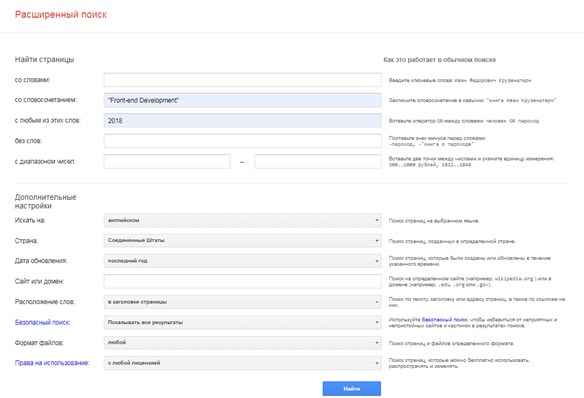
I will demonstrate this using Google. If I want to learn front-end development, I'm interested in the technologies I should focus on and the resources I should read.
- We go to the
- We set the parameters. For example:
a. with the phrase: Front-end Development,
b. with any of the words: 2018,
c. Search in: English,
d. Country: United States,
e. Last updated: past year,
f. Word position: in the title of the page. - Click Find.
- On the search results page, we select the resources that will serve as our starting point for exploring the topic.
To refine search queries, you can also use. These simple tricks will help you obtain more relevant results and save a lot of time spent searching for quality information.
2. Learn Online
By now, I'm sure everyone knows about MOOCs — freely available online courses for anyone interested. Some of the most well-known platforms include , , , , . Most of these resources offer courses in English, but there are also Russian-language options, for example, (where, by the way, the Corporate University of Sberbank publishes its courses).
In my personal ranking, the undisputed leader is — for its professional approach and involvement of industry experts. I often use Coursera as well — they have unique offerings not found on other platforms, such as peer reviews. This allows not only to receive feedback from other users but also to engage in the process and assume the role of an expert (which is also one of the self-education techniques, as I will discuss later).
In my opinion, Russian platforms still somewhat lag behind foreign ones in both material quality and delivery format, but if you answer 'Do you speak English?' with 'Yesлибы', then they are also a good option.

Let's consider the algorithm for finding the right program using the example of.
- Go to the course catalog —
- Select a category:
- Set the filter for 'free': Type — Free Courses
- Specify your level: Skill Level — for example, Beginner
- Refine the skills you want to improve: Skill — HTML, CSS, JavaScript
- And you will receive a list of courses that you can enroll in completely free of charge. The advantage is that most of them are developed with vendor participation, and the training takes place on real projects.
If you are a beginner and don't know in what order to structure your learning, which courses to take, or which problems to tackle, there is an option to enroll in so-called 'Comprehensive Programs.' Educators have already laid out the entire educational path, you just need to follow it.
How to search for such programs
- Let's go to the section with
- Through the Programming School () we find the direction we need: .
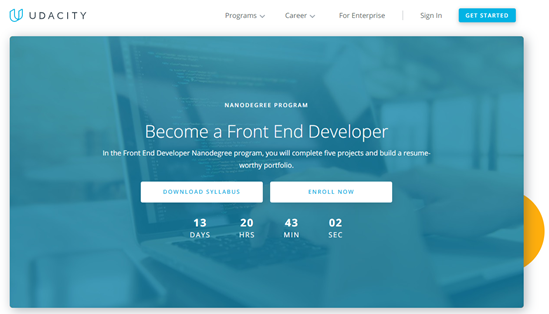
How to understand which of the courses found are better? There's no universal recipe; it all depends on the individual's goals, tasks, and qualities. However, I can offer some recommendations.
- Read reviews to find out what others think.
- Familiarize yourself with of the course, where the content, structure, techniques are described, and fragments are presented to evaluate how professional the course development approach is, whether the instructor explains the material clearly, and what additional mechanisms for self-control or automatic system monitoring are available.
By gathering these factors, you can determine whether it is worth taking this course.
Another common question is related to self-organization — only a maximum of 8% of listeners complete online courses. People look for solutions to specific problems and drop out of training as soon as they find them. Another reason is the course duration. Most people are sprinters by nature, and they find it difficult to run a long distance.
If you still want to finish your education, first of all, develop the qualities required for self-education:
- learn to plan your time;
- find the right motivation for yourself;
- invite friends to join you in your studies so that there is someone to discuss and dissect the material with.
The issue of self-organization is also effectively addressed when regular and final reporting is required before management or other parties. The certification system also works, but only in cases where there is a need to confirm status.
3. Seek experts
Look for people whose knowledge and experience you can rely on. Individuals from the industry who have established themselves as high-class professionals, willing to share their experience openly and without compensation. Think this is fantasy and that such people don't exist? They do. There are a couple of tricks you can use to find such individuals.
Refer to official sources—such as organizations that develop standards. They have working groups created to develop specialized content. Information about them is usually publicly available.
Let's take a specific example.
- Let's visit the website
- Navigate to Working Groups—
- Among them, select the one that interests us at the moment. For example, Cascading Style Sheets (CSS).
- Go to the Participants category and gain access to all organizations involved in developing these standards:
- Find invited experts—specialists recognized by the global community. Invited Experts:,
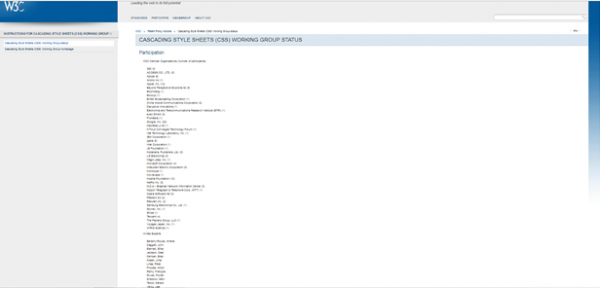
Experts in this field usually share their developments readily. You can find recordings of their talks, access lists of resources they utilized, view slides, and even the code they demonstrated. And learn from their example.
By the way, I particularly recommend Lea Verou—she has a plethora of 'delicious' developments that she shares publicly. Her example inspires a huge number of people around the world. I am no exception.
The second way to find experts is video hosting platforms where you can find recordings of conferences on the relevant topic. This or less well-known in our country , which holds many materials that simply are not available on YouTube at times.
And again, an example:
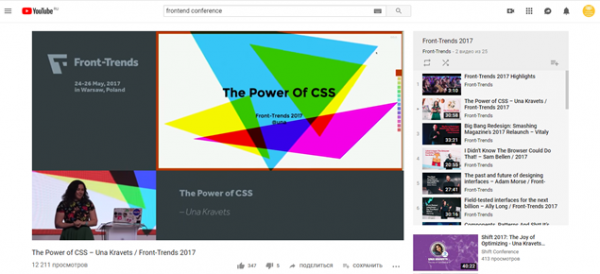
- Let's go to YouTube. Search for:
- An effective search works here as well, and it shouldn't be overlooked. Select: Filters → Channels
- And we get a list of channels dedicated to this topic.
- For example: Front-Trends → Playlists →
- Choose any speaker. Let's say, — she is a great expert with much to teach.
- Voila.
This is how you can find professionals in the necessary field and gain access to their work.
4. Make artificial intelligence work for you
Here, my advice is very simple and even somewhat contradictory in our 'Big Brother' era—leave 'digital footprints':
- Subscribe to channels so that you are offered 'similar';
- 'Like' and bookmark videos and materials;
- Follow the pages of professional communities that interest you on social media.
And based on your digital footprints, you will receive offers related to the topics you are interested in. This is an opportunity to join a professional community from which you will gain useful information and practical examples.
5. Read books
There is an opinion that with the abundance of information available online and countless online courses, reading books is becoming irrelevant. However, this is fundamentally incorrect.
Books are essential for gaining an extensive view on certain concepts, ideas, problems, and technologies. They broaden your horizons and are meant for deep study of the material.
However, reading should also be effective.
How to choose books to read?
For theoretical research, there are , regulations, etc.
If we are talking about technical literature, I follow a simple logic — I rely on recommendations from authoritative sources. By this, I mean recognized industry experts (I follow many of them on ), as well as respected electronic publications and specialized portals (for example, , , , ).
In general, I prefer practice-oriented sources. At the same time, it is very important for me that:
- the language of the exposition is simple and humanized (I love conversational books where questions are posed, and thoughts are stirred as you read),
- the quality of the formatted material. Of course, the content is more valuable. But the packaging allows one to make conclusions about the attitude that went into the book, provides insight into the time and effort spent to give the book life, and reflects the search for the right way of self-expression by the author (and the entire involved team) through the book. As they say, the devil is in the details. And I notice them closely.
Here are a few examples of books that I definitely recommend:
6. Use different tools
"I remember only what my hands do" — this is how the well-known educational principle "Learning by Doing" can be interpreted.
Sooner or later, you will need to apply all the accumulated knowledge in practice. Continuous practice is essential—find specific tools that allow you to organize such training most effectively.
Where can you find these tools?
By relying on one of the previous points—experts who share their working tools—you can discover interesting projects in their blogs and on the websites where they publish their materials. These projects allow you to practically apply new technologies and work techniques you are learning, as well as develop your own know-how. There are many such projects.
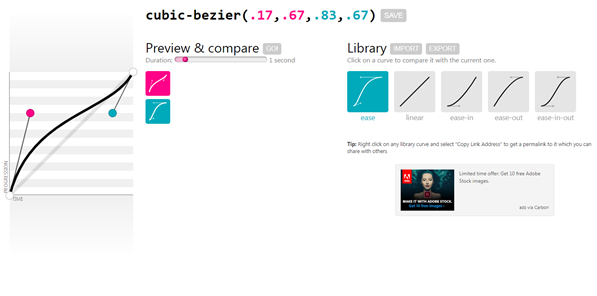
In animation, for example, the change of the animated property over time is described by a certain curve, or more precisely, a set of its parameters (coefficients). The most realistic animation effects, in terms of viewer perception, occur non-linearly over time (a quick look at the principles of animation established by Walt Disney confirms this). For example, an object starts moving gradually, then its speed increases, and eventually, it begins to slow down, and so on. Mathematically, such dependencies are described using Bézier curves.
Take a look at the interactive simulator where you can visually see how the shape of the curve affects the nature of the animation of an object's movement in space. The algorithm is as follows:
- Set ()
- Define the animation time as 1.5 to 2 seconds
- Run the test—it creates the correct animation effect: there is preparation for the beginning of the action, the action itself, and inertia at its conclusion.
Here are some more interesting examples:
I will elaborate more on a couple of the most illustrative examples, in my opinion.
- Password requirement compliance check :
The task: it is necessary for the form field used for user password input to accept only sequences of at least 6 characters long, containing at least one digit, one letter (regardless of case), and any symbol. The validation should occur on the client side using standard browser tools (for this purpose, the, the value of which is a regular expression).
:
- /^.{6,}$/ — любые 6 символов
- /^(?=.*d).{6,}$/ — из них хотя бы одна цифра
- /^(?=.*d)(?=.*[a-z]).{6,}$/i — из них хотя бы одна буква (регистр не важен)
- /^(?=.*d)(?=.*[a-z])(?=.*[W_]).{6,}$/i — из них хотя бы один символ (не буква и не цифра)

- Another example — patterns gallery : it's simply amazing how code turns into a geometric pattern!
Sequence of actions:
- Scale 90%
- Zig-zag — background code

The main idea is to use various tools available on specialists' sites that allow you to hone your skills completely for free.
7. Become an expert
Once you've gained some experience, take it to the next level — become an expert yourself.
How to do it? Easy.
Remember the story about the teacher: "I've told them three times, I understood everything myself, but they still don’t get it"? You need to convey your knowledge to solidify it. As a tool, I suggest using StackOverflow. It's a specially created resource where developers seek answers to their professional questions. They get responses from other developers. This way, a vast base of problems is gathered, each one with a solution. You can become an author of answers to these questions, diving into specific topics and sharing your experience.
You're killing two birds with one stone: firstly, you learn to solve the issue yourself. Secondly, you learn to explain the algorithm of the solution, thereby securing your new knowledge more reliably in your memory.
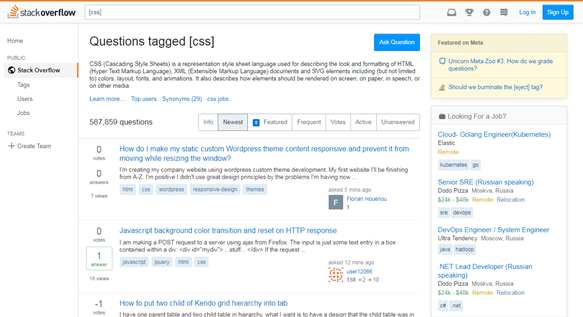
Sequence of actions on
- In the search field, enter a query — for example: CSS
- As a result, we have a list of all questions tagged "CSS"
- Go to the Unanswered tab. And we get
Or:
- Proceed in the same manner.
Don't forget about — a network of websites for questions and answers in various fields, and also a local resource (thanks, , for the tip).
Summary
I've shared some simple techniques that will help you "learn how to learn" and make the self-education process more effective:
- Search efficiently.
- Learn from massive online courses (and complete them).
- Look for experts from whom you could borrow experience, to whom you could talk and consult.
- Leverage the power of artificial intelligence: leave "digital footprints" for it to work for you, broadening your professional network and perspective.
- Read books. Approach your selection thoughtfully. Those authored by writers who challenge you with questions and stimulate your thinking will be the most beneficial. Don't forget about the aesthetic aspect: reading should not only provide intellectual pleasure.
- Practice using various tools that experts have to offer. Don’t hesitate to experiment.
- Finally, become an expert yourself to apply the knowledge you’ve accumulated in practice.
You might wonder: what's the purpose of training centers then?
I’ll answer:

There are openings at the Network Academy!
Source: habr.com
