

- The transition to Windows 10 allowed HP Inc. to increase revenue from corporate computer sales by 7 percent, and this factor will remain in the second half of the year.
- The shortage of Intel processors has hit sales of budget laptops the hardest, but the company is currently more interested in promoting higher-end products.
- The direct shortage of Intel processors may persist until the end of July or September; both scenarios are possible.
- China remains a strategically important market for HP Inc., but the company is not rushing to succumb to general panic — especially since revenue growth there had slowed down even before the escalation of relations with the U.S.
Regularly challenging Lenovo for the status of the world's largest PC manufacturer, HP Inc. reported this week on the results of its second fiscal quarter, which ended on April 30. It is well known that the personal computer market is shrinking, and even in the laptop segment, the previous dynamics are no longer present, although most of the new computers sold today can be considered mobile. Taiwanese laptop manufacturers have firmly established themselves in the gaming device niche, while giants like HP Inc. are left to collect dividends from the corporate segment.
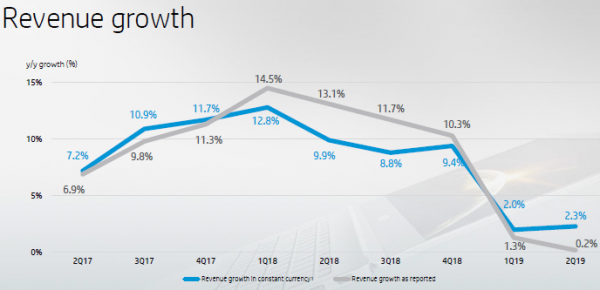
While HP Inc. managed to maintain revenue at the level of the second quarter of the previous fiscal year, net profit decreased significantly. Moreover, over the past couple of years, the revenue growth rate for HP Inc. has almost approached zero, and without active cost-cutting measures, it would not have been possible to achieve the current profit level. Like many market players, HP Inc. is trying to maintain profit margins amidst declining sales volumes by releasing more expensive products, but this type of business does not provide significant margins, and it is not easy to maneuver in this regard.
Migration to Windows 10 has been a steady source of revenue all year.
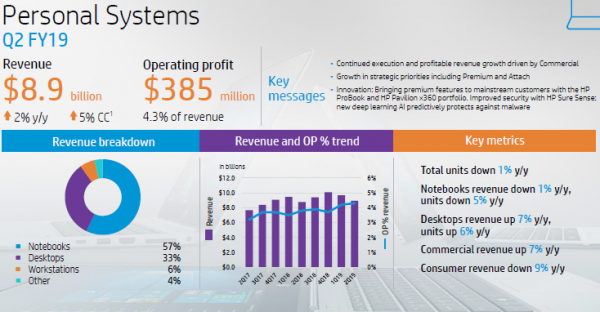
In natural terms, the sales volumes of the Personal Systems division decreased by one percent over the year, with the laptop segment seeing a decline of 5%, leading to a 1% drop in revenue for that category. However, the desktop segment experienced growth in both sales volumes (by 6%) and revenue (by 7%). In other words, revenue grew at a rate faster than sales, indicating a shift in the sales structure towards more expensive computers. Overall, revenue from the sale of finished PCs and laptops in the corporate sector increased by 7%, while the consumer segment showed a decline of 9%. The company tends to explain this latter trend as a result of "general demand weakness," while the uptick in the commercial segment is attributed to the ongoing migration to Windows 10. In the second half of the year, this factor will continue to be relevant, but in 2020, HP Inc. advises not to rely on it.
At the end of the first quarter of the calendar year 2019, HP Inc. held approximately 23.2% of the PC market, which is 0.5 percentage points higher than the same period last year. Gartner analysts noted this trend and made an important clarification: the shortage of Intel processors has helped major PC manufacturers strengthen their positions, as they received preferences from Intel for fulfilling component supply orders in comparison to smaller market players.
It doesn't matter how long the processor shortage will last; what matters is which specific processors are affected.
In general, HP Inc. representatives hold somewhat ambiguous views on the impact of Intel's processor shortage on their business. On one hand, they confirm that the processor shortage limited sales volumes of low-cost laptops in the past quarter. They also believe that the shortage will persist until the end of the third fiscal quarter, which will last until July in the company's calendar. On the other hand, HP Inc. representatives refer to Intel's own forecasts regarding the duration of the shortage, which indicate ongoing issues with processor availability until the end of the third calendar quarter—meaning until September.
We can recall how two other component suppliers commented on the shortage of Intel processors when they recently published their quarterly reports. AMD, for example, stated that significant market capture opportunities have not been unlocked by the existing "local discrepancies", but external analytical agencies note that AMD has strengthened its positions particularly in the laptop segment over the past year, with a sharp increase in the sector of affordable laptops powered by Google Chrome OS, as Intel was unable to supply their manufacturers with processors in necessary quantities.
NVIDIA discussed the shortage of Intel processors in the context of the early stages of the Max-Q gaming laptop expansion, which can hardly be classified as cheap due to the use of discrete graphics. The head of the company believes that the main part of the problems with the availability of Intel processors is already behind them, but in the quarterly report on Form 10-K, the corresponding risk extends its effects until the end of the second fiscal quarter — again, somewhere until the end of July.
Thus, even if the shortage of Intel processors persists until mid-year or early autumn, HP Inc. will suffer less from it than smaller manufacturers. Its scale of production has always allowed it to negotiate with Intel on special terms, and the desire to produce more expensive computers enables it to rely less on supplies of cheaper processors, which are the most limited under the current conditions.
Not by China alone
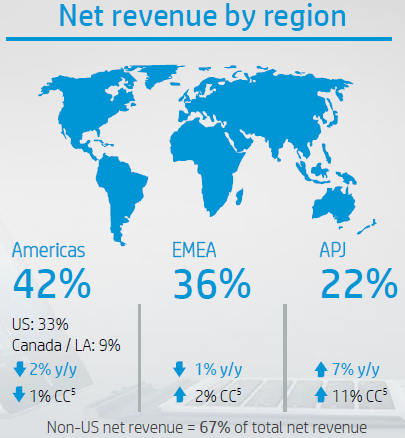
All attempts by experts present at the quarterly earnings conference to discern HP Inc.'s management's stance on trade sanctions and the situation surrounding U.S.-China tensions encountered cold rationality. Firstly, in the Asia-Pacific region as a whole, HP Inc. accounts for no more than 22% of total revenue. Although China is considered a strategically important market for the company, there has been a noticeable slowdown in revenue growth there recently, with Japan, for instance, moving ahead in this regard. On the other hand, HP Inc.'s gaming products are popular in China, and the market there has good growth potential.
Secondly, the corporation's management urges caution in drawing conclusions about the impact of American sanctions on Chinese-made goods. The company can organize the assembly of its computers for the U.S. market in many other countries, as this activity is not highly concentrated in China, unlike some other manufacturers. It is still uncertain which specific goods will be subject to increased tariffs, when they will come into effect, and whether they will be imposed at all. HP Inc. prefers to assess the situation based on specific actions taken by the U.S. authorities and is currently not ready to evaluate their impact on its own business.
Source: 3dnews.ru
