

In 1502, Sultan Bayezid II envisioned building a bridge over the Golden Horn to connect Istanbul with the neighboring city of Galata. Among the responses from leading engineers of the time, a particularly original project stood out from the well-known Italian artist and scientist Leonardo da Vinci. Traditional bridges of the time had noticeably curved arches with multiple spans. For the bridge over the bay, at least 10 supports would have been necessary, but Leonardo sketched a bridge design 280 meters long without a single support. The Italian scientist's project was not accepted. We cannot see this marvel of the world. But was this project feasible? Engineers from MIT answered that question by creating a scale model based on Leonardo's sketches. a scale model of the bridge at 1:500 and tested it under a full range of possible loads.
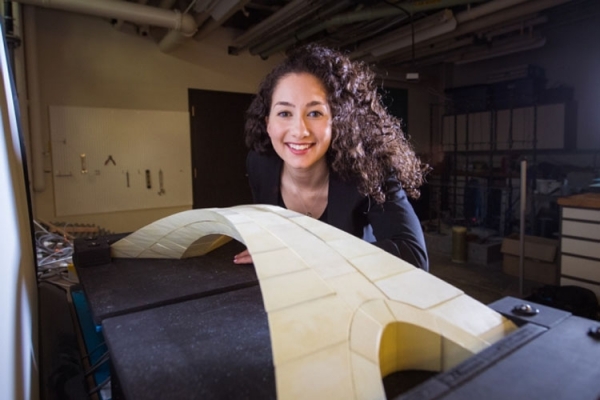
In reality, the bridge would have consisted of thousands of hewn stones. There was no other suitable material at that time (researchers attempted to closely replicate the bridge construction techniques available then and the materials on hand). To create the bridge model, modern specialists used a 3D printer and divided the model into 126 pre-shaped blocks. The stones were sequentially placed on scaffolding. After placing the keystone at the top of the bridge, the scaffolding was removed. The bridge remained standing and would likely have lasted for centuries. The Italian scholar of the Renaissance considered everything: from the seismic instability of the region to lateral loads on the bridge.
The flattened arch shape chosen by Leonardo allowed for navigation through the bay even by sailing ships with raised masts, while the design that spreads to the base ensured stability against lateral loads and, as experiments with the scale model showed, seismic resilience. Movable platforms at the base of the arch could shift significantly without collapsing the entire structure. Gravity and no fastening using mortar or fasteners—Leonardo knew what he was proposing.
Source: 3dnews.ru
