

Hello! We are starting the publication of reports from QIWI Kitchen, and the first one will be a presentation by Absamat about his subscription art service. The floor is yours, speaker.
My name is Absamat, I am a partner at the service design agency Useful, and I am also working on the DaiDa service, which allows people to rent pieces of art, namely — paintings by various artists.
In this post, I will share our experience with you: from the idea to the beginning of product creation, about our mistakes, and generally how it went.
There is a notion called PMF, product/market fit. There are many definitions for it; in short, it is the alignment of your product with market expectations and audience needs. It’s about how necessary it is and whether it will be in demand. Understanding whether you have achieved PMF is simple — if you see consistent and exponential user growth and understand what drives it — you have PMF, and it’s hard to be mistaken.
As a startup, we haven’t found PMF; we are still in the process. And as for the idea, it all started like this.
A year ago, within our agency, we conducted a large market research on contemporary art and identified a number of trends. Firstly, we noticed the democratization of this market as a whole. Secondly, we discovered a niche for affordable art and realized we needed to explore this topic further. In accordance with all service design guidelines, we consulted all market players — gallery owners, consumers, and artists. The result was three main questions we aimed to answer during the prototyping stage.
The first question: how to transform a classic gallery into a contemporary art style, creating an alternative to brands like Zara in this market.
The second question: how to solve the problem of free and already occupied walls. People usually have a limited number of walls in their apartments, and even less free space on these walls to hang something beautifully. Walls may already display shelves, calendars, photographs, TVs, and LCD panels. Or even other paintings that are already permanently hung. Therefore, people didn’t need new paintings because they either simply had no space to hang them, or they didn’t know how to match a new piece to the existing bare wall.
And the third question: how to strengthen the position and add some interactivity for the audience, because this market needs a push. And quite an active one.
Solution
We found the solution in the format of offering art pieces through a renewable subscription. Yes, this is not something completely new that no one has done before; we synthesized the best practices from existing industries here. It’s a marketplace, companies from the sharing economy (Uber, Airbnb), and the Netflix business model, where you simply pay once a month for content access.
Currently, this is how it works. A user visits the website, selects an art piece they like, and we deliver and hang it for them. The painting stays in their home for a month, and after that, they can either extend the subscription for the same amount and keep the art piece for another month or go back to the website and choose something else within the subscription. Then, within 3 days, the previous picture will be picked up, and a new one will be delivered in its place.
Idea
To choose the idea with which you will start creating the product and entering the market, it will be useful to start with this.
- Explore innovative business models. It sounds obvious, but it’s important.
- Research the users. This is a must-have; these are the people who will ensure the viability of your service. Or not.
- Immerse yourself in the industry. Usually, successful startups are so because their co-founders have worked in industries related to the startup's theme in one way or another. This means they have the necessary background and are well immersed in the market.
The importance of research should also not be overlooked; this is a case where it's better to spend an extra month conducting a series of studies than to save that month in pursuit of early sales.
After we came up with all this, a year went by. A whole year with this idea during which I did nothing. And as practice shows, time is a good filter for ideas. If you have some idea, you continue living as before, then after some time you return to this idea and realize that it is still relevant and a great idea—then it is definitely worth spending time and resources on.
How to make the decision
Here I can give my own example. The first thing I did was find like-minded people. This may also seem obvious, but without the right people who share your ideas and want to bring them to life, everything becomes much more complicated. Whether it will even work at all is another question.
In our team, Maksim is responsible for content; he is the person behind the art collective Sense. He also has valuable experience in product design, as he is a product owner in another project of ours. We have an IT specialist, Vadim, whom we met at a service design jam. De-facto, our entire team operates in a design format, so all participants are aligned with the current vision.
We began assembling the MVP (how could we do without it) and decided to do it right. When you're just starting out, you really want to do everything as correctly as possible so that later you only spend time on refinements and improvements, not on fixing what you did wrong. We formulated the main hypotheses and went to test them.
The first hypothesis was that a Hedonist (one of our target audience profiles) would be willing to pay 3,000 rubles per month for using the service. From this, we calculated the metrics—let's say we expect 7 purchases in the first 3 weeks. This means we can further explore user development, identify different contexts, and more. We used the simplest channels, landing pages and Facebook, just to assess whether anyone actually needs this or not.
By the way, we had a fairly solid backlog; our product designer ran UX/UI tests, and I handled the product testing itself. This is how we formed our CJM and blueprint service. This is one step I recommend everyone to take—it helps synchronize the team well. You will immediately identify strengths and weaknesses, understand where you might be falling short, what things you poorly thought through, and so on. A blueprint will help you align your internal processes with the user journey.
Product Launch
After all of this, we decided to launch. The golden rule of a product owner states: "If you've launched your product and you’re not ashamed of it, then you launched too late." Therefore, we aimed to launch as early as possible. So that there might be some shame, but not too much.
We received a lot of positive feedback, and it did exactly what it usually does — it dazzled us. Everyone who learned about the service praised us, even established entrepreneurs. A wave of reposts began, and people started writing about us, and these were not paid publications, but messages like, "Guys, you’re great, can we write about you?".
This went on for three weeks, and then we looked at the overall result.
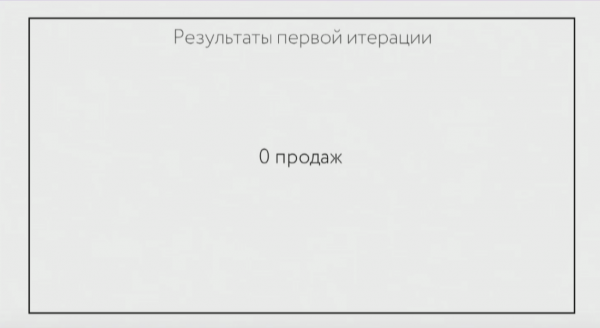
This was quite sobering and brought us back to reality. Of course, when everyone says that the service is cool, that’s good. But if at the same time no one is buying anything — something needs to be done.
Errors
In my opinion, the first mistake was that we set metrics as our goal instead of feedback. So, if 7 people buy a subscription, it means our hypothesis is correct, and we based our decisions on that. We should have understood how to act in that moment in order to refine the hypothesis itself. That’s how a service should function.
The second mistake is related to the website. We took references from the websites of direct competitors in the art market here. And these were not the most advanced sites. We decided to fix this by referencing the most innovative sites on the topic. This actually helped us increase conversion.
We tried to understand why, despite all this, the number of sales was landing on a round number (0). We had little data and tried to test everything possible. Ads on Facebook, asking for feedback from friends, even if they weren’t the target audience, would still provide useful feedback. The main thing is to gather as much feedback as possible; you can’t have too much. More feedback means more new hypotheses to test — better service.
A significant milestone was collecting information with the help of bloggers. When we started advertising with them, they offered to do more for us. So, we asked them to post surveys asking users why they visited the site but didn’t make any purchases. Almost all feedback, regardless of the sources, pointed to a major issue — lack of content.
So keep in mind, if you are dealing with any content in your project — content is the first thing to pay attention to.
Second iteration
Focusing on content, we took a step back. We remembered what makes a platform a platform — it’s when you simply connect the target audience. That is, artists upload their works to the site, and users choose what they want to buy. We don’t participate at all in the production of this content. The platform principle allowed us to sell what we have as a unit of value (a work of art).
After that, we managed to fine-tune a few things using the lean canvas, especially what was lacking in the channels. Now we’ve formed several hypotheses, allowing consumers to vote for their favorite works on the site, checking all of this within the context of customer development. The work on the platform is now fully in the hands of the user. We made it so that people choose what interests them, what they like, and this now shapes their feed of experiences. However, we are not involved in this process at all and do not curate it.
Curatorship itself as an entity is currently applied specifically as an entry moderation process for the works — the curator reviews the incoming flow of applications and admits (or does not admit) certain works to the platform. If there is doubt, we launch a test — we post the work on Instagram and allow users to vote on whether or not this work should be on the site. If it receives 50 likes, it gets onto the platform.
In the current prototype, we are testing a couple more themes. When enough works are gathered for analysis, we can use Google's technologies to recommend other works that users might like and that most closely match their choices.
Not just online
A service of this kind also involves offline interaction with the user. For us, this experience is no less significant than designing interfaces and other elements. Here we deliver works to our clients.
Let's get to the point. It's essential to understand where your product begins and where it ends. Designers today often focus solely on digital aspects, neglecting the user experience in physical spaces. In my opinion, that's a flawed approach. Therefore, I would like to encourage designers to broaden their horizons by designing platform business models and digital experiences. You'll see how your perception of the product will change.
And you'll see satisfied users.
What's happening now:
- We've developed , where a one-month subscription costs 990 rubles, 3 months — 2490 rubles, and 6 months — 4900 rubles.
- Within custdeva, we realized that our service is very relevant for those who have recently moved or made renovations.
- We started working with office spaces.
- We added content and in the catalog to simplify the discovery process for users.
Thank you!
Source: habr.com
