

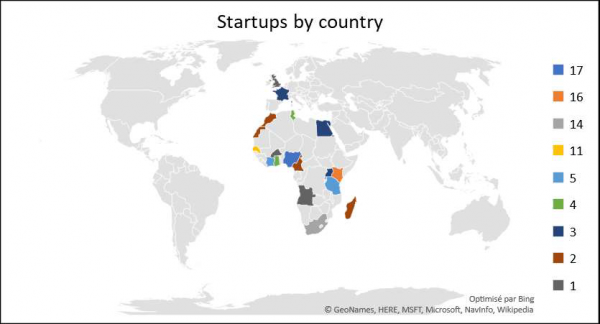
There is a strong stereotype about the backwardness of the African continent. Yes, there are indeed a vast number of problems. However, IT in Africa is developing rapidly. According to the venture firm Partech Africa, in 2018, 146 startups from 19 countries raised $1.16 billion. Cloud4Y has provided a brief overview of some of the most interesting African startups and successful companies.
Agriculture
Agrix Technology
, based in Yaoundé (Cameroon), was founded in August 2018. The platform, which is based on artificial intelligence, aims to help African farmers combat pests and plant diseases from their sources. The technology aids in identifying plant diseases and offers both chemical and physical treatments as well as preventive measures. With Agrix Tech, farmers can access the app on their mobile phones, scan a sample of an affected plant, and then find solutions. The app features text and voice recognition technology in local African languages, making it accessible even to those with limited literacy. Farmers living and working in remote areas without internet access can use the app because Agrix Tech's AI does not require internet to operate.
AgroCenta
is an innovative online platform from Ghana that allows small farmers and farming organizations in rural farming communities to access a broad online market. AgroCenta was founded in 2015 by two former employees of the mobile operator Esoko, who wanted to simplify market access and access to financing. They recognized that the lack of access to a structured market forced small farmers to sell their products to intermediaries at 'ridiculously exploitative' prices. The lack of access to financing also means that farmers will never be able to move from subsistence farming to a medium scale or even grow to industrial levels.
The AgroTrade and AgroPay platforms address these two issues. AgroTrade is a comprehensive supply chain platform where small farmers are on one end and large buyers are on the other, allowing them to trade directly. This ensures that farmers receive fair prices for their products and enables them to sell in bulk, as the buyers are typically very large companies, from breweries to feed manufacturers.
AgroPay, a financial accessibility platform, provides any small farmer who traded on AgroTrade with a financial ('banking') statement that they can use to gain access to financing. Some financial institutions specializing in funding small farmers have used AgroPay to better understand which farmers are eligible for loans. In a short time, according to the company's leader, the income of farmers in the network has increased by nearly 25%.
Farmerline
— another startup from Ghana that provides small farmers with access to information services, products, and resources to increase their incomes. To date, over 200,000 farmers have registered. In June 2018, Farmerline was one of three startups awarded the King Baudouin African Development Prize, receiving €75,000. The company was also selected to join the Swiss multi-corporate accelerator Kickstart and was named the second-best startup in the food industry.
Releaf
— an agri-tech startup from Nigeria that helps increase the sales volume of agricultural products through an efficient supply chain for the raw materials needed by the country's agricultural enterprises. Releaf builds trust among stakeholders in agribusiness by allowing registered sellers to bid for verified contracts with buyers. The startup emerged from stealth mode in August 2018, announcing that it had already verified over 600 agribusinesses and facilitated more than 100 contracts. Soon after, it was selected to join Silicon Valley's Y Combinator accelerator, resulting in $120,000 in funding.
Food Products
WaystoCap
— a trading platform from Casablanca (Morocco), launched in 2015. The company enables African businesses to buy and sell products – allowing them to find products, verify them, obtain financing and insurance, manage their supplies, and ensure payment security. The company prides itself on providing small businesses with the necessary tools and support to trade at local and international levels in a short time. It is the second African startup selected to join the Y Combinator accelerator from Silicon Valley and has received $120,000.
Vendo.ma
— another Moroccan startup that allows users to search for products and services in popular online and traditional stores. The company was founded in 2012 when e-commerce started to gain traction in the country. The 'smart' search engine easily identifies user needs and allows them to refine their search by adding tags, setting a maximum or minimum price, and finding stores on an interactive map. Due to its rapid growth, the startup secured $265,000 in seed funding.
Finance
Piggybank/PiggyVest
, also known as PiggyVest (implying a piggy bank) — is a financial service that helps Nigerians curb their spending habits, improving their saving culture by automating deposits (daily, weekly, or monthly) to achieve specific savings goals. The service also allows users to lock away funds for a specific period. Through PiggyVest, people learn to manage their money wisely and even invest. A real problem for many Africans is that money quickly disappears without a trace. PiggyVest helps individuals save something.
Kuda
(formerly Kudimoney) — a fintech startup from Nigeria, established in 2016. Essentially, it is a retail bank, but operating solely in a digital format. Much like the domestic Tinkoff Bank and its counterparts. It is the first digital bank in Nigeria with a separate license, which sets it apart from other financial startups. Kuda offers current and savings accounts with no monthly fees, a free debit card, and plans to offer consumer savings and P2P payments. The startup raised $1.6 million in investments.
Sun Exchange
— a blockchain startup from South Africa that emerged in 2015. It was named the winner of the Blockchain Challenge organized by the Smart Dubai office and received funding of $1.6 million. The company was also offered to install several 1 MW solar panels on the roofs of some higher educational institutions in Dubai. The startup aims to help people start investing in solar energy, obtain stable income, and promote the growth of 'green' technologies around the world. The platform uses a crowd-sale principle, similar to crowdfunding, but primarily uses digital assets instead of real currency. Sun Exchange allows minimal investments in energy projects. Individual solar panels can be purchased within small solar power plants, and owners of such energy sources can receive their share of the income from the electricity they generate.
Electrification
Zola
— a company from the city of Arusha (Tanzania) recently named Zola. The company operates in the solar energy sector, promoting innovative eco-friendly technologies in impoverished rural areas where kerosene lamps, deforestation, and lack of permanent electricity supply are prevalent. The Tanzanian startup Off Grid Electric installs affordable solar panels on rooftops for energy production in rural African areas, asking only $6 for them (the set includes a meter, LED lamps, a radio, and a phone charger). Additionally, the same $6 is required monthly for maintenance. Zola supplies solar panels, lithium batteries, and lamps directly from the manufacturer to end customers, significantly reducing product costs. This way, the company combats poverty and environmental issues in rural Africa. Since 2012, Off Grid Electric and then Zola has attracted over $58 million from international investors, including Solar City, DBL Partners, Vulcan Capital, and USAID — the U.S. Agency for International Development.
M-Kopa
— a Kenyan startup competing with Zola, helps households that are not connected to electricity. The solar panel capacity sold by M-Kopa is enough for two bulbs, a radio, and charging a flashlight and a phone (all except the last are included with the battery). The user pays about 3500 Kenyan shillings (approximately $34) upfront, and then 50 shillings (about 45 cents) daily. M-Kopa's batteries are used by over 800,000 homes and businesses in Kenya, Uganda, and Tanzania. In six years of operation, the startup has raised over $41 million in investments. Major investors include LGT Venture Philanthropy and Generation Investment Management. According to Jesse Moore, CEO and co-founder of the company, M-Kopa customers are expected to save $450 million over the next four years as they receive lighting without relying on kerosene.
Trade
Jumia
— yet another startup from Lagos, Nigeria (yes, they not only know how to write scam letters but also excel in IT) ). It is essentially analogous to the well-known Aliexpress, but more convenient in terms of the services offered. Five years ago, the company started with selling clothing and electronics, and now it is a large marketplace where you can buy everything from groceries to cars or real estate. Jumia also offers convenient job search and hotel booking services. Jumia operates in 23 countries that account for 90% of Africa's GDP (including Ghana, Kenya, Côte d'Ivoire, Morocco, and Egypt). By 2016, the company had over 3,000 employees, and in 2018, Jumia processed over 13 million orders. The company attracts not only African but also international investors. In March last year, it received $326 million from a pool of investors, including Goldman Sachs, AXA, and MTN, becoming the first African unicorn valued at $1 billion.
Sokowatch
— an interesting startup from Kenya, launched in 2013, increases the availability of everyday consumer goods by allowing small shops to place orders from various international suppliers at any time via SMS. Orders are then processed through the Sokowatch system, and courier services are notified to deliver the order to the store within the next 24 hours. Using accumulated purchasing data, Sokowatch assesses retailers to provide them with access to credit and other financial services typically unavailable to small businesses. Sokowatch was named one of the three winners of the Innotribe Startup Challenge and developed in the World Bank's XL Africa startup accelerator.
Sky.Garden
from Kenya effectively represents a startup platform offering "software as a service" () for small commerce, created specifically for African businesses. The user-friendly online store Sky.garden allows individuals, small entrepreneurs, and companies of various sizes to sell their products. A few months after its launch, the startup demonstrated a steady 25% monthly growth in order volumes. This made it possible for it to participate in a three-month development program of the Norwegian accelerator Katapult with financial support of $100,000.
Entertainment
Tupuka
— an Angolan startup that offered a unique food delivery service for the country. Launched in 2015, it became the first platform in Angola that allows users to order from multiple restaurants directly from their smartphones. The company now has over 200,000 active customers. Interestingly, at the very beginning of its development, the company failed to secure a prize at the Angolan stage of the Seedstars World startups competition. However, in 2017, they refined their solution and reapplied for participation. This time they won. Now the company offers not only food delivery but also medicines and shopping from supermarkets.
PayPass
— a Nigerian startup that organized the process of buying and selling tickets for any events in the country (seminars, public lunches, movie screenings, concerts, etc.). Users can create their own events, share them on social networks, register their audience, buy and sell tickets, with payments processed through a third-party payment processor, Paystack.
Technologies
Will&Brothers
— an interesting company from Cameroon that emerged in 2015 and actively creates startups. The most well-known and popular among them offers solutions for AI-based drones. The company developed AI 'Cyclops', capable of helping drones detect people, objects, and vehicles, as well as identifying various types of animals in specific locations. The project is called Drone Africa. Recently, the TEKI VR project was also launched, aimed at utilizing virtual reality technologies.
MainOne
— a popular provider from Lagos, Nigeria. The company offers telecommunications services and networking solutions throughout West Africa. Since its launch in 2010, MainOne has been providing services to major telecom operators, internet service providers, government agencies, small and large businesses, and educational institutions in West Africa. MainOne also owns the data center subsidiary MDX-i. MDX-i, as part of the first Tier III data center in West Africa and the only hosting center certified with ISO 9001, 27001, PCI DSS, and SAP Infrastructure Services, offers hybrid cloud services domestically. (Cloud4Y, as , simply had to include this company in the list :))
What else useful can be read in the Cloud4Y blog?
→
→
→
→
→
Subscribe to our -channel so you won’t miss another article! We write no more than twice a week and only when necessary.
Source: habr.com
