

Tidelift has published the results of a survey of over 400 maintainers of open projects. The most interesting findings include:
- 60% of maintainers of open projects do not receive payment for their work on project maintenance, with 14% considering this activity a hobby and not interested in receiving money for it, while 44% would not mind receiving funding. For 24% of maintainers, part of their earnings is related to this work, and for 12%, project maintenance is their main source of income. 24% receive payment as a salary from an employer, while 32% receive funds from external organizations or individuals (in 25% of cases, this is through donations via platforms like GitHub Sponsors, Open Collective, and Patreon, 5% are direct transfers, and 3% involve funds). Paid maintainers have assistants 74% of the time, while those who do not receive payment have assistants only 39% of the time.
- Maintainers spend 11% of their time on tasks related to ensuring security (up from 4% in 2021), 50% (down from 53% in 2021) on routine work, and 35% (up from 25% in 2021) on developing new features. Paid maintainers spend 13% of their time on security-related tasks, while unpaid maintainers spend 10%.
- 71% of maintainers (76% of those paid and 68% of those unpaid) use two-factor authentication, 65% (75% / 59%) use static code analysis tools, 60% (70% / 54%) work on creating patches to fix vulnerabilities, 36% (50% / 28%) sign releases with a digital signature, and 29% (37% / 23%) use secure build tooling.
- Practices used for maintenance include: 53% (51% unpaid) - reproducible or verifiable builds, 46% (34%) - rules for ensuring backward compatibility, 40% (24%) - a formalized process for managing dependencies, and 37% (33%) - code reviews by multiple participants.
- Documentation in projects: 93% document the license, 76% document release notes and upgrade recommendations, 61% provide guidelines for contributors, 53% create a code of conduct, 17% document conflict resolution rules, and 13% have a plan for when a maintainer leaves the project.
- 48% of maintainers feel their work is undervalued. 38% are considering leaving their role as a maintainer.
- After the backdoor incident in the xz library, 66% of respondents started to trust pull requests from developers who are not maintainers less, while 37% became less trusting of co-maintainers.
- 31% (9% — very positively, 22% — somewhat positively) of respondents view the influence of AI tools for coding positively, 45% (23% — very negatively, 22% — somewhat negatively) view it negatively, and 24% are neutral.
- 27% of respondents are unlikely to review and accept project changes made by AI tools, and 37% might be unwilling to accept such changes. Only 3% expressed a readiness to accept changes from AI (more likely) and 6% (possibly).
- 45% of respondents have been maintaining for more than 10 years, 24% for 6-10 years, 23% for 2-5 years, 7% for 1-2 years, and 2% for less than a year.
- 48% of maintainers live in Europe, 38% in North America, and 8% in Asia (in 2021, 24% were from Asia, 35% from Europe, and 35% from North America).
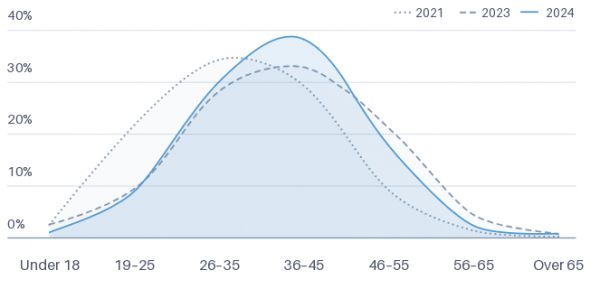
- There is an increasing age trend among maintainers — compared to 2021, the number of maintainers aged 46 to 65 has doubled (from 11% in 2021 to 27% in 2023, and projected to be 21% in 2024). The number of maintainers under 26 has decreased from 25% in 2021 to 12% in 2023 and 10% in 2024.
- Tidelift has published the results of a survey of more than 400 maintainers of open projects.

Source: opennet.ru
