

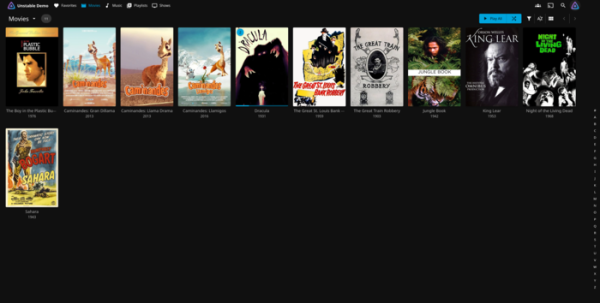
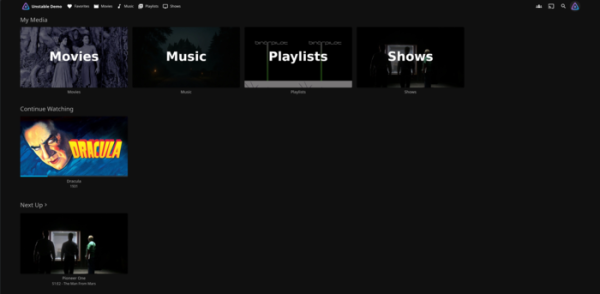
The Jellyfin 1.12 project release has been announced, allowing users to deploy a multimedia broadcasting system on their own servers for streaming existing content to user devices. The project was founded in 2018 as a fork of the Emby media server, continuing the development of the open code base after Emby's transition to a proprietary development model. The Jellyfin code is written in C# using the .NET platform and is distributed under the GPLv2 license. Client applications are provided for PCs, mobile devices, TVs, set-top boxes, and game controllers, as well as a web interface for configuring the media server, organizing online broadcasting, and managing the multimedia collection.
Video and audio streaming is supported; navigation through a collection of movies, photos, e-books, and music; viewing and recording of live TV if a TV tuner is available; synchronized simultaneous content viewing by multiple users (SyncPlay); automatic detection, cataloging, and sorting of content; downloading additional information (such as album covers and artist details); parental control features. Real-time format transcoding is possible with acceleration using Intel QSV, NVIDIA NVENC, and AMD AMF technologies, or video can be streamed in its original format if the client supports the required codec.
A client-server model based on the HTTP protocol is used for interaction with front-ends. Broadcasting is supported using HLS (HTTP Live Streaming), DLNA, and Google Cast protocols (for Chromecast). Functionality can be extended through plugins. The server can be run on Linux, macOS, and Windows. To simplify deployment, a pre-configured Docker container image is offered.
Among the changes in the new version:
- The database structure has been changed and optimized for storing playlists and collections (each item is now stored as a separate row in the table). The execution of resource-intensive database maintenance and library scanning operations has been separated.
- The web interface has been optimized, and freezing when opening certain pages has been eliminated.
- The main package now includes tools for working with eBooks. There is now the ability to extract data about books and comics from OPF, ComicInfo, and ComicBookInfo files. Plugins have been added for integration with OpenLibrary, GoogleBooks, and ComicVine. A separate section has been implemented in the web interface for navigation through authors and collections of eBooks.
- For series, the option to choose material variants (director's/theatrical version, 4K/1080p quality) has been implemented.
- The possibility of separate customization of the recommendation source and subtitle settings for each library has been added.
- The clients for PC and mobile devices have adopted a new Modern interface, while the old version has been renamed Legacy.
- The server has been migrated to .NET 10 (plugin rebuild required). The FFmpeg libraries have been updated to version 8.1.
Source: opennet.ru
