

The DRAMeXchange division of TrendForce its latest observation. TrendForce is a marketplace for contracting the supply of NAND memory and related products. The DRAMeXchange group uses this data while maintaining anonymity to provide a fairly accurate short-term price forecast, even over relatively longer periods. Fresh data and consideration of the market situation, as well as production plans from Samsung, SK Hynix, Intel, and Micron, give DRAMeXchange analysts grounds to make an intriguing conclusion. By the end of this year, specialists report, the price for each gigabyte of SSDs with capacities of 512 GB and 1 TB will drop to 10 cents and even lower. This will mark a historic low for SSD prices.
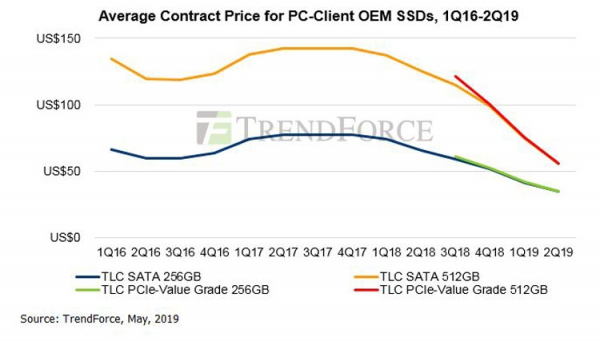
The reduction of the price of 512 GB SSDs to $50 or less will make this product the second most widely used after 256 GB SSDs. Additionally, 512 GB SSD models will replace the previously popular 128 GB models. Another related trend is the decrease in prices for mainstream SSDs with PCI Express interfaces to the price level of SATA SSDs. This phenomenon will result in the penetration rate of PCIe SSDs exceeding 50%.
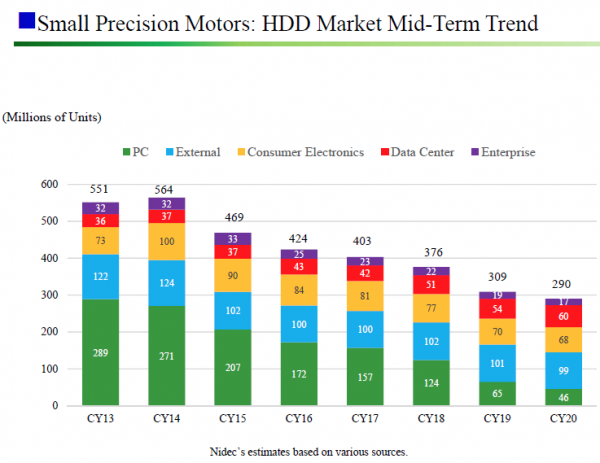
The use of SSDs in laptops, as noted by TrendForce, exceeded 50% back in 2018. Contract prices for 128, 256, and 512 GB SSDs have dropped by 50% from their peak in 2017 and are likely to fall below 10 cents per gigabyte by the end of this year. This is encouraging system builders and users to move away from 512 GB and 1 TB hard drives, which is clearly the motor manufacturer for HDDs, the Japanese company Nidec. Thus, the adaptation of SSDs in PCs in 2019 will reach 60–65%.
In the second quarter of 2019, the average contract price for SSDs decreased for the sixth consecutive quarter. Specifically, the average contract prices for mass SATA SSDs for OEM computers fell by 15–26% during the quarter, while the average contract prices for PCIe SSDs dropped by 16–37%. The decline in prices is attributed to overproduction, a high level of stockpiled products, increased market competition, and relatively weak demand for storage devices. Most manufacturers have transitioned to using 64/72-layer 3D NAND, while Intel has started price-cutting with its 3D NAND QLC (which writes four bits per cell). In the third quarter, new Apple products are expected to revive demand in the NAND market, but analysts do not anticipate any price increases; the further decline in NAND memory and product prices may slow down somewhat. Nevertheless, analysts promise "tasty" prices on 512GB and 1TB SSDs before the end of this year. We can only hope and wait a little longer.
Source: 3dnews.ru
