


In our recent many interesting details remained behind the scenes. Therefore, we decided to highlight the most important of them in separate publications. Today, we will try to answer the question of how salaries have changed for developers of different programming languages.
All data is taken from , where users specify the salaries they receive after all taxes are deducted. We will compare salaries by halves of the year, each of which has more than 7,000 salaries collected.
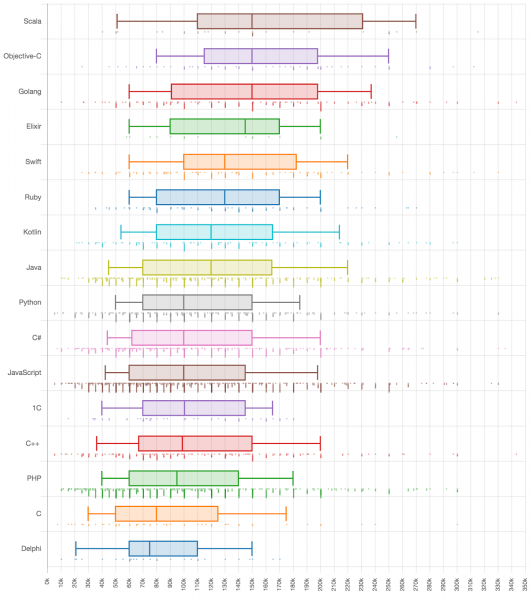
For the second half of 2019, salaries for the main programming languages are as follows:
the highest median salaries are for developers in Scala, Objective-C, and Golang — 150,000 rubles per month, followed closely by Elixir at 145,000 rubles. Next are Swift and Ruby at 130,000 rubles, followed by Kotlin and Java at 120,000 rubles.
The lowest median salaries are for Delphi at 75,000 rubles and C at 80,000 rubles.
All other languages have median salaries around 100,000 rubles or slightly below.
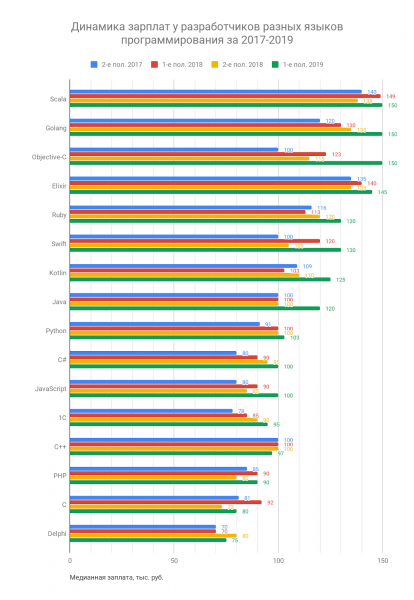
How long has this situation persisted? Have the aforementioned leaders always been in this position? Let's look at how the median salaries have changed for all the programming languages we studied over the past two years.
We see that while the median salaries for Scala and Elixir have increased only slightly, Objective-C and Go experienced a significant jump, allowing them to catch up with these two languages. Swift has, during this time, caught up with Ruby and slightly surpassed Kotlin and Java.
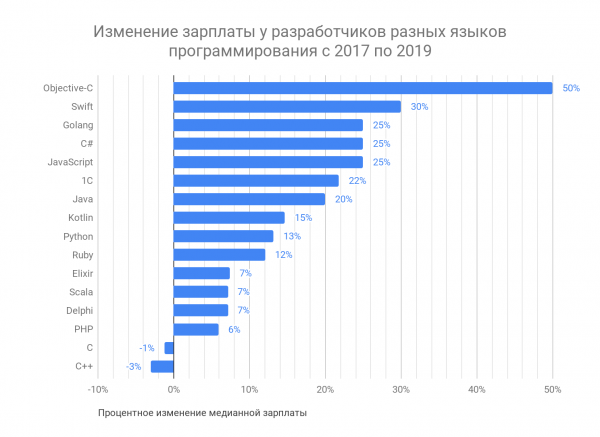
The dynamics of relative salaries across all languages are as follows: over the last two years, the greatest increase in median salary was for Objective-C — 50%, followed by Swift at 30%, then Go, C#, and JavaScript at 25%.
Considering , it can be said that the median salary for PHP, Delphi, Scala, and Elixir developers remains almost unchanged, while for C and C++ developers, it is clearly declining.
It's interesting to compare salary dynamics with the dynamics of the popularity of programming languages among developers. Based on data collected in our calculator, we calculated for each half-year the share of those who indicated each language compared to all who reported programming languages.
JavaScript is the most widely used, with around 30% citing it as their primary skill, and the share of such developers has slightly increased over the past two years. Next is PHP, with about 20%-25% proficient in it, although its share is steadily decreasing. Following closely are Java and Python, each with approximately 15% proficiency—while the number of Java specialists has slightly increased, the share of Python specialists has seen a slight decline. Rounding out the top most common languages is C#, with about 10-12% proficiency and an increasing share.
The rarest languages are Elixir, Scala, Delphi, and C, with 1% of developers or fewer being proficient in them. It is difficult to discuss the dynamics of their prevalence due to the relatively small sample size for these languages, but in general, it appears their relative share is falling.
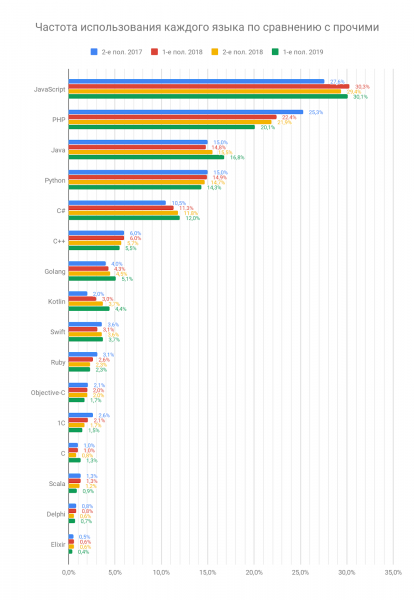
The following chart shows that over the past two years, the share of developers proficient in JavaScript, Kotlin, Java, C#, and Go has increased, while the share of PHP developers has noticeably decreased.
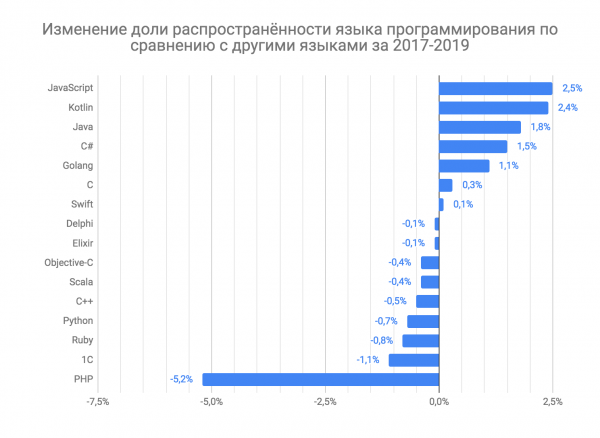
In summary, we can highlight the following overall observations:
- We see a simultaneous noticeable increase in salaries and the share of developers proficient in the languages JavaScript, Kotlin, Java, C#, and Go.It seems that the consumer market utilizing these technologies and the corresponding labor market are currently growing in sync.
- A significant increase in salaries and a small or nonexistent increase in the share of developers is observed in Objective-C, Swift, 1C, Ruby, and Python.It is likely that the consumer market leveraging these technologies is growing, while the job market is not keeping pace or is still using outdated technologies.
- Minimal or no growth in salaries and the share of developers is seen in Scala, Elixir, C, C++, Delphi.In this case, the consumer market and labor market utilizing these technologies are not growing.
- Minimal salary growth and a noticeable decrease in the share of developers is evident in PHPThe consumer market and labor market using these technologies are contracting.
If you like our salary studies and want to receive more accurate and useful information, don’t forget to share your salaries in our calculator, where we source all the data: .
Source: habr.com
