

We discuss the history of the programming tool OpenMusic (OM), examining its features and telling about its early users. Additionally, we provide analogs.
Photo / Unsplash
What is OpenMusic
It is an object-oriented for digital sound synthesis. The utility is based on a dialect of the LISP language — . It is worth noting that OpenMusic can be used as a universal graphical interface for this programming language.
The tool was developed in the 1990s by engineers from the French Institute for Research and Coordination in Acoustics and Music (). A total of seven versions of OpenMusic were released — the latest was published in 2013. At that time, an engineer from IRCAM, Jean Bresson,) rewrote the utility from scratch, using the of the sixth version (OM6). Today, OM7 is distributed under a license — its source codes can be found on GitHub. .
Programs in OpenMusic are created by manipulating graphical objects instead of writing code. As a result, a kind of flowchart is produced, called a ‘patch’. Similar to modular synthesizers, where patch cords were used for connections.
Example Program
Here In OpenMusic, there are two types of objects: basic and score objects (Score Object). The former represent various mathematical operations for working with matrices, columns, and text forms.
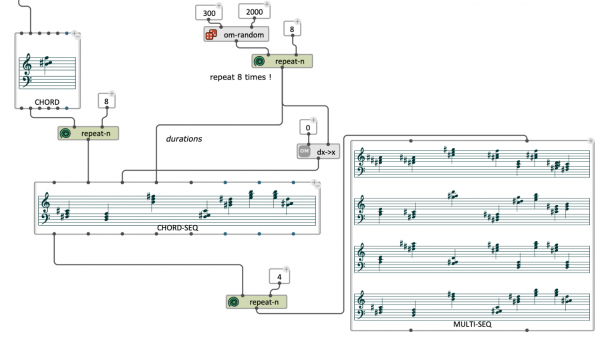
Score objects are necessary for working with sound. They can also be divided into two groups:
Harmonic — notes, chords, and
- harmonic sequences. .
- Score objects are controlled using score functions, for example, combining several components into one to create polyphonic sound. Additional functions can be found in plug-in libraries — a complete list
is available on the official website. .
in this video. :
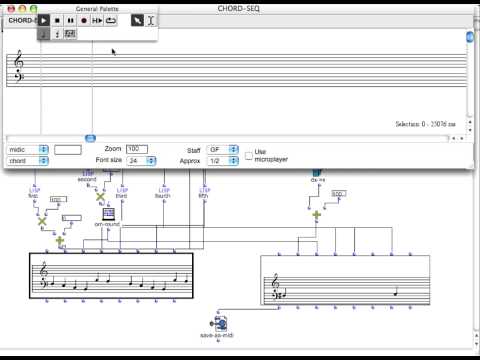
The guide for OM7 click on the link and in the left window expand the User Manual section.
Who uses
According to the developers' idea, OpenMusic can be used for creating and editing audio tracks, generating mathematical models of compositions, and analyzing recorded musical snippets. Engineers from ITCAM have applied the tool in several scientific studies. For example, for an artificial intelligence system that recognizes in audio recordings.
OpenMusic is also used by professional performers—they utilize the utility to study harmonic spectra. One example is the Swiss composer , who is a recipient of the Beethoven Prize. His works performed by the Hong Kong Symphony Orchestra can be .
. It is also worth noting . He is one of the leading composers working in the field of . For example, his works can be found on YouTube, including and , created using OpenMusic.
English composer and educator used OpenMusic to work with rhythm. Today, his music is part of the repertoire of major contemporary ensembles and performers— and .
Analogues
There are several systems similar to OpenMusic. Perhaps the most well-known is the commercial tool . It was developed by Miller Puckette in the late 1980s while he was working at IRCAM. The system allows for the real-time synthesis of digital sound and video.
In the video below, an installation on one of the buildings in the Italian city of Cagliari is presented. The color of the screens changes depending on the noise from passing cars. The installation is controlled by a combination of Max/MSP and Arduino.
It is worth noting that Max/MSP has an open-source counterpart. It is called , and it was also developed by Miller Puckette.
Another notable visual system is , which was created by Perry Cook and colleagues from Princeton University in 2003. It supports the parallel execution of multiple threads, and changes can be made to the program during execution. It is distributed under the GNU GPL license.
This list of tools for synthesizing digital music does not end here. There are also and , which allows programming mixes live on stage. We will try to talk about them next time.
Additional reading from our 'Hi-Fi World' and Telegram channel:


Source: habr.com
