

In previous posts, we discussed simple video surveillance systems in business; now we will talk about projects where the number of cameras reaches thousands.
Often the difference between the most expensive video surveillance systems and solutions that small and medium businesses can already implement lies in scale and budget. If there are no cost constraints for the project, you can start building the future in a specific region right now.
Solutions in the EU
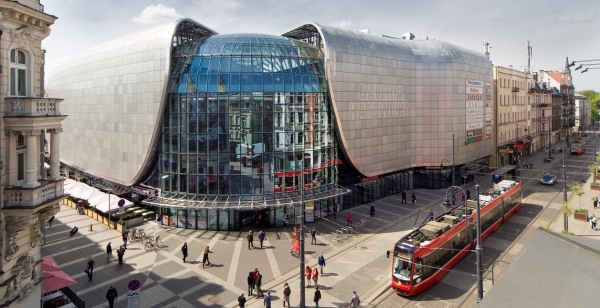
The Galeria Katowicka shopping complex opened in 2013 in the center of the Polish city of Katowice. The area of 52,000 m² houses over 250 stores and service company offices, a modern cinema, and an underground parking lot with 1,200 spaces. There is also a train station located within the shopping center.
Considering the large area, the managing company Neinver set a challenging task for the contractors: to create a video surveillance system that would fully cover the territory (without blind spots, to prevent various illegal activities, ensure the safety of visitors, and protect the property of retail companies and guests), store data about visitors, and count them in order to generate individual data on the number of visitors to each store. In this case, the complexity of the project can be multiplied by 250 — the number of observation points. In fact, this equates to 250 separate sub-projects. From our experience, placing even a single visitor counter can pose a challenging task when installing equipment without specialists' involvement.
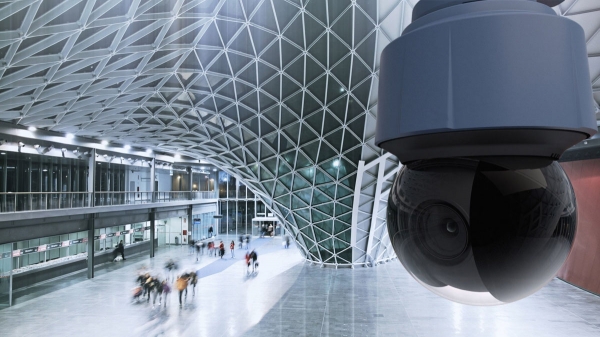
For the implementation of the project, IP cameras with integrated video analytics were chosen. One of the key features of the cameras was the ability to record information even in case of a connection loss with the server.
Since the shopping center has many entrances and exits, as well as numerous retail halls and utility rooms, several cameras needed to be installed in each area.
To ensure maximum quality and speed of signal transmission, a combined network structure was chosen, utilizing fiber optic cables alongside traditional twisted pairs. Throughout the building, 30 kilometers of cabling were installed during the installation works.
During the installation of the system, the designers encountered some difficulties that required unconventional approaches. Since the main entrance of Galeria Katowicka is in the shape of a wide semicircle, the engineers had to install ten cameras simultaneously to accurately count incoming visitors. Their operations and the incoming video had to be synchronized to avoid double counting the same visitor.
The challenge of integrating the counting system with the parking surveillance system proved to be quite complex: it was necessary to consolidate data from both systems into a unified report without duplicates and in a single format.
To monitor and verify operational performance, the video system is equipped with self-diagnostic and testing tools, allowing for accurate visitor data collection and quick equipment repairs.
The system in the Galeria Katowicka shopping center has become the largest commercial automatic people counting system in Europe.
The oldest video surveillance system in London
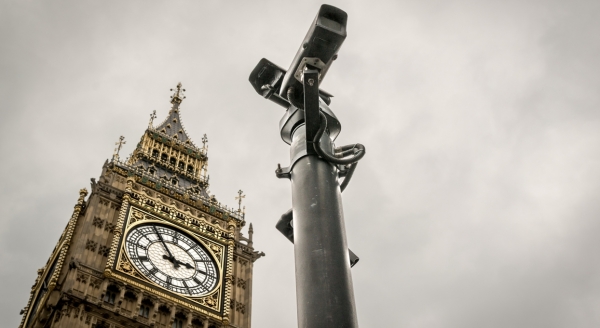
During the operation 'Vedan' (the investigation into the Skripal case), Metropolitan Police members reviewed, according to official data, 11,000 hours of various video materials. Naturally, they needed to present the results of their work to the public. This episode perfectly illustrates the scale that a video surveillance system can achieve with a virtually unlimited budget.
The London security system can undoubtedly be called one of the most extensive in the world, and this leadership is readily explained. The first video cameras were installed in 1960 at Trafalgar Square to maintain order during the visit of the Thai royal family, as a large gathering of people was expected.
To grasp the scale of London's video system, let's mention some impressive numbers provided by the British Security Industry Authority (BSIA) in 2018.
In London, there are about 642,000 surveillance devices installed, 15,000 of which are in the subway. That means there is roughly one camera for every 14 residents and visitors, and each person is captured on camera around 300 times a day.
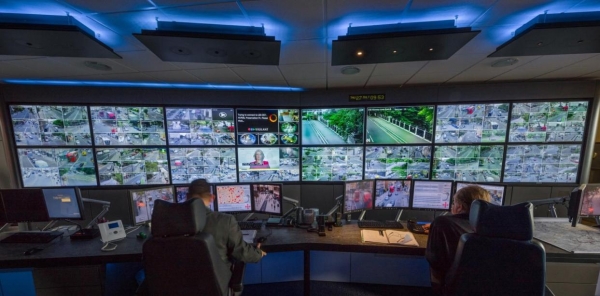
Two operators are constantly present in the dispatch center to monitor the situation in one of the districts of London.
All data from the cameras is sent to a special underground bunker, the location of which is not disclosed. This facility is managed by a private company in cooperation with the police and the local council.
The city’s surveillance system also includes private, closed systems located in shopping centers, cafes, stores, and more. There are about 4 million such systems in the UK, more than in any other Western country.
According to official data, the government spends about £2.2 billion to maintain this system. The system does its job well — it has helped the police solve about 95% of crimes in the city.
Moscow's Surveillance System
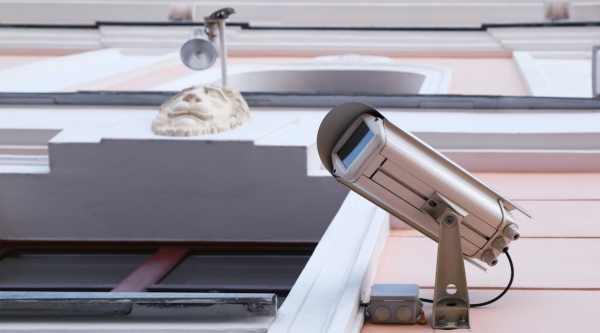
Currently, there are about 170,000 cameras installed in Moscow, of which 101,000 are in building entrances, 20,000 are in courtyard areas, and more than 3,600 are in public places.
The cameras are distributed in such a way as to minimize blind spots. If you look around carefully, you will notice that control devices are practically everywhere (most often at the level of the roof edge of buildings). Even the intercoms at the entrances of residential buildings have cameras that capture the face of the person entering.
All the city’s cameras continuously transmit images via fiber optic channels to the Unified Data Storage and Processing Center (UDSPC) — this is where the core of the city’s video system is located, which includes hundreds of servers capable of receiving incoming traffic at speeds of up to 120 Gbps.
Video data is transmitted via the RTSP protocol. For archival storage of recordings, the system uses more than 11,000 hard drives, with a total storage capacity of 20 petabytes.
The modular architecture of the software center allows for the most efficient use of hardware and software resources. The system is prepared for the most extreme loads: even if all residents of the city want to watch video recordings from all cameras at the same time, it will not "crash".
In addition to its primary function of preventing offenses in the city and assisting in their resolution, the system is widely used for monitoring courtyard areas.
Records from cameras installed in public places, commercial facilities, courtyards, and building entrances are stored for five days, while footage from cameras located in educational institutions is retained for 30 days.
The operational reliability of the cameras is ensured by contracting companies, and currently, the number of malfunctioning cameras does not exceed 0.3%.
AI in New York
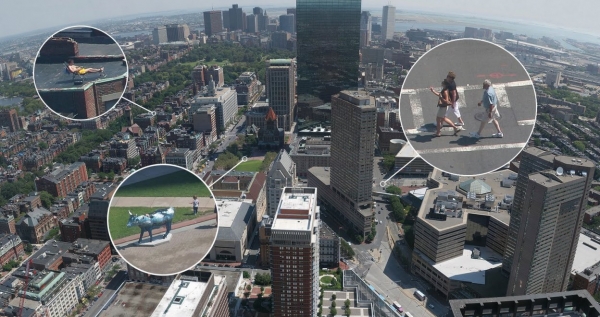
The scale of the video surveillance system in New York, despite the population of the "Big Apple" (about 9 million), significantly lags behind London and Moscow — the city has only about 20,000 cameras installed. The largest number of cameras are located in places with a high concentration of people — in the subway, at railway stations, on bridges, and in tunnels.
A few years ago, Microsoft implemented an innovative system — Domain Awareness System (), which, according to the developer, is expected to bring a real breakthrough in the activities of law enforcement and intelligence.
The point is that compared to a regular video surveillance system that transmits images from a specific area, DAS can provide police with a wealth of operational information. For instance, if a known offender appears in the controlled area, the system will recognize him and display all data about his criminal history on the operator's monitor, based on which he will decide what measures to take. If the suspect arrives by car, the system will track his route and inform the police.
The Domain Awareness System can benefit agencies fighting terrorism, as it allows for easy tracking of any suspicious individual who has left a package, bag, or suitcase in a crowded area. The system will completely recreate the entire route taken on the monitor screen in the situational center, so the police won't have to waste time on interrogations and searching for witnesses.
Today, DAS integrates more than 3,000 surveillance cameras, and their number continues to grow. The system is equipped with various sensors that respond, for example, to explosive vapors, environmental condition sensors, and a license plate recognition system. The Domain Awareness System has access to nearly all city databases, enabling prompt information retrieval about all objects captured by the cameras.
The system is constantly expanding and being supplemented with new functional capabilities. Microsoft plans to deploy it in other cities across the U.S.
The Great Chinese System
In China, there is even an 'analog surveillance network': over 850,000 volunteer pensioners, dressed in official red vests or wearing armbands, monitor suspicious behavior among citizens on the streets.
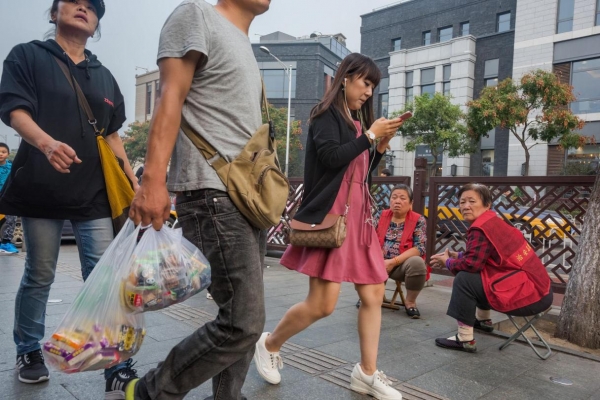
China has a population of 1.4 billion people, of which 22 million live in Beijing. This city ranks second after London for the number of installed cameras per capita. Authorities assure that the city is covered by surveillance 100%. According to unofficial data, the current number of cameras in Beijing exceeds 450,000, although there were only 46,000 back in 2015.
The tenfold increase in the number of cameras is due to the fact that the Beijing surveillance system recently became part of the national Skynet project, which was initiated 14 years ago. The creators of the project surely did not choose this name by accident. On one hand, it perfectly correlates with the well-known unofficial name of China — the 'Celestial Empire' or Tianxia. On the other hand, it evokes associations with the movie 'Terminator,' where a planetary-scale artificial intelligence system was named Skynet. We believe that both of these implications are valid, and you'll understand why further on.
The thing is, the global surveillance and facial recognition system in China is designed to record everything that every citizen does. All actions of the Chinese people are constantly captured by cameras equipped with facial recognition technology. The information from these cameras is sent to various databases, of which there are currently several dozen.
The main developer of the video monitoring system is the company SenseTime. The specialized software, built on machine learning, easily recognizes not only every person in the video but also identifies car makes and models, clothing brands, ages, genders, and other important characteristics of the objects captured.
Each person in the frame is marked by a specific color, and a description of the color block is displayed next to it. This way, the operator immediately receives maximum information about the objects in the frame.
SenseTime actively collaborates with smartphone manufacturers. Its programs, SenseTotem and SenseFace, assist in recognizing scenes of potential crimes and identifying possible offenders.
The control system also collaborates with developers of the popular messenger WeChat and the payment system Alipay.
Next, specially designed algorithms evaluate each citizen's actions, awarding points for good deeds and deducting them for bad ones. Thus, a personal "social score" is formed for each resident of the country.
Overall, life in the Middle Kingdom is starting to resemble a computer game. If a citizen misbehaves in public places, insults others, and leads what can be described as an antisocial life, their "social score" will quickly turn negative, and they will face rejections everywhere.
The system is currently in an experimental mode, but by 2021, it will be implemented nationwide and integrated into a single network. So in a couple of years, Skynet will know everything about every citizen of China!
In conclusion
The article discusses systems whose cost amounts to millions of dollars. However, even in the most extensive systems, there are no unique capabilities available only for astronomical sums. Technologies are constantly becoming cheaper: what cost tens of thousands of dollars 20 years ago can today be purchased for thousands of rubles.
When comparing the features of the world's most expensive video surveillance systems with the popular solutions currently used by small and medium-sized businesses, the difference will only be in scale.
Source: habr.com
