

Hello everyone! I am Anna Khatsko, the HR Director at Omega-R. My job is focused on enhancing the training and development strategy within the company, and I want to share my experience and knowledge on how to manage the professional and career growth of employees in a way that supports other key business priorities.

According to , 50% of Russian companies report a lack of qualified IT specialists with the needed profile, and 44% cite insufficient qualifications of candidates. Therefore, every employee is priceless, and this automatically reflects on the quality of products, for which we have a mandatory requirement to develop on the most modern platforms and languages.
Initially, training at Omega-R is not a management requirement, but a market requirement. If an employee does not possess a new IT technology needed to fulfill a new order, the company will be unable to complete the order. Finding a new employee with the required skill can take months, which is unacceptable. It is quite feasible, convenient, and to teach existing employees, who are already integrated into the business processes, on their own. We maintain the viewpoint that valuable employees can and should be grown within the company.
Omega-R has already become a 'talent incubator'; many of our employees have grown within the company from interns to highly skilled specialists or even team leads, and they themselves are now mentors and examples for newcomers. We gladly accept students for internships, assessing their level of engagement, and help them adapt and become professionals. Among the students, there are some very talented individuals, and it's important to recognize them in time. No matter how much the company invests in training and development, it is these investments that guarantee success.
Why training in the workplace?
Internal training at Omega-R is not aimed at obtaining certificates but is part of the training and development strategy focused on mastering new technologies and effectively executing work tasks. It takes place directly in the company's office and significantly differs from training provided by external educational organizations.
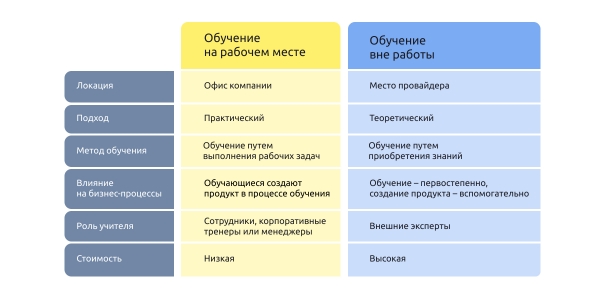
During training, an employee gains not only knowledge and practical experience but also absorbs the values, strategies, and goals of the company.
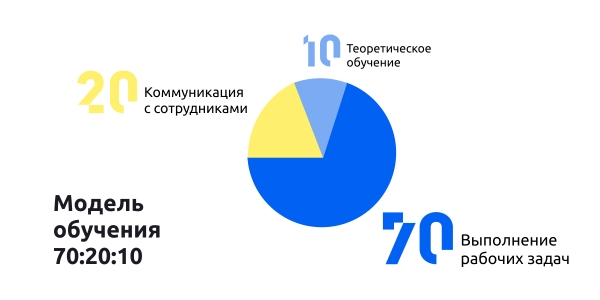
Thus, the training follows the model of “»:
70% of the time is spent on learning within work processes and daily tasks: here the employee develops their own experience, makes and corrects mistakes, works on projects, trains colleagues, and engages in self-reflection;
20% is social learning through communication with colleagues and management;
10% is traditional theoretical learning: lectures, courses, books, articles, seminars, meetups, webinars, certifications.
Defining the skill level during the hiring process and planning the career path.
The candidate primarily completes a test assignment to validate their knowledge and skills, and only then is invited for an interview for expert evaluation. Experienced mid-level and senior candidates may skip the test assignment stage.
It is important for us that each employee has an understanding of their individual development plan within the company. A soldier who does not aspire to be a general is a poor one. The vision of a successful future should be clear and understandable from the first days of work.
Of course, career path planning is a process that spans from school through a lifetime, not an outcome, so the individual plan sometimes changes. However, the choice of career path affects how the learning process proceeds. Usually, the choice is between technical or managerial career paths.
To determine a career path, in my opinion, it is sufficient to follow 5 steps:
- Establish a circle of individuals providing feedback on the employee;
- Develop, distribute, and collect surveys on a competency matrix to determine indicators for roles;
- Analyze the surveys and agree on the results with management;
- Inform the employee about the results of their evaluation;
- Plan the career and develop an individual plan.
, the founder and CEO of Bersin & Associates, a sign of a poor career development system is that companies hire management positions from outside. Therefore, following an individual career plan is important not only for the employee but also for the company.
Systematic knowledge enhancement
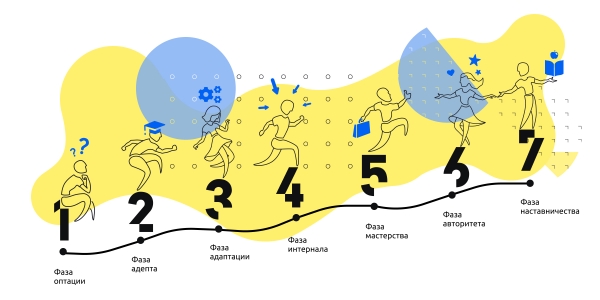
Development, training, and competency improvement occur systematically and regularly. Any professional goes through regardless of position and age:
Stage 1 – Phase of Optation: choosing a profession by a student or a professional in another field;
Stage 2 – Phase of Adept: mastering the profession, from brief instruction to years of training or work;
Stage 3 – Phase of Adaptation: the adapter gets used to the job, team, tasks, difficulties, and forms a certain loyalty to the team;
Stage 4 – Phase of Internalization: the employee enters the profession as a full-fledged colleague and independently performs key tasks;
Stage 5 – Phase of Mastery: the employee gains an informal status of an irreplaceable or versatile employee capable of handling complex tasks;
Stage 6 – Phase of Authority: the master becomes well-known in professional circles;
Stage 7 – Phase of Mentorship (in the broadest sense): the master gathers like-minded people and students not only through high professionalism but also through fostering the best professionals in their field.
At Omega-R, a specific mentor and adapter from among the highly loyal specialists with at least middle-level professional experience and a certain tenure at the company are defined for the newcomer. During the adaptation period, it is important not only to gain an understanding of specific technologies and work specifics but also to absorb the nuances of corporate culture and become part of the team. Understanding the goals and mission is a crucial component of successful adaptation, long fruitful work, and high loyalty to the company.
The clearer and more structured the first days and weeks in the company are, the faster the newcomer adapts to the process and demonstrates results. On the first day, the newcomer is introduced to a mentor and provided with study materials and a "newcomer's folder" containing useful information, a plan for the probationary period approved by the immediate supervisor. A zero assessment takes place after two weeks of work in the company, after which the next checkpoint is established.
Transition to the next level of development
The successful completion of the assessment serves as the main trigger for an employee's promotion.
There are specific time intervals between assessments, determined by the results of the previous evaluation, and each employee is aware of the dates for the next assessment. The HR manager monitors these timelines and initiates preparation in advance.
Every employee has the right to independently approach the responsible parties for an unscheduled assessment. The motivation for an unscheduled assessment depends not only on the fact of promotion but also on factors such as the complexity of the project or salary level. In fact, we value responsibility and interest in personal and professional growth—professional development is embedded in our corporate culture.
Every team lead is involved in the professional development of their employees—this demonstrates both their level of expertise and interest in learning, as well as the benefits of the training and development system through personal example. Regardless of who initiates the assessment, the team lead and other leaders determine the readiness for advancement to the next level of professional development based on the competency matrix and their own experience. If an employee does not pass the assessment on the first attempt, they can retake the exam.
Objectives of the assessment:
- Determine the current level of the specialist;
- Find out in which areas the person is interested in developing;
- Provide feedback to the employee;
- Identify growth areas;
- Set the date for the next assessment.
Everyone is familiar with the situation in the labor market, so the purpose of performance review is not to judge the employee, but to help them grow.
Performance review
A performance review is a systematic and periodic process that evaluates the effectiveness and productivity of an individual employee's work according to pre-established criteria and organizational goals. The performance review has evolved over its century-long history from the principles of scientific management established by Frederick W. Taylor and during World War I to identify underperformers.
The performance review is beneficial to the employee as it uncovers the reasons for the lack of career advancement and pathways for resolution. The company can transparently and objectively identify employees worthy of rewards, promotions, or salary increases. It is worth noting that this evaluation tool is quite complex and has many potential pitfalls.

The performance review is conducted in several stages:
Stage 1 – Preparation. It is crucial to discuss the entire process and its goals with stakeholders and managers. The process of gathering feedback and the procedure for its use must be clearly communicated to all participants in meetings or newsletters. As practice shows, without this stage, the performance review can become a waste of time.
Stage 2 – self-review. The employee should recall and document what they have been doing over the past few months or year: tasks and qualities expected of the employee, including when performing non-routine roles; projects, core activities, and other engagements; work achievements and successes; shortcomings, failures in specific tasks from the employee and department, and self-criticism based on facts. Since it is quite challenging to remember details from a year ago, it is better to conduct performance reviews at least once every six months.
Stage 3 – identification of respondents. The employee or the performance review managers list those who will evaluate them: the immediate supervisor; managers from other teams who have worked or periodically collaborate on specific projects with the employee, clients; peers (colleagues from the department, from temporary or permanent project teams); subordinates, including those for whom the employee is merely a mentor.
Stage 4 – distribution of survey forms. One of the leaders of the performance review, such as the department head, analyzes the evaluation given by the employee to themselves, requests clarification if the employee’s information is vague, prepares a questionnaire, and sends it to the respondents. Since each employee in the company receives several questionnaires, a reasonable deadline must be set for each one, allowing time for thoughtful reading and completion.
Stage 5 – conducting the evaluation. Each respondent reviews the employee's self-review, assigns an overall rating reflecting how they perceive the employee's expected task performance quality, provides comments explaining specific reasons for the rating, and any detailed recommendations for development.
Stage 6 – data analysis. Discussing the results can lead to misunderstandings, so it is important to maintain a certain level of confidentiality, as each assigned rating, whether positive or negative, is subjective and can sometimes be provocative. In any case, it is advisable for the organizer of the performance review to start the discussion of the results with the department head using aggregated data for the company and department. The same approach is used when communicating within the department. Moreover, some employees may receive clearly unfair ratings based on personal preferences. This can be evident in the formality of completion, lack of specificity, or excessive emotionality in the comments on the evaluation in the questionnaire.
Stage 7 – the project roadmap. Based on the results, a specific action plan should be developed to lead each employee to growth: specific training, temporary or permanent transfer to another position, working on a new project, mentorship, leave, adjustments in time management, or other activities.
Stage 8 - tracking changes. Essentially, this stage can be called the preparation and conduct of the next performance review, as in anticipation of it, employees begin to track everything they need to indicate in the questionnaires and take a more careful approach to their activities.
11 reasons why a performance review may fail
During a performance review, small mistakes can occur, some of which may only be corrected during the next performance review. Therefore, the first stage of preparation is just as important as all the others. The following shortcomings and failures are most commonly encountered:
- Inappropriate questions in the survey. A lengthy survey of 10+ questions that addresses general company issues should be separate from the key performance review survey focused on a specific department or employee.
- Manager's avoidance of difficult topics. The self-review may highlight prospects for the employee, department, or company that require heated discussion, but the manager's evaluation overlooks these aspects. In such cases, it can be concluded that the manager needs training on this hot topic.
- Lack of specificity in answers and comments. This may indicate poorly formulated questions or a lack of clarification work with participants that needs to be addressed. Persistent psychological biases of respondents, affecting their ratings across all completed questionnaires and causing them to give similar ratings and comments, should reduce the relevance of their evaluations during analysis.
- Absence of evaluation from the direct supervisor. They know practically everything about the formal and informal duties within the department and can provide the strictest and most objective assessment. Moreover, in cases of unequivocal informal leadership by one of the employees within the department, one should not rely entirely on the evaluations provided by their colleagues.
- Intentional or unintentional bias. Among the evaluations compiled for one employee, there may be outliers that should not always be trusted, hence the average rating is taken into account primarily. Furthermore, the assessment may be based on personal likes and dislikes, a desire to avoid conflict, which is reflected in the absence of facts and quantitative indicators in comments.
- Legal nihilismIf a union has been established in the company, it makes sense to coordinate the performance review procedures and their implications for employees, as the personnel effects, such as termination, reassignment, salary increases or decreases, are regulated by labor law and regulations.
- Mismatch between performance enhancement goals and performance review objectivesIf the goal of performance enhancement leads to a violation of ethical standards, legal requirements, or product and service quality, it will undoubtedly hinder the learning that follows the performance review.
- Serious/Non-serious surveyingIf employees are not fully informed about the essence and objectives of the performance review, they may approach it either too casually and formally or excessively seriously out of fear of losing their job or salary level and may attempt to artificially inflate their ratings.
- Incorrect translation of ratings into bonusesThe rating system should not guarantee mandatory bonuses, whether small or large. If bonuses become universal, the performance review will signal employees to let their guard down.
- Incomplete list of respondentsAn employee may intentionally exclude from the list of respondents those they have worked with periodically or consistently. In such cases, it is necessary to clarify that anyone can register as a respondent if they have valid reasons.
- Directive styleSome managers are so afraid of being put in an uncomfortable position that they do not discuss the results of evaluations, instead simply telling subordinates what to do in a directive manner. The performance review should involve two-way communication for effectiveness.
The performance review is a preparatory part of shaping the training and development strategy. Each company creates its own strategy; in any case, the main task of the training and development strategy is to manage employee development in a way that supports other key business priorities. The training and development function within the organization plays a strategic role in five areas:
- Employee potential development;
- Attracting and retaining talent;
- Motivation and engagement of employees;
- Creating an employer brand;
- Establishing corporate culture values.
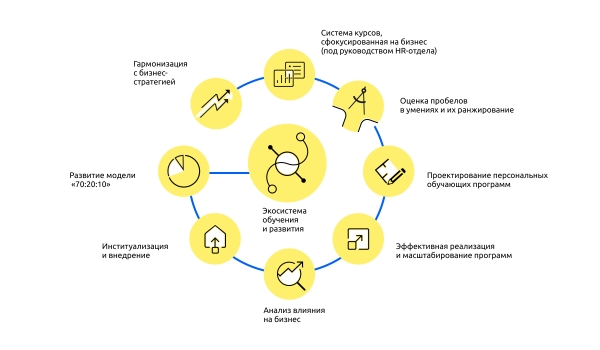
Thus, the training and development strategy entails the creation of 8 key components of a closed-loop educational and development ecosystem within the company, which should begin with aligning training and development with the business strategy. As shown by , only 40% of companies confirm alignment between training and development strategies and strategic goals, while 60% of companies lack clear alignment between training and development and business objectives. This is why training programs should not be developed solely by the HR department, but rather by divisions under organizational leadership and in collaboration with the HR department.
One might assume that implementing a training and development system will consume not only the company's financial resources but also the employees' work time. In reality, the costs of training and development are far outweighed by the actual benefits for the company:
- Increased employee effectiveness: training boosts their self-confidence and helps the company achieve leadership positions.
- Increased employee satisfaction and enhanced team morale: the company demonstrates to employees that they are valued, invested in, and provided access to training they otherwise might not even know about.
- Addressing weak points: every team has weak links, whether individual employees or business processes. Training and development elevates all employees to a level where each of them is interchangeable and autonomous.
- Improved productivity and adherence to quality standards: continuous training cultivates a sense of internal responsibility for processes within the company and drives motivation for productivity growth.
- Growth of innovations in new strategies and products: during upskilling, new ideas are sought, creative approaches are nurtured, and attempts to view situations differently are encouraged.
- Reduction in employee turnover: the employer's investment retains employees and lowers recruitment costs.
- Strengthening the company's profile and reputationHaving a strong training and development strategy enhances the company's brand, attracts students, graduates, and colleagues from other companies, and creates a queue of job seekers, allowing for the selection of the most promising candidates.
A corporate training and development system cannot be implemented overnight. Many mistakes can be made during the implementation process. The main one is the mismatch between the development strategy and the business mission. With proper execution, healthy competition and a brand of leadership are fostered within the company, leading to increased profits, strengthening its position in the IT services market, engaging in real external competition with market leaders, and strategic flexibility.
Source: habr.com
