

Without the recommended three years of practical experience
*Note: this article is about the Google Cloud Professional Data Engineer certification exam, which was relevant until March 29, 2019. Some changes have taken place since then — these are described in the section "Additional»*

Google hoodie: check. Serious expression: check. Photo from the video version of this article .
Want to get a new hoodie like the one in my photo?
Or perhaps you're interested in the certificate and you're trying to understand how to obtain it?
In the last few months, I have taken several courses while simultaneously working with Google Cloud — in preparation for the Professional Data Engineer exam. I then took the exam and passed it. A few weeks later, the hoodie arrived — but the certificate came faster.
This article will provide some insights that may be helpful, along with the steps I took to obtain the Google Cloud Professional Data Engineer certification.
Translated in
Why should you obtain the Google Cloud Professional Data Engineer certification?
Data surrounds us, it's everywhere. Therefore, there is a high demand for specialists who know how to create systems capable of processing and utilizing data. Google Cloud provides the infrastructure needed to build these systems.
If you already have skills in using Google Cloud, how can you demonstrate them to future employers or clients? You can do this in two ways: by having a portfolio of projects or by obtaining certification.
The certificate tells potential clients and employers that you have specific skills and that you have made an effort to obtain official recognition of them.
This is also mentioned in the official exam description.
Demonstrate your ability to design and build data processing systems and machine learning models on the Google Cloud platform.
If you don't have those skills yet, while studying the certification materials, you'll learn everything you need about how to use Google Cloud to create top-notch data processing systems.
Who needs to obtain the Google Cloud Professional Data Engineer certification?
You've seen the numbers — the cloud technology sector is growing, and it's here to stay. If you're not familiar with the statistics, just believe this: "clouds" are on the rise.
If you are already working as a data processing or analysis specialist, a machine learning engineer, or looking to transition into the data processing field, then the Google Cloud Professional Data Engineer certification is what you need.
The ability to use cloud technologies is becoming a mandatory requirement for all professionals working with data.
Is a certification necessary to be a professional in data processing, analysis, or machine learning?
No.
You can use Google Cloud for data processing solutions without having a certification.
A certification is just one of the ways to validate the skills you possess.
How much does it cost?
The cost of taking the exam is $200. If you fail, you'll have to pay again.
Additionally, you will need to spend on preparatory courses and the use of the platform itself.
The costs associated with working on the platform are fees for using Google Cloud services. If you are an active user, you already know this well. If you are a newcomer and just starting to explore the study materials described in this article, you can create a Google Cloud account and get everything you need within $300, which Google credits to your account upon registration.
We'll get to the course costs in just a moment.
How long is the certification valid?
Two years. After this period, you will need to retake the exam.
And since Google Cloud is constantly evolving, it is quite likely that the certification requirements will change (this happened just as I started writing this article).
What do you need to prepare for the exam?
For the professional level certification, Google recommends having more than three years of industry experience and more than a year in developing and managing solutions using GCP.
I didn’t have anything like that.
The relevant experience was about six months in each case.
To fill the gap, I utilized several online training resources.
What courses did I take?
If your situation is similar to mine and you do not meet the recommended requirements, you can take some of the courses listed below to improve your skills.
These were the ones I used in preparation for the certification. They are listed in the order I completed them.
For each one, I indicated the cost, duration, and usefulness for passing the certification exam.
Some of the great online educational resources I used to improve my skills before the exam — in order: , , .
Cost: $49 per month (after a 7-day free trial).
Duration: 1–2 months, over 10 hours per week.
Usefulness: 8 out of 10.
Course on Coursera developed in collaboration with Google Cloud.
It is divided into five nested courses, each of which consists of about 10 hours of study time per week.
If you are not familiar with data processing on Google Cloud, this specialization will provide you with the necessary skills. You will need to complete a number of practical exercises using an iterative platform called QwikLabs. Before that, there will be lectures by Google Cloud specialists on how to use various services, such as Google BigQuery, Cloud Dataproc, Dataflow, and Bigtable.
Cost: free of charge.
Duration: 1 week, 4–6 hours.
Usefulness: 4 out of 10.
A low usefulness rating does not mean that the course is entirely useless — it's quite the opposite. The only reason for the low rating is that it is not oriented towards the Professional Data Engineer certification (as can be understood from the title).
I took it to refresh my knowledge after completing the Coursera specialization since I had used Google Cloud in some limited cases.
If you have previously worked with another cloud provider or have never used Google Cloud, this course may be useful to you: it’s a great introduction to the Google Cloud platform as a whole.
Cost: $49 per month (after a 7-day free trial).
Duration: 1–4 weeks, more than 4 hours per week.
Usefulness: 10 out of 10.
After passing the exam and reflecting on the courses taken, I can say that the most useful was indeed the Linux Academy Google Certified Professional Data Engineer.
Video lessons, as well as (a great free educational resource provided with the course) and practice exams make this course one of the best I have ever taken.
I even recommended it as reference material in Slack notes for the team after the exam.
Notes in Slack
• Some questions on the exam were not covered in either the Linux Academy course, A Cloud Guru, or the Google Cloud Practice exams (which was to be expected).
• One question had a graph of data points. It asked which equation could group them (for example, cos(X) or X²+Y²).
• It's essential to understand the differences between Dataflow, Dataproc, Datastore, Bigtable, BigQuery, Pub/Sub, and how they can be utilized.
• Two specific examples on the exam were the same as those in the practice, although I didn't read them at all during the exam (there were enough questions to answer).
• It’s helpful to know basic SQL query syntax, especially for questions about BigQuery.
• The practice exams in Linux Academy and GCP courses are very similar in style to the exam questions — it's worth taking them several times to identify your weak spots.
• It is important to remember that Dataproc works with : depends on you, Spark, Hive and Pigs.
• Dataflow works with Apache Beam.
• Cloud Spanner — is a database originally designed for the cloud, compatible with ACID and operates worldwide.
• It’s useful to know the names of the “old-timers” — equivalents of relational and non-relational databases (e.g., MongoDB, Cassandra).
• IAM roles for services differ slightly, but it would be beneficial to understand how to separate users' abilities to see data and design workflows (for example, in the Dataflow Worker role, you can design workflows but cannot see data).
For now, this is probably enough. Each exam will be unique in its own way. The Linux Academy course will provide 80% of the necessary knowledge.
Cost: free of charge.
Duration: 1–2 hours.
Usefulness: 5 out of 10.
These videos were recommended on A Cloud Guru forums. Many of them are not related to the Professional Data Engineer certification, so I just selected those whose service names seemed familiar.
While going through the course, some services might seem complex, so it was nice to see how a specific service was described in just a minute.
Cost: 49 $ for the certificate or free (without the certificate).
Duration: 1–2 weeks, more than six hours a week.
Usefulness: not assessed.
I found this resource a day before the scheduled exam date. There wasn’t enough time to go through it — hence the lack of a usefulness rating.
However, after reviewing the course overview page, I can say that this is an excellent resource to revisit everything you learned about Data Engineering in Google Cloud and to identify your weak points.
I told one of my colleagues about this course, who is preparing for certification.
Cost: free of charge.
Duration: unknown.
Usefulness: not assessed.
Another resource I came across after the exam. It looks comprehensive, but the presentation is quite brief. Moreover, it's free. You can refer to it between practice exams and even after certification—to refresh your knowledge.
What did I do after the courses?
Approaching the end of the courses, I booked the exam with a week's notice.
Having a deadline is great motivation to review what you've learned.
I took the practice exams from Linux Academy and Google Cloud several times until I started scoring consistently above 95%.
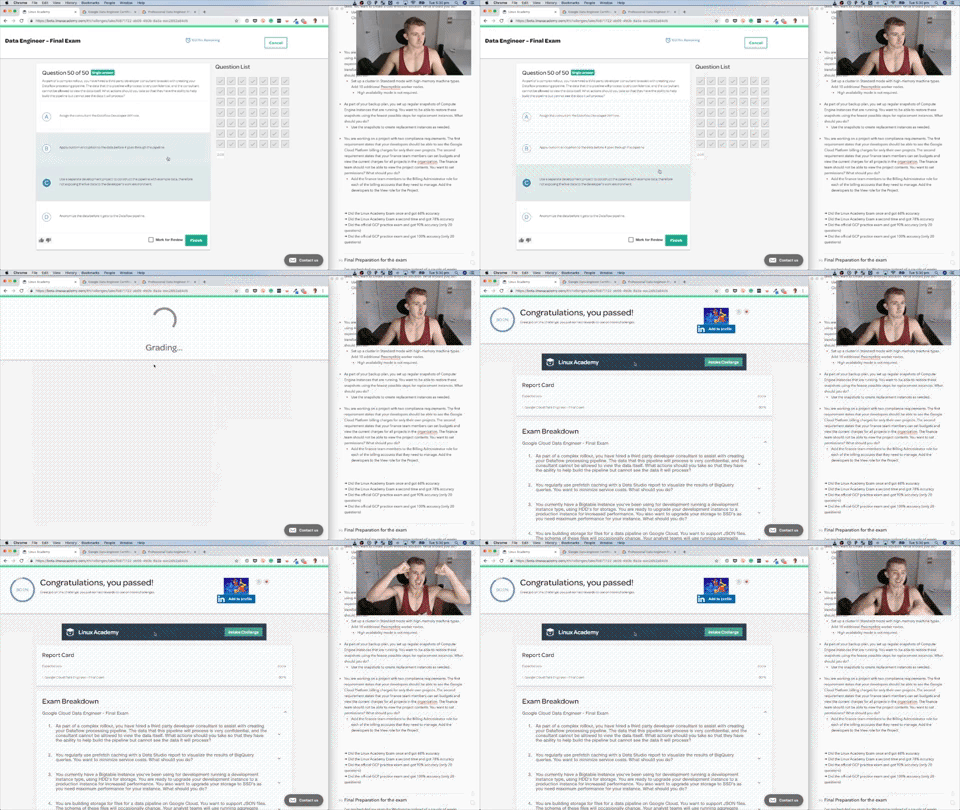
The first attempt at the Linux Academy practice exam resulted in over 90%.
The tests for each platform are similar; I recorded and analyzed the questions I kept getting wrong—this helped eliminate my weak points.
During the actual exam, the topic was data processing system design in Google Cloud based on two examples (the exam content changed on March 29, 2019). The entire exam consisted of multiple-choice questions.
Taking the exam took two hours; it seemed about 20% harder than the practice exams I was familiar with.
Nevertheless, the latter is a very valuable resource.
What would I change if I were to retake the exam?
More practice exams. More hands-on experience.
Of course, there's always room for a little more preparation.
The recommended requirements state more than three years of GCP experience, which I did not have—so I had to deal with what I had.
Additional
The exam was updated on March 29. The materials in the article will still provide a solid foundation for preparation; however, it's important to note some changes.
Sections of the Google Cloud Professional Data Engineer exam ()
1. Designing data processing systems.
2. Building and maintaining data structures and databases.
3. Analyzing data and integrating machine learning.
4. Modeling business processes for analysis and optimization.
5. Ensuring reliability.
6. Data Visualization and Decision Support.
7. Security and Compliance-Focused Design.
Sections of the Google Cloud Professional Data Engineer exam ()
1. Designing data processing systems.
2. Building and Operating Data Processing Systems.
3. Operating Machine Learning Models (most changes occurred here) [NEW].
4. Quality Assurance of Solutions.
In version 2, sections 1, 2, 4, and 6 from version 1 have been merged into sections 1 and 2, while sections 5 and 7 have combined into section 4. Section 3 in version 2 has been expanded and now covers all new machine learning capabilities in Google Cloud.
These changes occurred quite recently, so many training materials have not yet been updated.
However, using the materials from the article should suffice to cover 70% of the necessary knowledge. I would also independently familiarize myself with the following topics (they appeared in the second version of the exam):
- (hardware developed by Google specifically for machine learning).
As you can see, the exam update is primarily related to machine learning capabilities in Google Cloud.
Supplement as of 04/29/2019. I received a message from the instructor of the Linux Academy course (Matthew Ulasien).
Just for your reference: we plan to update the Data Engineer course in Linux Academy to reflect new goals — somewhere around mid to late May.
After the Exam
Upon passing the exam, you will receive a result of 'passed' or 'not passed'. It is advisable to aim for at least 70% on practice exams, so I targeted 90%.
After successfully passing the exam, an activation code will be sent to your email along with the official Google Cloud Professional Data Engineer certificate. Congratulations!
The activation code can be used in the exclusive Google Cloud Professional Data Engineer store, where you can find some nice items: there are T-shirts, backpacks, and hoodies (some items may be out of stock by the time you take it). I chose a hoodie.
Having the certificate allows you to officially demonstrate your skills and return to the work you do best — building systems.
See you in two years — at the recertification.
P. S. A big thank you to the wonderful instructors of the above courses and for providing resources and time for training and exam preparation.
About the translator
The translation of the article was done at Alconost.
Alconost specializes in , into 70 languages. Native-speaking translators, linguistic testing, a cloud platform with API, continuous localization, project managers 24/7, any formats of string resources.
We also create — for websites, sales, promotional, educational, teasers, explainers, trailers for Google Play and the App Store.
→
Source: habr.com
