

We discuss what new developments may arise in data centers and beyond.
/ фото Unsplash
It is believed that silicon transistors are approaching their technological limits. The last time we talked about materials that could replace silicon and alternative approaches to transistor development. Today, we discuss concepts that could transform the principles of traditional computing systems: quantum machines, neuromorphic chips, and DNA-based computers.
DNA computers
This is a system that utilizes the computational capabilities of DNA molecules. DNA strands are made up of four nitrogenous bases: cytosine, adenine, guanine, and thymine. By linking them in a specific sequence, information can be encoded. Specialized enzymes are used to modify the data by extending DNA chains, as well as cutting and shortening them through chemical reactions. These reactions can occur simultaneously in different parts of the molecule, allowing for parallel computations.
The first DNA-based computer was introduced in 1994. Professor of molecular biology and computer science (Leonard Adleman) used several test tubes filled with billions of DNA molecules to attempt to solve for a graph with seven vertices. Adleman labeled its vertices and edges with fragments of DNA containing twenty nitrogenous bases, and then applied the method of (PCR).
The drawback of Adleman's computer was its "narrow focus." It was tailored to solve one specific problem and could not perform others. Since then, the situation has changed — at the end of March, scientists from Menout University and the California Institute of Technology developed a computer where data is loaded in the form of DNA sequences and can be reprogrammed.
This system has the potential to pave the way for a new type of computing systems, but the problem of slow data input and output remains (the process of is quite costly and time-consuming).
Despite the challenges, experts , which in the future DNA computers the size of modern desktops will surpass supercomputers in performance. They could find applications in data centers that handle large volumes of data.
Neuromorphic Processors
The term 'neuromorphic' indicates that the chip architecture is based on the principles of the human brain's operation. Such processors emulate the functions of millions of neurons with extensions known as axons and dendrites. The former are responsible for transmitting information, while the latter are for perception. Neurons are interconnected by synapses—special contacts that transmit electrical signals (nerve impulses).
The idea of creating neuromorphic systems first emerged back . However, serious developments in this field began after the 2000s. Specialists at IBM Research the SyNAPSE project, aimed at developing a computer with an architecture different from the von Neumann architecture. As part of this project, the company designed the chip . It emulates the functioning of one million neurons and 256 million synapses.
Work on neuromorphic processors is not only happening at IBM. Intel has been the Loihi chip since 2017. It consists of 130,000 artificial neurons and 130 million synapses. A year ago, the company the development of a prototype using a 14nm manufacturing process.
Neuromorphic devices can accelerate the training of neural networks. Unlike classical processors, such chips do not need to regularly access registers or memory for data. All information is constantly stored in artificial neurons. This feature will allow the training of neural networks locally (without connecting to a storage device with a database of test data).
It is expected that neuromorphic processors will be used in smartphones and Internet of Things devices. However, large-scale deployment of the technology in consumer devices is not yet a reality.
Quantum Machines
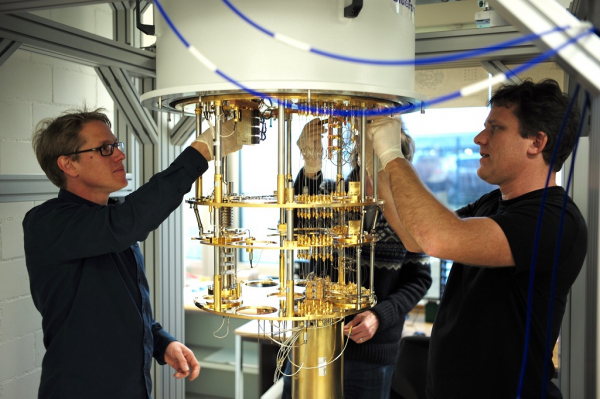
Quantum computers are built on qubits. Their functioning is based on the principles of quantum physics—entanglement and superposition. Superposition allows a qubit to be in a state of both zero and one simultaneously. Entanglement is a phenomenon where the states of multiple qubits become interlinked. This approach enables operations with both zero and one at the same time.
/ фото CC BY-NA
As a result, quantum computers solve a number of problems much faster than traditional systems. Examples include Currently, a relatively small number of companies are involved in the development of quantum computing. Among them, IBM stands out with its
50-qubit 49-qubit 79-qubit device. Rigetti , and .
In particular, quantum machines operate at a temperature
close to absolute zero. decoherence. ).
Materials from our Telegram channel: What is VMware Virtual SAN (vSAN) — exploring the basics
Continuing the topic of virtualization — discussing VMware NSX
Source: habr.com
