

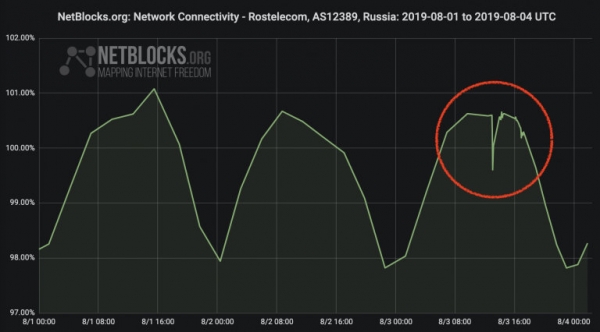
On August 3rd in Moscow, between 12:00 and 14:30, the Rostelecom network AS12389 experienced a slight but noticeable slowdown. NetBlocks was the first government-imposed internet shutdown in Moscow's history. This term refers to the disconnection or restrictions of internet access by authorities.
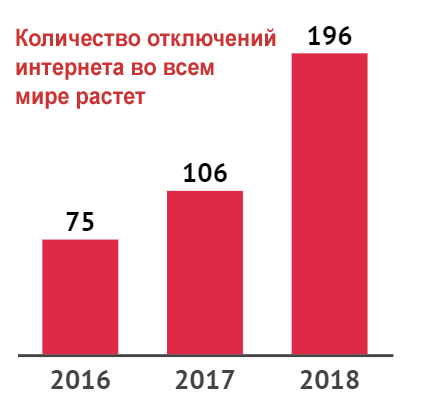
What happened in Moscow for the first time has been a global trend for several years now. Over the past three years, there have been 377 documented instances of targeted internet shutdowns by authorities worldwide, according to .
Governments are increasingly using internet access restrictions both as a tool for censorship and to combat illegal activities.
But the question remains, how effective is this tool? What results does its use lead to? Recently, several studies have emerged that shed some light on this issue.
There are two main methods of implementing internet shutdowns that are most commonly used:
The first is a total disruption of the entire network, as happened .
The second is blocking access to specific websites (e.g., social media) or messengers, as occurred .
The world's first major incident of an internet shutdown occurred in 2011 when the Egyptian government cut off internet and mobile networks for five days during the».
However, it wasn't until 2016 that some African governments began actively using regular shutdowns. The Republic of Congo initiated a test shutdown by blocking all telecommunications for a week during the presidential elections.
It's important to understand that shutdowns are not always a form of political censorship. during school exams to prevent leakage of exam questions. In Brazil, WhatsApp in 2015 and 2016 after Facebook Inc (which owns WhatsApp) failed to meet court orders for data in a criminal investigation.
Furthermore, it is undoubtedly true that hateful speech and false news can spread very quickly on social networks and messengers. One way authorities attempt to prevent the dissemination of such information is by limiting access to the internet.
Last year, for example, the flow was triggered by rumors spread via WhatsApp, resulting in a shocking 46 murders.
Nevertheless, the digital rights group believes that the spread of false information often serves merely as a pretext for temporary shutdowns. For example, internet shutdowns in Syria have shown that they generally coincide with significantly higher levels of violence from government forces.
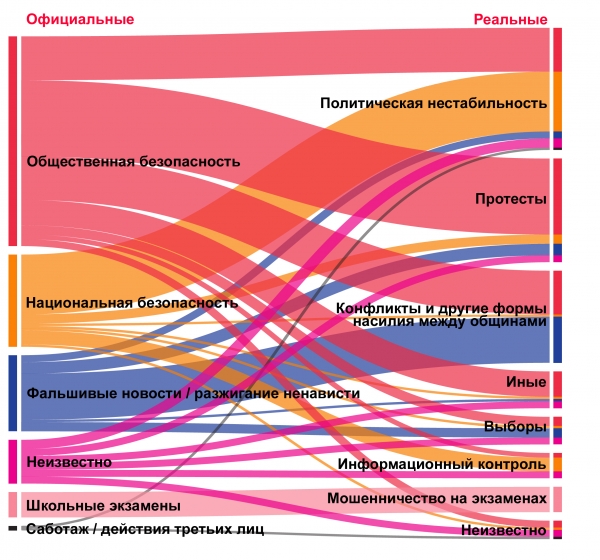
Official vs real reasons for internet shutdowns in 2018 according to .
Geography of shutdowns
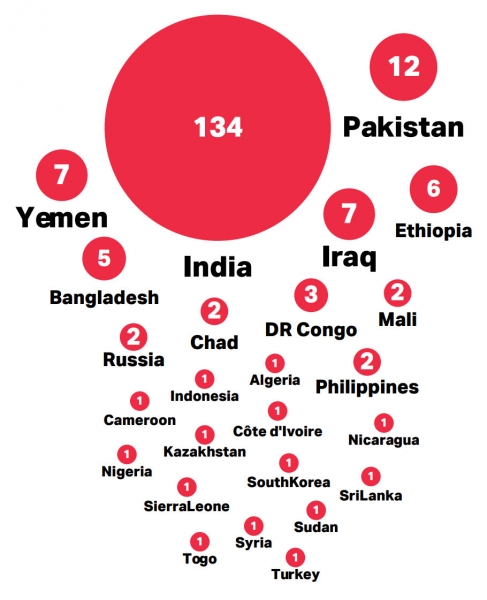
In 2018, registered 196 internet shutdowns worldwide. As in previous years, most shutdowns were in India, accounting for 67% of all registered incidents globally.
The remaining 33% occurred in various countries: Algeria, Bangladesh, Cameroon, Chad, Côte d'Ivoire, the Democratic Republic of the Congo, Ethiopia, Indonesia, Iraq, Kazakhstan, Mali, Nicaragua, Nigeria, Pakistan, the Philippines, and Russia.
Impact of shutdowns
was published in February 2019; its author, Jan Rydzak from Stanford University, has been researching internet shutdowns and their effects for about 5 years.
Jan Rydzak studied India, where there have been more internet shutdowns than anywhere else in the world. Many of the reasons were unexplained, but those that were officially acknowledged were generally justified as necessary to suppress various violent collective actions.
Rydzak analyzed a total of 22,891 protests in India from 2016 to 2017. His research indicates that both internet and social media access restrictions seemingly do not lead to a decrease in levels of escalation.
In cases where protests were associated with violence, he found that internet shutdowns were typically linked to an escalation of that violence. Each subsequent day after an internet shutdown led to greater violence than when protests occurred with constant internet access.
Meanwhile, during internet outages at peaceful demonstrations, which likely depend more on careful coordination via digital channels, no statistically significant impact of shutdowns was found.
Additionally, the data suggests that in some cases, loss of network access led to a shift from non-violent tactics to violent ones, which apparently rely less on effective communication and coordination.
The cost of shutdowns
Despite the increasing popularity of shutting down internet access among many governments, it should not be forgotten that it's not a cost-free measure.
in 19 countries from July 2015 to June 2016, Darrell West from the Brookings Institution found that the total GDP loss is estimated at $2.4 billion.
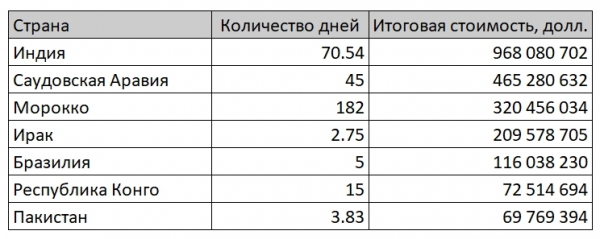
List of countries with the highest losses from internet shutdowns.
It is important to note that Darrell West only considered the economic impact of shutdowns on . He did not assess losses from missed tax revenues, impact on labor productivity, or loss of investor confidence as a result of shutdowns.
Thus, the figure of $2.4 billion is a conservative estimate, likely underestimating the actual economic damage.
Output
The question certainly requires further study. For instance, the extent to which the research on shutdowns in India can be projected to other countries is not at all obvious.
At the same time, it seems that shutting down the internet is at best a poorly functioning tool with a high cost of use. Its usage may lead to negative consequences.
And it may also pose other risks, such as restrictions from international organizations or courts, and deterioration of the investment climate. The likelihood of these risks has yet to be studied.
And if so, why?
Source: habr.com
