

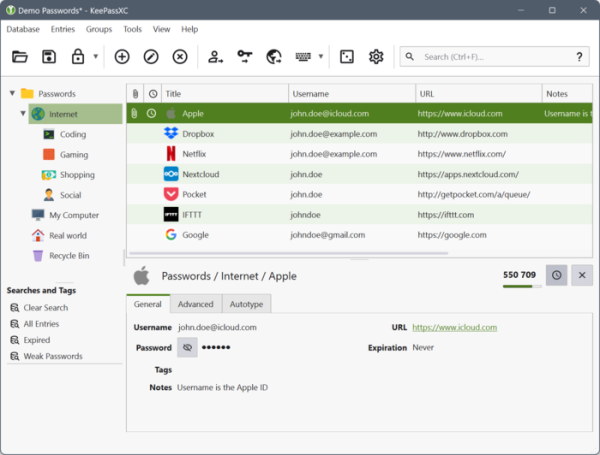
The release of the open-source cross-platform password manager KeePassXC 2.8.0 has been published, offering tools for securely storing regular passwords, one-time passwords (TOTP), SSH keys, and any other information deemed confidential by the user. Data can be stored in a local encrypted vault or in external cloud storage. The project's code is written in C++ using the Qt library and is distributed under the GPLv2 and GPLv3 licenses. Ready-made builds are prepared for Linux (AppImage, Flatpak, Ubuntu PPA, Snap), Windows, and macOS.
Main Features:
- Working with KDBX format databases. Storing information in encrypted form. Ability to attach files and custom attributes to saved password entries.
- Systematization of information with categorization. Built-in search system. Autofill passwords in applications. Command line management capability (keepassxc-cli).
- Reliable password generator. Storage and generation of one-time passwords (TOTP). Analyzing the quality of stored passwords and generating reports with statistics.
- Integration with web browsers such as Chrome, Mozilla Firefox, Edge, Chromium, Vivaldi, Brave, and Tor Browser. Support for Passkeys-based authentication implemented through browser integration.
- Support for importing password databases from CSV, 1Password, Bitwarden, Proton Pass, and KeePass1 formats. Export options to CSV, XML, and HTML formats.
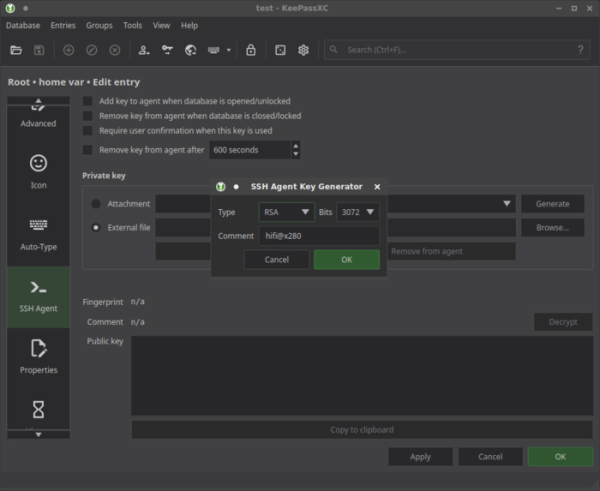
- Support for YubiKey and OnlyKey. Integration with SSH Agent. Shared access to KeeShare DB.
Support for FreeDesktop.org Secret Service, for example, to be used instead of GNOME keyring. Support for Twofish and ChaCha20 encryption algorithms.
Key changes in the new release:
- Migration of the graphical interface from Qt5 to Qt6.
- Ability to use the autofill password feature in applications in Wayland-based environments using XDG portals.
- Support for key combination customization.
- Ability to sync the database with external systems and support for using external utilities for import.
- Quick unlock access mode via Polkit in Linux.
- Formation of ARM64 builds for Windows and experimental ARM64 builds in AppImage format for Linux.
- Transition to storing application state files in the directory ~/local/state/ (XDG_STATE_HOME) instead of ~/cache (XDG_CACHE_HOME).
- Support for generating RSA, ECDSA, and Ed25519 keys for SSH Agent.
- Improved integration with the desktop of AppImage format builds.
- SSH key, Wi-Fi password, and unknown type entries import from Proton Pass have been implemented.
- A vulnerability (CVE-2026-69150) has been fixed, which led to the access of already freed memory when importing a specially crafted KDB file.
Source: opennet.ru
