

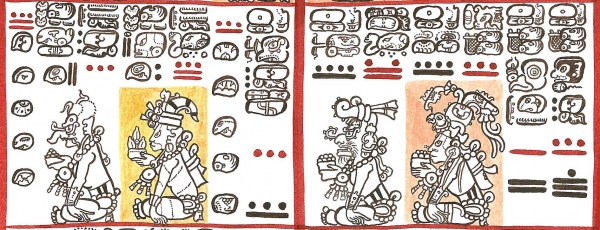
The Maya script was the only fully developed writing system in the Americas, but due to the efforts of brave Spanish conquistadors, it was completely forgotten by the 17th century. Nevertheless, thousands of these symbols have survived on carved stones, frescoes, and ceramics, and in the 20th century, an ordinary Soviet graduate student proposed an idea that allowed them to be deciphered. This article will show how this system works.
Maya writing is a logosyllabic system, where most symbols consist of , representing words or concepts (for example, 'shield' or 'jaguar'), while a smaller portion consists of , which represent the sounds of individual syllables ('pa', 'ma') and determine the pronunciation of the word.
Up to the present time, about 5000 texts have survived, from which epigraphist scholars have identified more than a thousand glyphs. Many of these are variations of the same signs (allographs) or have the same pronunciation (homophones). Thus, it is possible to identify 'only' about 500 hieroglyphs, which is much more than in our familiar alphabets, but fewer than in Chinese with its 12,000 characters. The phonetic value is known for 80% of these signs, while the semantic value is known for only 60%, but their decipherment continues.
The earliest known Maya texts date back to the 3rd century BC, while the latest date to the time of the Spanish conquest in the 16th century AD. This writing system completely disappeared in the 17th century when the last Maya kingdoms were conquered.

The scribe rabbit on
How to read Maya hieroglyphs
The first difficulty in studying Maya hieroglyphs is that their design was quite flexible, so there are various ways to write the same word without changing its reading or meaning. Yes, it was a creative endeavor, and the Maya scribes seemed to enjoy this and fully embraced the freedom of creativity:

A small clarification# На иллюстрациях транслитерация иероглифов майя в латинский алфавит выделяется жирным шрифтом. При этом заглавными буквами указываются LOGOGRAMS, while in lowercase — syllabograms. Transcription is highlighted in italics, and the translation is enclosed in quotes ‘’.
Like in the Latin system, Maya words consisted of several interconnected signs, but due to the pictorial nature of the writing, they are much harder to perceive for the untrained eye than familiar alphabetic systems.
A group of characters forming a word is called a block or a complex of glyphs. The largest character in the block is called the main glyph, while the smaller ones attached to it are known as affixes.
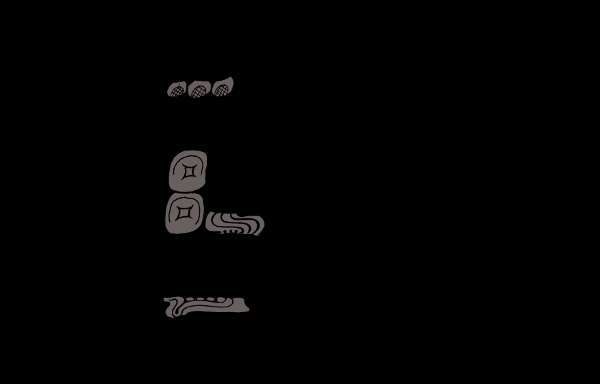
Typically, characters in a block of glyphs are read from left to right and top to bottom. Similarly, Maya texts are written left to right and top to bottom in columns of two blocks.

Logograms
Logograms are characters that represent the meaning and pronunciation of a complete word. Even in our alphabetic-phonetic writing system based on the Latin script, we use logograms:
- @ (commercial at): used in email addresses and social media, originally applied in payment documents in place of the English word at in the meaning of "per [price]"
- £: the pound sterling symbol
- & (ampersand): replaces the conjunction "and"
Most characters in Maya hieroglyphic writing are logograms:

A system consisting solely of logograms would be too cumbersome, as it would require a separate character for each thing, idea, or emotion. For comparison, even the Chinese alphabet, which contains more than 12,000 characters, is not a purely logographic system.
Syllabograms
In addition to logograms, the Maya used syllabograms, which allowed them to keep the alphabet from becoming unwieldy while maintaining the system's flexibility.
A syllabogram or phonogram is a phonetic sign representing a syllable. In Maya languages, it functions as a CV (consonant-vowel) syllable or as a C(VC) (consonant without a following vowel).
Overall, the Maya language follows a consonant-vowel-consonant (CVC) pattern, and according to the principle of the vowel of the last syllable in a word is usually suppressed:
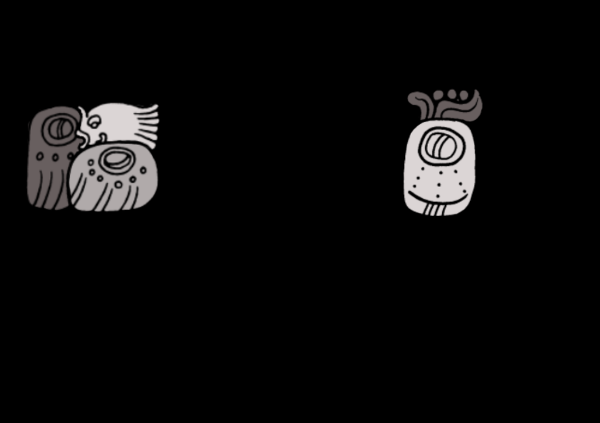
Interestingly, any word written as a logogram could be fully recorded using syllabograms. The ancient Maya often did this, but they never completely abandoned logograms.
Phonetic complements
Phonetic complements are among the most common affixes in Maya. This syllabogram helps to read logograms that have more than one meaning or indicates the pronunciation of the first syllable, facilitating reading.
In the example below, the symbol "stone" (in gray) is also a phonogram for the sound "ku", which is used in words like "ahk" "turtle" or "kutz" "turkey" (the last vowel sound in both cases is omitted). However, when written as a separate word, it is accompanied by the phonetic addition "ni", confirming that it is indeed the word "stone":
Semantic determiners and diacritical marks
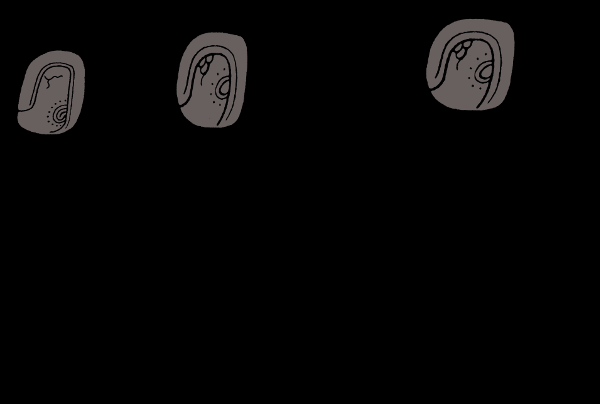
Semantic determiners and diacritical markers help the reader understand the pronunciation or meaning of a word, but unlike phonetic additions, they are not pronounced.
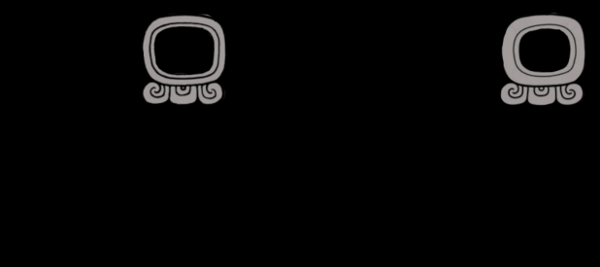
A semantic determinant specifies the polysemous logograms. A good example of a semantic determinant is a decorative frame around a drawing or inscription. It is used to denote days in the :
Diacritical markers define the pronunciation of the glyph. In European languages, there are common markers, such as
- the cedilla: in French, it indicates that the letter c is pronounced as s instead of k, for example, façade
- the diaeresis: in German, it indicates a shift of the vowels /a/, /o/, or /u/ forward, for example, schön [ʃøːn] — "beautiful", schon [ʃoːn] — "already".
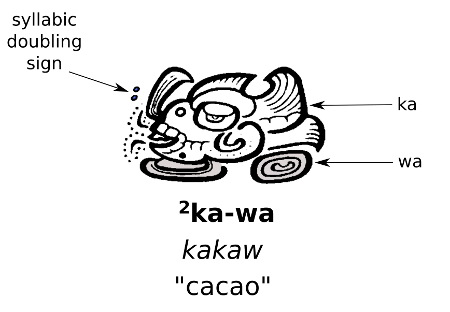
In Mayan writing, a common diacritical marker is a pair of dots in the upper (or lower) left corner of a block of glyphs. They indicate to the reader a repetition of the syllable. So in the example below, the syllable "ka" is duplicated:
Polyphony and homophony
Furthermore, Mayan writing is complicated by polyphony and homophony. In polyphony, the same sign is pronounced and read differently. In Mayan hieroglyphic writing, for example, the word tuun and the syllable ku are represented by the same symbol:

means that the same sound is represented by different signs. Thus, in Mayan writing, the words "snake", "four", and "sky" are pronounced the same but written differently:

Word order
Unlike English, which uses the structure "subject-verb-object" (Subject-Verb-Object), the Mayan language applies the order "verb-object-subject" (Verb-Object-Subject). Since hieroglyphic texts of the ancient Maya typically begin with a date and contain no objects, the most common sentence structure will be "date-verb-subject" (Date-Verb-Subject).
Most of the texts found are carved on monumental structures and describe the lives of kings and the histories of dynasties. In such inscriptions, dates take up to 80% of the space. Verbs are usually represented by one or two blocks of glyphs, followed by long names and titles.
Pronouns
The Maya had two sets of pronouns. Set A was used with transitive verbs, while Set B was used with intransitive verbs. The third-person singular pronouns ('he, she, it', 'his, her, its') from Set A were most commonly used by the Maya. Pronouns from this set are used with both nouns and verbs. The third-person singular is formed using the following prefixes:
- u- before words or verbs that begin with a consonant
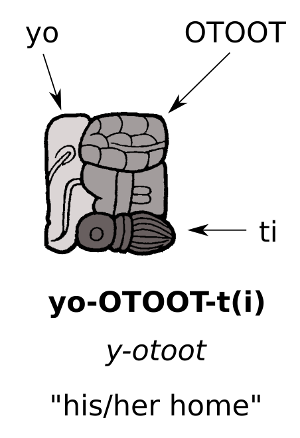
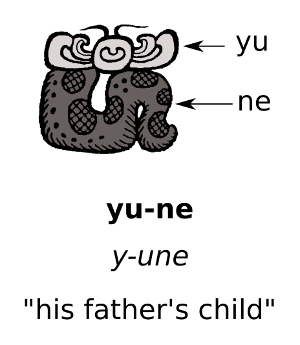
- ya-, ye-, yi-, yo-, yu- before words or verbs that begin with the vowels a, e, i, o, u respectively.
In the first case, the following signs are used:

Any of these symbols can be used to denote the third-person singular:
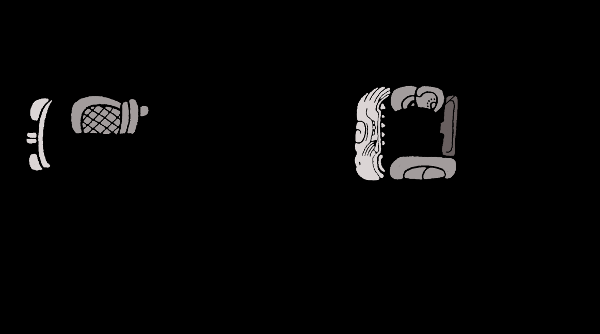
Note the prefix /u/ in the first example. This is a simplified version of the first glyph in the third row of the previous diagram.
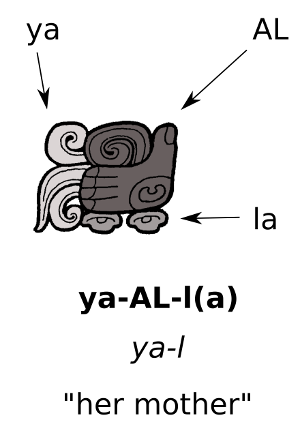
Syllabograms for the prefix -ya:

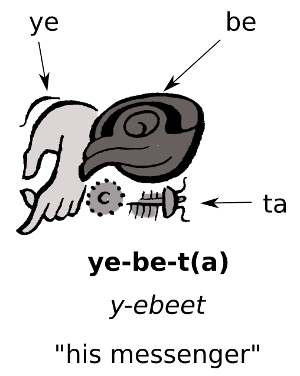
For ye-:

In the example below, the symbol ye- is stylized as a hand:
For yi:

In this example, yi is rotated 90° counterclockwise for aesthetic reasons:

For yo-:

For yu-:

Nouns
The Maya had two types of nouns: 'possessed' and 'unpossessed'.
Unpossessed nouns do not have any affixes, with two exceptions:
- the suffix -is denotes body parts
- the suffix -aj indicates items worn by people, such as jewelry

Gender
In the Maya language, there is no gender, with the exceptions of nouns that describe occupations or titles, such as 'scribe', 'queen', 'king', etc. For these words, the following is used:
- the prefix Ix- for women
- the prefix Aj- for men

Verbs
Most ancient Maya texts have been preserved on monumental structures, telling biographies of rulers. This means that almost all verbs are written in the third person and placed immediately after the dates. In such inscriptions, intransitive verbs that cannot take objects are most frequently encountered.
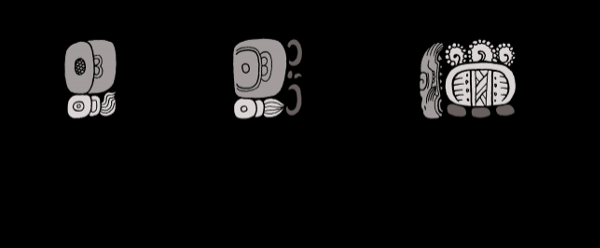
For the past tense (which is still under discussion), the suffix -iiy is used, and for the future, the suffix -oom:
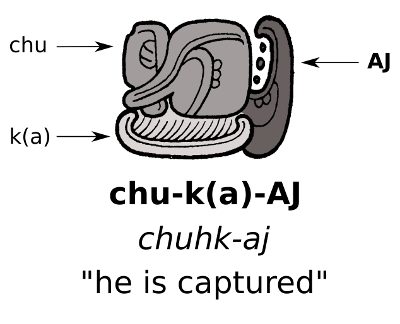
Often after a verb, you can see the sign -aj, which transforms a transitive (able to govern a complement) root into an intransitive verb, for example, chuhk-aj ("he is captured"):
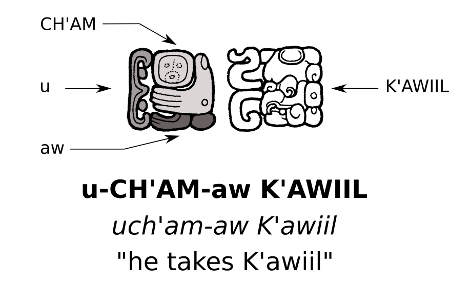
One of the common forms of transitive verbs can easily be recognized by the prefix u- (third-person pronoun) and the suffix -aw. For example, the phrase to describe the beginning of a reign in texts uses uch’am-aw K’awiil — "he takes K’awiil" (Maya rulers received not a throne, but a scepter, embodying ):
Adjectives
In classic Maya inscriptions, adjectives precede nouns, and by adding a syllable (-al, -ul, -el, -il, -ol) to the noun, following the rule of singharmonicity. Thus, the adjective "fiery" is k’ahk ‘ ("fire") + -al = k’ahk’al:

The Origin of Maya Writing
Maya writing was not the first writing system in Mesoamerica. Until recently, it was believed to have originated from (or Epi-Olmec) writing, but in 2005 discoveries pushed back the date of the creation of Maya writing. It is believed that the first writing systems in Mesoamerica appeared in the late Olmec period (around 700-500 BC) and then split into two traditions:
in the north in the Mexican highlands
- in the south in the highlands and foothills of Guatemala and the Mexican state of Chiapas.
- Maya writing refers to the second tradition. The earliest texts are paintings in
San Bartolo Cerros Text and Image of Early Maya

Decoding Maya Writing
The decoding of Maya writing lasted one and a half centuries. It is described in several books, the most famous of which is
/Тут и далее я расширил исходную статью материалами из отечественных источников — прим. переводчика/
"Breaking the Maya Code" Maya texts were first published in the 1810s when miraculous surviving Maya books were found in European archives, which were called codices by analogy with European ones. They attracted attention, and from the 1830s, comprehensive studies of Maya monuments in Guatemala and Belize began.
In 1862, French priest
Brasseur de Bourbourg discovered at the Royal Academy of History in Madrid the 'Report on the Affairs in Yucatan' — a manuscript written around 1566 by the bishop of Yucatan, Diego de Landa. In this document, de Landa mistakenly attempted to correlate Maya glyphs with the Spanish alphabet:
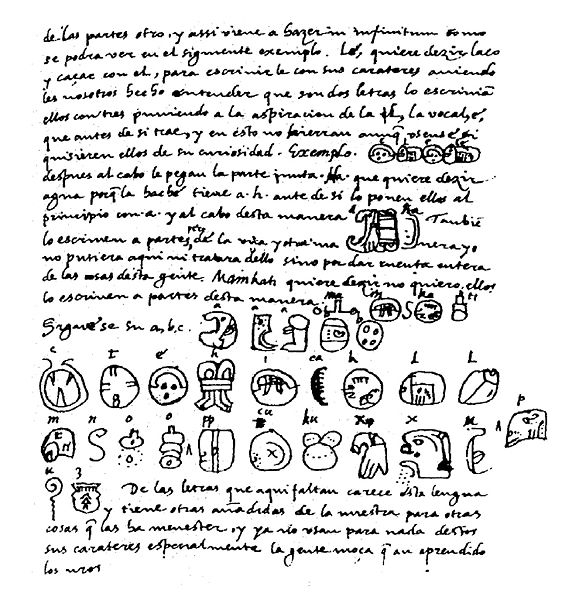
Despite this erroneous approach, de Landa's manuscript played a significant role in the deciphering of Maya writing. A turning point occurred in the 1950s.
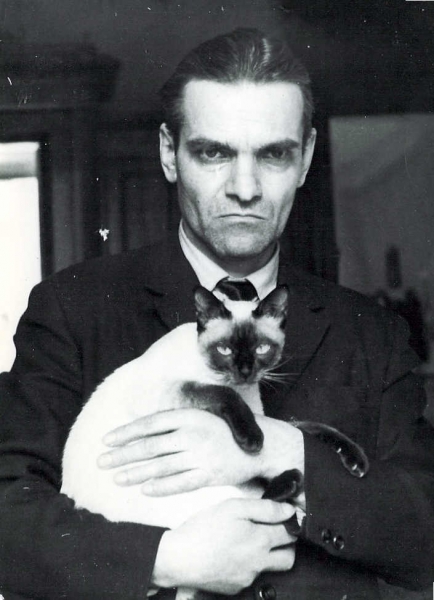
Yuri Knorosov, 11.19.1922 — 03.30.1999
According to one legend, in May 1945, artillery spotter Yuri Knorosov found in the fiery ruins of Berlin books prepared for evacuation from the Prussian State Library. One of them was a rare edition containing three of the surviving Maya codices. Knorosov, who had studied history at Kharkov University before the army, became interested in these manuscripts, completed his studies in history at Moscow State University after the war, and began deciphering Maya writing. This story is recounted by Mayanist Michael Coe, but it is likely that Knorosov, who experienced the end of the war in a part of Moscow Region, embellished the facts in a personal conversation to shock his impressionable American colleague.
Knorosov's main area of interest was the theory of collectives, and his involvement in deciphering Maya writing was not accidental; rather, it aimed to practically verify his ideas regarding common principles of information exchange among all people. 'Nothing is made by one person that cannot be understood by another.'
Nevertheless, based on reproductions of the three Maya codices and de Landa's manuscript, Knorosov realized that the signs in the 'Report on the Affairs in Yucatan' represented syllables rather than letters.
Knorosov's Method
In the description by Knorosov's student — Doctor of Historical Sciences G. Ershova — his method appeared as follows:
Stage one — selection of the theoretical approach: establishing patterns of correspondence between signs and their readings under conditions where the language is either unknown or has significantly changed.
Stage two — precise phonetic reading of the hieroglyphs, as this is the only way to read unknown words that contain known signs.
Step three — the use of positional statistics method. The type of writing (ideographic, morphemic, syllabic, alphabetic) is determined by the number of characters and the frequency of their use. Then, an analysis of the frequency and positions where these characters appear is conducted—this reveals the functions of the characters. This data is compared with materials , which allows for the identification of separate grammatical and semantic referents, root and service morphemes. Then the reading of the main set of characters is established.
Step four — the identification of hieroglyphs that can be read using the key "Message about affairs in Yucatán." Knorosov noticed that the sign "cu" from the de Landa manuscript in the Maya codices followed another sign and that this pair was associated with the image of a turkey. "Turkey" in Maya is "kutz" — and Knorosov reasoned that if "cu" was the first sign, then the second should be "tzu" (assuming the last vowel is dropped). To test his model, Knorosov began searching the codices for a glyph starting with the sign "tzu" and found it above an image of a dog (tzul):

Details from and codices
Step five — cross-reading based on known signs.
Step six — confirmation of the rule of singharmonicity. The same sign could denote both a syllable and a separate sound. It turned out that signs for individual sounds were required to have singharmonically matching vowels with morphemic ones.
Step seven — proof that for all vowel sounds in Maya writing, there were independent signs listed in the de Landa alphabet.
Step eight — formal analysis of the text. Knorosov determined that in three manuscripts, there are 355 unique signs, but due to the use of composite graphemes and allographs, their number is reduced to 287, while in practice, no more than 255 are actually readable — the rest are heavily distorted or possibly variations of known signs.
Stage nine - frequency analysis of the text. The following pattern was revealed: as we progress through the text, the number of new characters decreases, but it never reaches zero. The characters had varying absolute and relative frequencies: about a third of all characters appeared within only one hieroglyph; approximately two-thirds were used within less than 50 hieroglyphs, while single characters occurred extremely frequently.
Stage ten - determining grammatical referents, which required analyzing the composition of hieroglyphs. Yu. Knorosov spent much time determining the order of writing individual characters in blocks. Based on their position in the line, he divided these hieroglyphs into six groups. Analyzing their compatibility with variable signs allowed him to identify grammatical indicators — main and secondary elements of the sentence. The variable signs within hieroglyphic blocks represented affixes and function words. After this, work began with dictionaries and increasing the number of recognizable characters.
Recognition of Knorosov's method
Knorosov's syllabic approach contradicted the ideas , who made significant contributions to the study of Maya texts in the 1940s and was regarded as the most authoritative scholar in this field. Thompson employed a structural method: he attempted to determine the order and purpose of Maya glyphs based on their distribution in inscriptions. Despite his successes, Thompson categorically denied the very possibility that Maya writing was phonetic and could record spoken language.
In the USSR of those years, any scientific work was required to contain justification from a Marxist-Leninist perspective, and based on this nominal insertion, Thompson accused Knorosov of promoting Marxist ideas among Maya scholars. An additional reason for criticism was a statement from programmers in Novosibirsk, who announced the development of an 'automated deciphering theory' of ancient texts based on Knorosov's work and ceremoniously presented it to Khrushchev.
Despite intense criticism, KНРоза's phonetic theory began to attract the attention of Western scholars (Tatyana Proskuryakova, Floyd Lounsbury, Linda Schele, David Stuart), and after the death of Thomson in 1975, the large-scale deciphering of Maya texts began.
Maya Writing Today
Like any writing system, Maya glyphs were used for a variety of purposes. Mostly, monuments with biographies of rulers have survived to this day. In addition, four : the 'Dresden Codex', the 'Paris Codex', the 'Madrid Codex', and the 'Grolier Codex', which was discovered only in 1971.
Also, deteriorated books have been found in Maya burials, but they have not yet been deciphered, as the manuscripts have stuck together and been saturated with lime. Nevertheless, with the development of scanning systems, these manuscripts have a . Considering that only 60% of the glyphs have been deciphered, Mayan studies will surely gift us with something interesting.
P.S. Useful Materials:
- Syllabary tables from the book Harri Kettunen & Christophe Helmke (2014), Introduction to Maya Hieroglyphs:


- Harri Kettunen & Christophe Helmke (2014), Introduction to Maya Hieroglyphs, []
- Mark Pitts & Lynn Matson (2008), Writing in Maya Glyphs Names, Places, & Simple Sentences A Non-Technical Introduction, []




- – a database of Maya glyphs in graphic format
- with explanations detailing the scene, Peabody Museum of Archaeology and Ethnology, Harvard University.
Source: habr.com
