

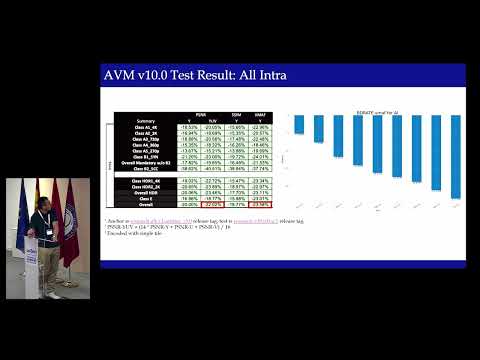
At the QoMEX (Quality of Multimedia Experience) conference, one of the presentations showcased the testing results of the AV2 video encoding format, developed by the Open Media Alliance (AOMedia) as a successor to the AV1 format. Using the quality assessment metrics VMAF (Video Multi-Method Assessment Fusion) developed by Netflix, the AV2 codec achieved a bitrate reduction of 32.59% compared to AV1 at the same quality level. When using PSRN-YUV (Peak-Signal-to-Noise Ratio 14:1:1) metrics, the bitrate was reduced by 28.63%. The testing involved version AVM 11.0 with a reference implementation of AV2.

The AV2 video encoding format does not require licensing fees and allows for the free use of related technologies, patents, and intellectual property. Features of AV2 include: optimization for streaming applications; significant performance improvement over AV1 in compression operations; enhanced support for virtual and augmented reality; support for a wider range of visual quality; and the ability to simultaneously deliver multiple videos within a single video stream with support for their separate display on the screen.
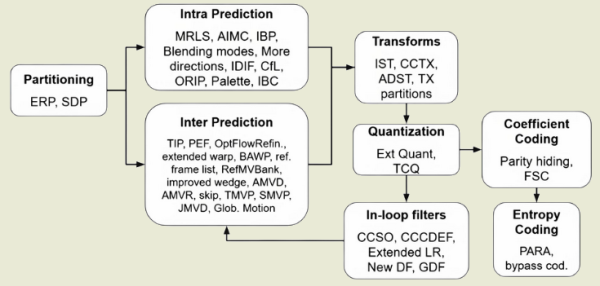
AV2 continues to use a hybrid block-oriented structure, but unlike AV1, it supports larger superblocks of 256×256, fully recursive partitioning, and more efficient separation of luminance and chrominance parameters. AV2 employs a unified exponential quantizer that encompasses a wider luminance range and provides greater quantization accuracy for 8-, 10-, and 12-bit video, as well as better management of low bitrates.
The capabilities of predicting frame-to-frame changes have been expanded, offering better modeling of brightness and color changes, considering up to 7 previous frames in the modeling process, supporting temporal interpolation, and improving motion handling in high-resolution videos or rapidly changing content. Additional filters have been added to suppress noise, reduce compression artifacts, and maintain detail. It is noted that work on the AV2 codec and its reference implementation is already complete, but there remains a need to refine the specification, with the final version expected to be published by the end of the year.
Source: opennet.ru
