

Collabora has introduced the Linux distribution Apertis 2024.3, originally created for automotive devices but later repurposed for a wider range of electronic devices, embedded technology, and industrial equipment. Among the devices using Apertis are the Atari VCS gaming console and Bosch D-tect 200 wall scanner.
Basic system images are distributed for x86_64, arm64, and armhf architectures. The distribution is modular, allowing device manufacturers to customize the system environment as needed. It supports both traditional deb package builds and monolithic atomic updatable images based on OSTree.
Apertis is built on the package base of Debian GNU/Linux 12, but the contents are formed with consideration of the risks manufacturers may face when using certain free licenses, such as GPLv3, which prohibit tivoization, i.e., the binding of software to hardware, for example, by allowing only firmware signed by the manufacturer to be loaded.
In the development and creation of the distribution's contents, the Apertis project adheres to Debian's rules and includes only applications provided under open licenses or at least allowing free distribution. Companies creating their products based on Apertis can be assured of the licensing purity of derivative works — for each build, an SBOM report (Software Bill of Materials) is generated that details the licensing information of all used code files and provides data on program versions, which is convenient for checking vulnerable versions.
An important feature of Apertis is the ability to create a build that does not include code under the GPLv3 license family. Instead of using outdated versions of GNU utilities created before the transition to the GPLv3 license, Apertis employs more modern alternatives under permissive licenses. For example, instead of the GNU coreutils and findutils packages, Apertis offers equivalents from the uutils project, written in Rust and distributed under the MIT license, while Sequoia-PGP replaces GnuPG under the GPL-2+ and LGPL-2+ licenses. However, for those unconcerned with the legal issues related to GPLv3, the option to use traditional utility sets remains.
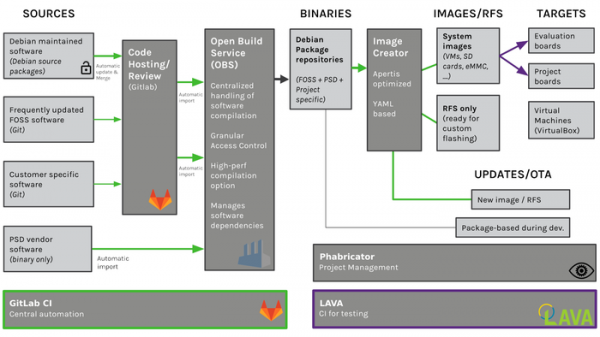
All components of Apertis undergo extensive automated and manual testing on benchmark hardware platforms, such as Raspberry Pi 4 boards and R-car automotive SoCs, with the results of such testing published publicly. Automated testing of system builds on reference hardware is organized based on the LAVA (Linaro Automated Validation Architecture) system.
The kernel package offered in the distribution is based on the latest LTS branch of the Linux kernel. For instance, Apertis 2024.3 uses kernel 6.6 rather than the 6.1 kernel from Debian 12 packages. Each Apertis release is supported for 1 year and 9 months, with a corrective release issued every three months to fix bugs.
The distribution includes over 5000 packages. All packages, images, utilities, and configurations are developed in a public git repository. GitLab is used for collaborative work, while GitLab CI is employed for testing using continuous integration. The OBS (Open Build Service) toolkit is used to build binary packages from source code. Built packages are distributed through APT repositories managed using the aptly toolkit.
Among the new features of Apertis 2024, in addition to the transition to a Debian 12 package base and a new Linux kernel, are mentioned:
- Support for managing containers in the OCI format using the Podman toolkit.
- The ability to use ONNX Runtime to accelerate machine learning tasks.
- Support for the OP-TEE project packages optee-os (OP-TEE Trusted OS), optee-client (OP-TEE Client API), and optee-test (OP-TEE Test suite) for creating trusted execution environments (TEE) isolated from the main system.
- Initial support for the TI SK-AM62 board and the creation of separate system images for it.
- By default, additional compiler warning output is included when building packages.
- The build system has been improved. A utility has been added to generate a report on the differences in specified system images. SBOM reports have been enhanced for license analysis and assessment of build dependencies.
- Testing tools have been expanded. Support for testing packages after each merge request has been added. Reports for quality control have been improved.
Source: opennet.ru
