

Qualcomm has introduced the Qualcomm Linux 2.0 distribution, providing a software stack optimized for Qualcomm Dragonwing IoT platforms. The project implements a unified distribution that allows for rapid solution development for various Qualcomm SoCs, such as QCS5430, QCS6490, IQ-8275, IQ-9075, and IQ-615. Qualcomm Linux is built using tools and meta-packages from the Yocto and OpenEmbedded projects, enhanced with patches, drivers, firmware, packages, and configuration files to support specific hardware blocks used in Qualcomm chips.
The distribution is developed using an open model and conveys prepared changes to upstream projects. Proprietary Qualcomm components are integrated into the distribution in the form of distinctly marked modular overlays. The proposed software stack supports all processors, subsystems, and components of the Qualcomm platform, including CPU, GPU, and various hardware accelerators for AI, data processing, and multimedia operations (VPU, DPU, NPU, DSP). In addition to the Yocto-based user environment, the composition includes a bootloader with verified boot capability, UEFI firmware, and supported packages with the Linux kernel from Qualcomm engineers, including additional drivers and patches.
The platform is noted as fully ready for creating operational systems based on Qualcomm hardware. It offers features such as virtualization support, mandatory access management using SELinux, testing of all components on reference hardware, a long package support cycle for all supported platforms, and the ability to integrate custom BSP (Board Support Package) and OEM layers. System image rewriting or automatic OTA updates can be used for upgrading. 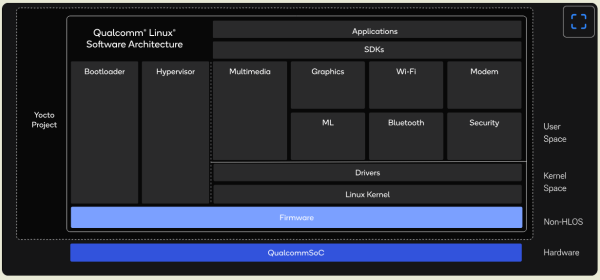
The release of Qualcomm Linux 2.0 is notable for the transition to using Yocto platform 6.0 and the implementation of Linux kernel 6.18 (previously used Yocto 5.0 and kernel 6.6). The core includes capabilities for running applications in real-time (the kernel is compiled with PREEMPT_RT support). Instead of two separately maintained variants of the distribution, 'Base' and 'Custom', a unified stack is offered with one common kernel and system environment (rootfs).
The transparency of the development processes has increased: releases are now generated publicly on GitHub using an open continuous integration system and a predictable schedule for publishing updates. The organization of modular overlays has been restructured, with additions now created from a single open codebase, rather than splitting open and proprietary builds. In addition to the previously supported SoC QCS5430, QCS6490, IQ9075, IQ8275, and IQ615, support for the IQ-X platform for industrial computers has been added.
Meta-packages with basic functionality are now developed in publicly accessible repositories and are open to changes from external participants, forking, or use without waiting for releases. Some of these meta-packages include: meta-qcom (hardware support layer), meta-qcom-distro (distribution framework, build scripts for system images and configuration), meta-qcom-3rdparty (components for supporting third-party platforms), and meta-qcom-releases (reproducible release builds), meta-selinux (mandatory access control via SELinux), meta-updater (OTA updates based on OSTree), meta-security (additional mechanisms to enhance baseline security and auditing), and meta-virtualization (Docker, Kubernetes). KVM).
In addition to meta-packages, overlays are offered as separately supplied versioned sets with kernel modules and libraries to support extended capabilities. Installing an overlay leads to the installation of the corresponding optimized kernel modules and libraries on top of the standard base environment without altering it. Some available overlays include:
- audio processing (AudioReach and hardware acceleration for sound processing);
- camera management (camX ISP);
- graphics processing (acceleration of OpenGL ES, OpenCL, and Vulkan on the Adreno GPU);
- video processing (using the VPU Iris for accelerated video encoding and decoding);
- sensor support (integration of Qualcomm Sensor Hub);
- computer vision tasks (acceleration of FastCV on DSP/Adreno).
Source: opennet.ru
