

August 24, 1995, marked the official presentation of the legendary Windows 95, which brought graphical user interface operating systems to the masses and made Microsoft widely known. Twenty-five years later, let's try to understand how 'Windows' won the hearts of billions of users around the world.
One of the most important features of Windows 95 was that the operating system allowed users to operate the computer without needing to interact with the command line. Unlike its predecessor, Windows 3.11, the new OS loaded directly into the graphical interface, even though the same DOS kernel, albeit significantly improved, lay beneath it. It’s worth noting that before Windows 95, users had to purchase MS-DOS and Windows separately, and then install the shell on top of the OS. The 'Ninety-Five' combined the graphical interface and the OS into one complete product. Moreover, for most users, the upgrade was completely painless, as Windows 95 offered backward compatibility with all software written for DOS.
On the other hand, due to the use of the DOS kernel, Windows 95 was plagued by unpleasant crashes, often related to memory management conflicts, a flaw absent in Windows NT. However, the popularization of NT systems among everyday users began only five years later with the release of Windows 2000, and the full transition was completed a year later with the release of the legendary Windows XP.

In addition, Windows 95 introduced elements such as the Start menu and the taskbar for the first time, without which it is now hard to imagine using a computer. Microsoft positioned the 'Start' as a key component of the system, a simple way for inexperienced users to begin working with their PCs. The taskbar also provided users with a convenient way to manage programs opened in different windows, a feature that none of the popular operating systems at the time could boast.
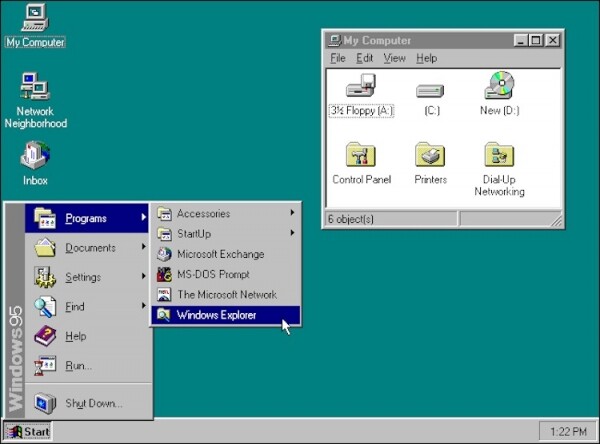
Among other significant innovations, Windows 95 introduced the file manager "Explorer", which notably differed from what was available in previous versions of operating systems, where file and application management was divided among different programs and resembled the functionality of its counterpart in Mac OS. Additionally, contextual menus could be invoked with the right mouse button, file shortcuts, a recycle bin, device manager, system-wide search, and built-in support for Win32 applications and DirectX, which allowed for fullscreen gaming.
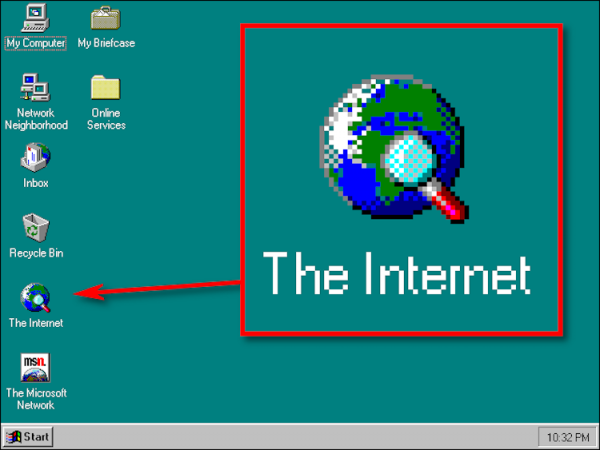
Windows 95 initially did not include a web browser, which had to be installed separately. In December 1995, the legendary Internet Explorer, originally called Internet, was integrated into Windows 95. This so outraged developers of third-party browsers that in 1998, Microsoft became the subject of a major antitrust hearing.
Moreover, the launch of Windows 95 was accompanied by the most expensive advertising campaign at the time, costing around $300 million. The OS was advertised everywhere: in newspapers, magazines, on the radio, television, and billboards.
The effect was impressive. Microsoft sold one million copies of Windows 95 in its first week. The total number of copies sold in the first year reached about 40 million. Windows 95 became a truly outstanding product in the operating system market, and many of the features and characteristics that were introduced with it 25 years ago still thrive in the current Windows 10.
Source:
Source: 3dnews.ru
