

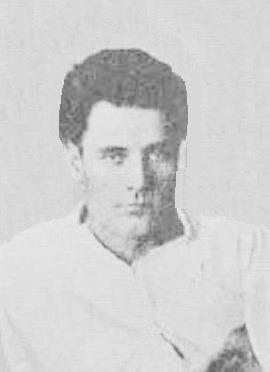
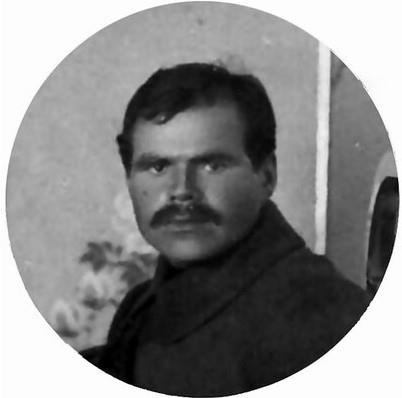
In my childhood, I was probably an anti-Semite. And it was all because of him. There he is.
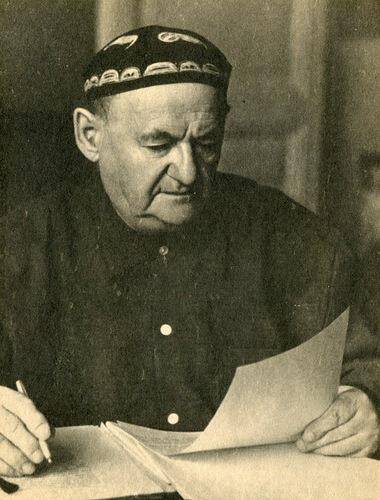
He used to annoy me all the time. I just adored the magnificent cycle of stories by Paustovsky about the thieving cat, a rubber boat, etc. And he ruined everything.
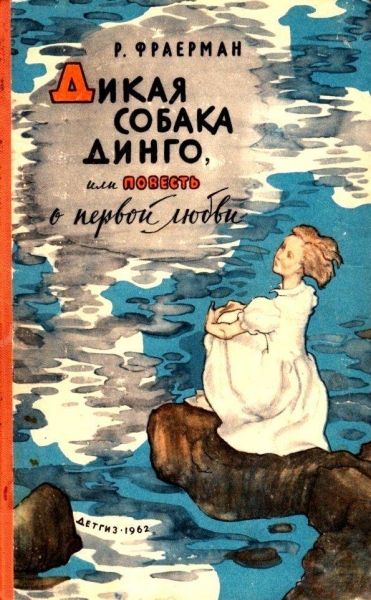
I couldn't understand for a long time why Paustovsky hung out with this Fraerman. Some caricatured Jew with a silly name — Ruven. No, of course, I knew he was the author of the book 'The Wild Dingo Dog, or A Tale of First Love,’ but that only worsened the situation. No, I hadn't read the book and had no intention to. What self-respecting boy would read a book with such a sappy title when 'The Odyssey of Captain Blood' hasn't been read for the fifth time?
But Paustovsky... Paustovsky was cool. A truly great writer; I somehow understood that even as a child.
And when I grew up and learned about his three nominations for the Nobel Prize, international fame, and Marlene Dietrich publicly kneeling before her favorite writer, I respected him even more.
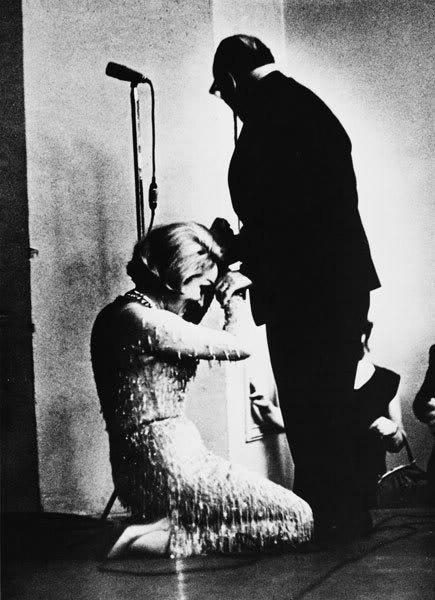
I came to respect him even more when I got wiser and reread his books... Paustovsky not only saw a lot and understood much about this world — he was wise. And that is a very rare quality. Even among writers.
Especially among writers.
Around that time, I also understood why he hung out with Fraerman.
And after the recent story about the demons of the Civil War, I decided to tell you as well.
***
I've always been amazed by why poignant films were made about the Great Patriotic War that made people cry, while the Civil War was some sort of entertainment attraction. Mostly, they made lighthearted, entertaining 'historicals' like 'White Sun of the Desert' or 'The Elusive Avengers.'
And it wasn't until much later that I figured out — this was what psychology calls 'substitution.' Behind this entertainment, they hid the truth from us about what the Civil War really was.
Believe me, there are cases where it is not a fact that the truth needs to be known.
In history, just like in mathematics, there are axioms. One of them states: in Russia, nothing is scarier than the Time of Troubles.
No wars, no epidemics could compare. Anyone who delves into the documents will recoil in horror and repeat after the stunned classics who tried to study the Pugachev's rebellion: "God forbid to see a Russian rebellion...".
The Civil War was not just horrific — it was something beyond imagination.
I can't help but repeat — it was hell unleashed on earth, a breach of Inferno, an invasion of demons that consumed the bodies and souls of once-peaceful citizens.
It resembled a mental epidemic — the country went mad and fell into chaos. For a couple of years, there was no authority at all; the land was ruled by small and large groups of crazed armed men who flailed aimlessly, devouring each other and soaking the ground in blood.
The demons showed no mercy to anyone; they infected both the Reds and the Whites, the poor and the rich, criminals and peaceful inhabitants, Russians and foreigners alike. Even the Czechs, who in ordinary life are peaceful hobbits. They were already being transported home in trains, but even they got infected, and blood flowed from Penza to Omsk.
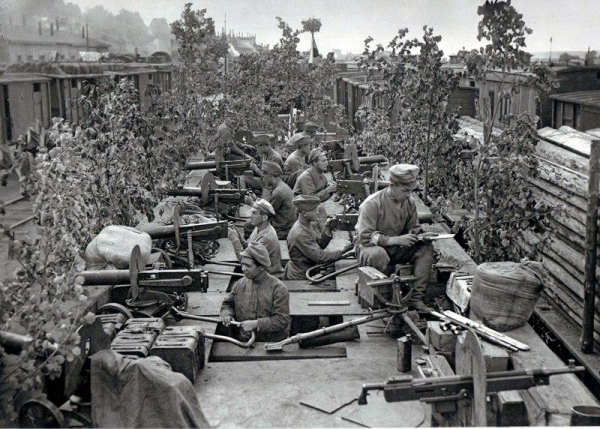
I will recount just one episode of that war, later referred to by diplomats as the 'Nikolaev Incident.' I won't go into detail; I'll just provide the main outline of events.
There was a field commander of 'Red' orientation named Yakov Tryapitsin. He was indeed an extraordinary man. A former ensign, who rose to officer rank from the ranks during World War I, a soldier who received two St. George's crosses. An anarchist, he fought against those very White Czechs in Samara during the Civil War, later retreating to Siberia and making his way to the Far East.
Once, he quarreled with the command, and dissatisfied with the decision to suspend hostilities until the arrival of the Red Army, he left with his loyal men, which amounted to just 19. Despite this, he announced that he was going to restore Soviet power on the Amur River and set off on a campaign — already with 35 men.
As the raid progressed, the detachment grew; they began to occupy villages. Then, the commander of the garrison in Nikolaevsk-on-Amur, the de facto capital of the region, White Colonel Medvedev sent a detachment led by Colonel Vits to confront Tryapitsin. The Whites planned to eliminate the Reds before they gained more strength.
Meeting with the punitive forces, Tryapitsin, stating that he wanted to avoid bloodshed, personally went to the whites' headquarters for negotiations. The charisma of this man was so great that soon after, a rebellion broke out in Vitsa's detachment, and the colonel, along with a few remaining loyal fighters, retreated to De-Kastri Bay, while most of the recent white soldiers joined Tryapitsin's detachment.
Since there were almost no armed forces left in Nikolaevsk — only about 300 fighters — the whites in Nikolaevsk invited the Japanese for the city's protection. They, of course, were keen to comply, and soon a Japanese garrison of 350 men under the command of Major Ishikawa was stationed in the city. Additionally, about 450 Japanese civilians lived in the city. As in all Far Eastern cities, there were many Chinese and Koreans, and a detachment of Chinese gunboats led by Commodore Chen Shin was wintering in Nikolaevsk, having not had time to reach the Chinese shore of the Amur before the ice formed.
By spring and the breaking of the ice, all of them found themselves trapped in the city, from which there was no escape.
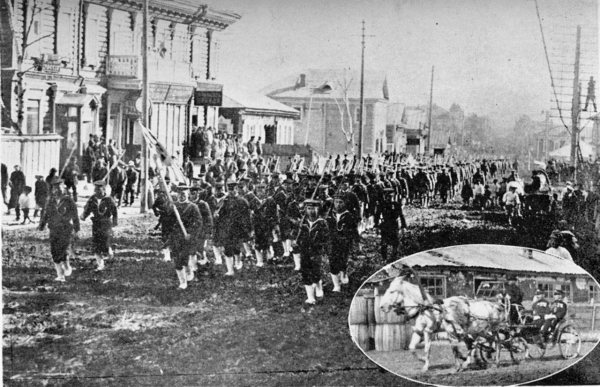
The entry of Japanese troops into Nikolaevsk-on-Amur in 1918. Major Ishikawa is separately noted in a horse-drawn carriage.
However, soon after, making an unprecedented winter crossing, Tryapitsin's 2,000-strong 'partisan army' approached the city, among whom was Ruven Fraerman — an infected geek, a recent student of the Kharkov Technological Institute, who had been sent on an internship to the railway in the Far East after his third year. It was here that the Civil War found him, in which he sided with the reds and was now one of Tryapitsin's agitators.
The city was besieged.
And the long and horrifically bloody dance of the demons of the Civil War began.
It all started small — with two individuals, red negotiators Orlov-Ovcharenko and Shchetikov, who were killed by the whites.
Then the reds propagandized the garrison of the fort Chnyrrah, which controlled the approaches to Nikolaevsk-on-Amur, and took the fort, gaining artillery.
Under the threat of shelling the city, the Japanese declared their neutrality.
The reds entered the city and occupied it practically without resistance, seizing, among other things, the entire archive of the white counterintelligence.
The disfigured bodies of Ovcharenko and Shchetnikov are displayed in coffins in the garrison assembly building of the Chnyrrah fortress. The partisans demand revenge, and arrests and executions of the whites begin based on the counterintelligence lists.
The Japanese maintain neutrality and actively communicate with the new masters of the city. Soon, the conditions of their stay in their quarter are forgotten, fraternal bonds begin, and armed Japanese soldiers, wearing red and black (anarchist) ribbons, wander throughout the city, while their commander is even allowed to maintain radio contact with the Japanese headquarters in Khabarovsk.
However, the idyll of brotherhood quickly came to an end. On the night of March 11 to March 12, the Japanese open fire on the headquarters building of Triapitsyn with machine guns and incendiary rockets, hoping to decapitate the Red forces immediately. The building was wooden, and a fire breaks out. The head of the staff, T. I. Naumov-Medved, dies; the staff secretary Pokrovsky-Chernykh, cut off from the exit by flames, shoots himself; Triapitsyn, with gunshot wounds to his legs, is carried out on a bloody sheet and, under fire from the Japanese, is moved to a neighboring stone building, where they organize a defense.
Shooting and fires rage across the city; it quickly became clear that in the armed uprising not only the soldiers of the Japanese garrison participated, but also all able-bodied Japanese men.
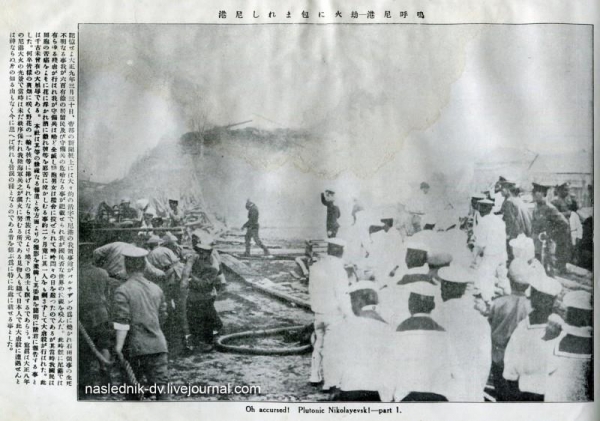
The battles are to the death, and both sides finish off the prisoners.
Triapitsyn's personal bodyguard, a former convict from Sakhalin nicknamed Lapta, breaks through with a squad to the prison and cuts down all the inmates.
To avoid attracting the attention of the Japanese with gunfire, everyone is 'finished off' with cold weapons. Since blood intoxicates no less than vodka, maddened people kill not only the arrested whites but also their own partisans who were sitting in the guardhouse.
The fighting in the city lasts several days, with the outcome of the battle being determined by the commander of the partisan detachment of red miners, Budrin, who came with his squad from the nearest major settlement—Kirby village, located 300 km from Nikolaevsk.
Ultimately, all the Japanese were wiped out, including the consul, his wife and daughter, and geishas from local brothels. Only 12 Japanese women, married to Chinese men, survived—they hid with the urban Chinese on the gunboats.
The new commander of the partisan unit is appointed as Trjapicin's mistress, Nina Lebedeva—a maximalist SR, exiled to the Far East as a high school student at 15 for participating in an assassination attempt on the governor of Penza.
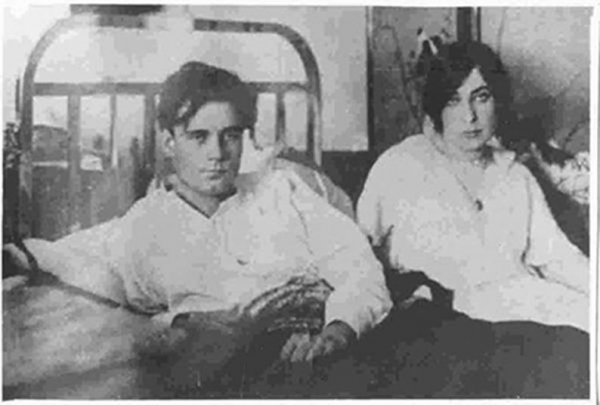
Wounded Y. Trjapicin with his common-law wife N. Lebedeva.
After the defeat of the Japanese, the Nikolaev Commune is announced in the city, currency is abolished, and a real hunt for the bourgeoisie begins.
Once set in motion, this mechanism is practically impossible to stop.
I will spare you the bloody details of what happens next in Nikolaevsk; I will only say that the outcome of the so-called 'Nikolaev incident' was the death of several thousand people.
This includes all together, different: reds, whites, Russians, Japanese, intellectuals, hunhuzi, telegraphers, convicts, and thousands of various others.
And the complete destruction of the city—after the evacuation of the population and the departure of Trjapicin's squad, nothing was left of old Nikolaevsk.
No-thing.
As calculated later, out of 1,165 residential buildings of various types, 21 buildings (stone and half-stone) were blown up, and 1,109 wooden ones were burned, thus a total of 1,130 residential houses were destroyed, which is almost 97% of the entire housing stock of Nikolaevsk.
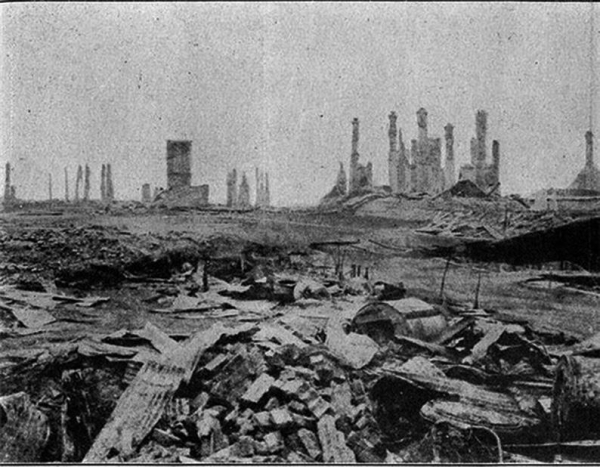
Before leaving, a blood-crazed Trjapicin sent a radio telegram:
Comrades! We speak to you for the last time. We are leaving the city and the fortress, blowing up the radio station and heading into the taiga. The entire population of the city and district has been evacuated. Villages along the coast and in the lower reaches of the Amur have been burned. The city and fortress are destroyed to the ground, major buildings blown up. Everything that could not be evacuated and that could be used by the Japanese has been destroyed and burned by us. In place of the city and fortress remain only smoking ruins, and our enemy, upon arriving here, will find only piles of ash. We are leaving...
You may ask—what about Fraerman? There is no evidence of his involvement in the atrocities, rather the opposite.
A mad playwright named Life decided that it was at this moment that the former Kharkov student should experience his first love. Naturally, it was an unhappy one.
Here is what partizán Sergey Ptitsin wrote in his memoirs:
«Rumors of the supposed terror spread among the population, and people who did not receive passes (for evacuation) rushed in horror around the city, seeking any means and ways to escape. Some young, beautiful women from the bourgeoisie and widows of shot White Guards offered themselves as wives to partisans in order to get help to leave the city, entered into relations with more or less responsible workers to use them for their salvation, and threw themselves into the arms of Chinese officers from the gunboats to escape with their assistance.
Fraerman risked his life to save the priest's daughter, Zinaida Chernykh, helped her hide as if she were his wife, and later, appearing to her in another setting, was not recognized as her husband.
There is no evidence of his involvement in the atrocities.
But he was there and saw it all. From the beginning — and practically to the end.
***
Tsyapitsyn, Lebedev, Lapta, and another twenty individuals who distinguished themselves in the destruction of Nikolayevsk were "finished off" by their own partisans, not far from that same village of Kirbi, now the village named after Polina Osipenko.
The successful conspiracy was led by a former lieutenant, now a member of the executive committee and head of the regional police, Andreev.
They were shot by the decision of a quick trial long before receiving any instructions from Khabarovsk and even more so from Moscow.
Simply because, after crossing a certain line, people must be killed — by both human and divine laws, at least out of a sense of self-preservation.
Here it is, the executed leadership of the Nikolayevsk Commune:
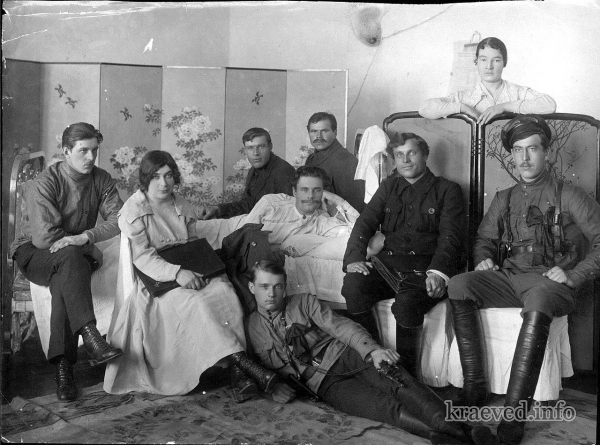
Fraerman did not participate in the execution of the former commander — shortly before the evacuation, he was appointed commissioner of a partisan unit formed to establish Soviet power among the Tungus.
«With this partisan unit, — the writer himself recalled in his memoirs, — I traversed thousands of kilometers through impenetrable taiga on reindeer…». The journey lasted four months and ended in Yakutsk, where the unit was disbanded, and the former commissioner started working at the newspaper 'Lensky Communard.'
***
They lived in the forests of Meshchera together — he and Paustovsky.
He too had seen a lot during the Civil War — both in occupied Kyiv and in the independent army of Hetman Skoropadsky, and in the Red regiment formed from former Makhnovists.
To be precise, it was three of them, as their very close friend Arkady Gaidar often visited. This was even mentioned in Soviet slide films.
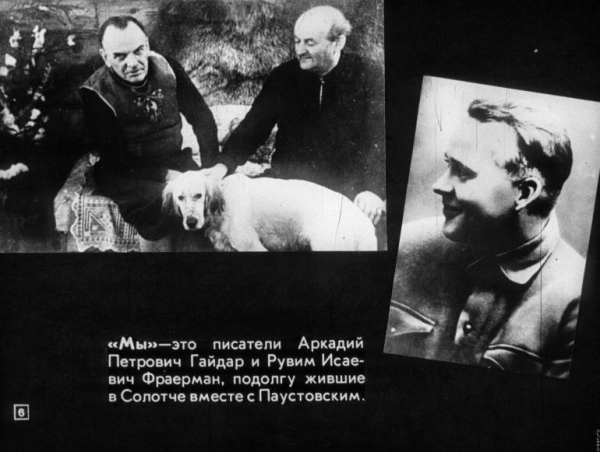
The same Gaidar who once wrote in his diary: “I dreamt of the people I killed in my childhood.”.
There, in the unspoiled forests and lakes of Meshchera, they cleansed themselves.
They transformed the dark demonic energy into precious words of rare purity and tenderness.
Gaidar wrote the 'Blue Cup' there — the most crystalline work of Soviet children's literature.
Freyerman remained silent for a long time, but then he burst out and wrote 'The Wild Dog Dingo, or The Tale of First Love' in a week.
The story, set in the Soviet era, features a city on the Amur that is vividly recognizable from the book's details.
This is the very pre-revolutionary Nikolaevsk-on-Amur that no longer exists.
The city they erased.
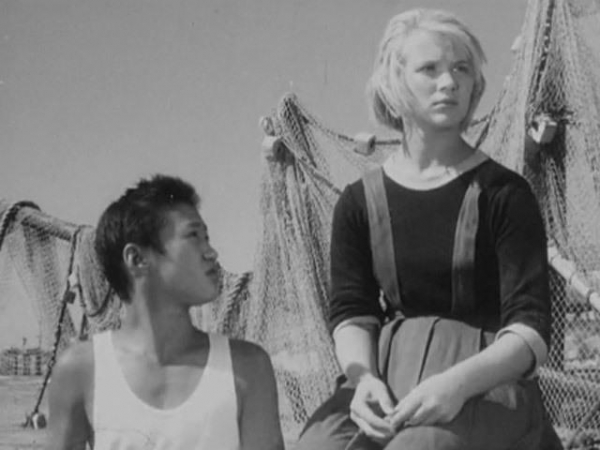
Pauostovsky wrote at that time: “The expression 'kind talent' directly relates to Freyerman. It is a kind and pure talent. Therefore, Freyerman was able to delicately touch upon aspects of life such as first youthful love. Freyerman's book 'The Wild Dog Dingo, or The Tale of First Love' is a bright, transparent poem about the love between a girl and a boy.”.
They generally lived well there. In a way that felt right, kind, and joyful:
Gaidar always came with new playful poems. Once, he wrote a long poem about all the young writers and editors of the Children's Publishing House. This poem got lost and forgotten, but I remember the cheerful lines dedicated to Freyerman:
In the skies above the entire universe,
Tormented by eternal sorrow,
The unshaven, inspired one gazes,
The all-forgiving Ruvi…
They only allowed themselves to release their suffocated demons once.
In 1941.
You probably know about Gaidar; Pauostovsky wrote to Freyerman from the front: 'I spent a month and a half on the Southern Front, almost all the time, except for four days, at the front line...'.
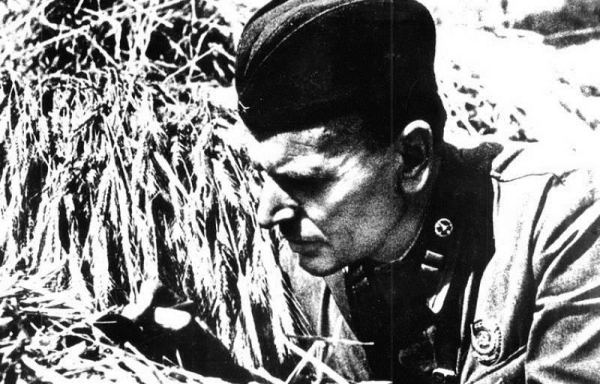
Pauostovsky at the Southern Front.
And Freyerman... Freyerman, who was already nearing his sixth decade, joined the Moscow militia in the summer of '41 as a private soldier. He didn’t hide from the frontline and thus suffered a serious wound in 1942, after which he was discharged.
The former Kharkiv student and partisan agitator was destined for a long life — he lived for 80 years.
And every day, like Chekhov's character, he squeezed out this black demon of the Civil War from himself.
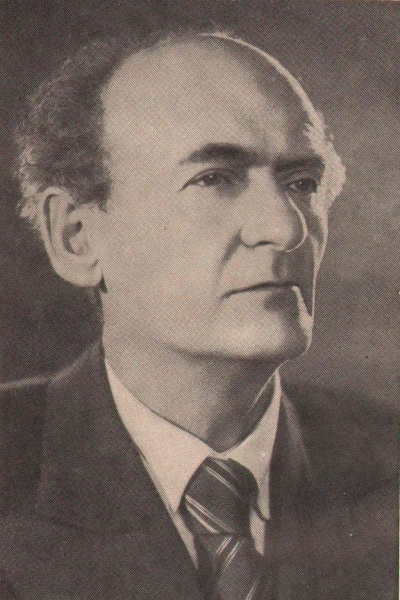
Unlike his friends Paustovsky and Gaidar, he was not a great writer. However, according to many recollections, Ruven Fraerman was one of the brightest and kindest people they had ever met.
And after that, Ruven Isaevich's lines sound completely different:
“To live one's life with dignity on earth — this is also a great art, perhaps even more complex than any other mastery…”.
P.S. Do read "The Cat Burglar" if you haven't yet.
Source: habr.com
