

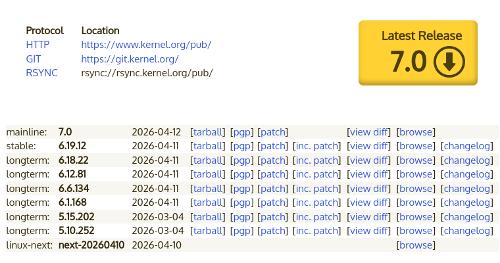
After two months of development, Linus Torvalds presented announced the release of the kernel Linux 7.0Among the most notable changes: rules for the use of AI assistants, translation of Rust into core capabilities, improved swap performance, enabling PREEMPT_LAZY mode by default, support for filters for io_uring operations, a new FS Nullfs, fserror infrastructure, monitoring tools for XFS, support for remapping in Btrfs, enabling version NFS 4.1 by default, integration of the post-quantum crypto algorithm ML-DSA, activation of AccECN in the network subsystem, initial support for WiFi 8.
The number 7.0 was assigned because the 6.x branch accumulated enough releases to change the first digit of the version number (at the time, version 6.0 was released right after 5.19). The change in numbering is made for aesthetic reasons and is a formal step to alleviate discomfort from the accumulation of a large number of releases in the series.
The new version includes 15,624 fixes from 2,477 developers, with a patch size of 56 MB (changes affected 18,053 files, added 704,060 lines of code, and removed 278,132 lines). In the previous release, there were 15,657 fixes from 2,237 developers, with a patch size of 52 MB. About 51% of all the changes in 7.0 relate to device drivers, approximately 11% pertain to architecture-specific code updates, 14% is related to the network stack, 5% to file systems, and 3% to internal kernel subsystems.
Key innovations in kernel 7.0 (kernelnewbies.org, lwn.net, OpenNET):
- Disk subsystem, input/output, and file systems
- The fserror infrastructure has been implemented and implemented API for obtaining information on I/O errors and metadata corruption while working with files. The proposed infrastructure unifies the transmission of error information from file systems to user space through the fsnotify mechanism.
- In XFS added new capabilities for monitoring the state of the file system from user space. An ioctl operation XFS_IOC_HEALTH_MONITOR is proposed, returning a file descriptor through which information about failures related to metadata corruption or I/O errors can be obtained, as well as tracking changes in FS states, such as unmounting and shutdown. Additionally, a managed background process xfs_healer is proposed, which handles FS state events from user space and, if necessary, automatically initiates recovery procedures.
- Experimental support for the "remapping tree" structure has been added to the Btrfs file system (remap tree), which may serve as an intermediary layer for input-output operations in the future. The essence of the added feature is that after moving the data on the storage device, instead of updating all structures related to this data in the additional 'remap tree' structure, both old and new data addresses are stored, allowing address replacements when accessing the data. This new approach is presented as more reliable and flexible, simplifying further expansion of Btrfs functionality.
- In Btrfs within direct input/output support in situations where the block size exceeds the system's page size.
- finalrd enabled the new filesystem Nullfs, which can be used as a placeholder for the root FS. The Nullfs filesystem is always empty, contains no data, and does not support changes. Its purpose is to serve as the initial FS to simplify the system boot process—other FSs are then mounted on top of Nullfs, and the system call pivot_root() is used to switch the root FS instead of clearing the contents of initramfs and using the associated root FS.
- Implemented updating the file modification time information in a non-blocking mode. Previously, calling file_update_time_flags() with the IOCB_NOWAIT flag returned an error -EAGAIN, which prevented direct write operations from being used in non-blocking mode.
- In filesystems as a separate optional feature translated support for notification locks (lease). By default, such a mechanism is now not activated due to issues with filesystems that were not originally designed for its use. For example, it is not supported by the 9p and cephfs filesystems.
- In the EROFS (Extendable Read-Only File System), intended for use on partitions available in read-only mode, the LZMA algorithm is used for compression by default. Optionally available algorithms include DEFLATE and Zstandard, which are no longer marked as experimental. Shared entries in the page cache for identical files in separate EROFS filesystems have been implemented.
- Removed The laptop_mode, which saves energy consumption by deferring and merging disk write operations to extend the drive's sleep time and reduce the number of wake-ups. This mode has become obsolete, as traditional hard drives have been replaced by solid-state drives in modern mobile devices.
- The F2FS file system has been translated to use large memory folios (large folios).
- The work on the ntfs3 driver has been revived, developed by Paragon Software. Support has been added for file operations based on iomap, implementing the llseek SEEK_DATA/SEEK_HOLE options, and the delalloc mode for deferred block allocation. Meanwhile, in the kernel developers' mailing list in February, there was inclusion in one of the future kernel versions of a new implementation of NTFS — approved ntfsplus , designed to replace ntfs3.By default, during the build process,
- the NFS protocol version 4.1 (CONFIG_NFS_V4_1) is enabled. enabled The export locking of specialized pseudo-FS such as pidfs and nsfs through NFS is implemented. In NFSD, Ensured an experimental option for using POSIX ACL and within support for dynamically adjusting the thread pool based on load has been introduced. has added Official rules have been approved for
- Memory and system services
- Virtualization and Security
- In the io_uring asynchronous I/O system within the ability to attach BPF programs with filters controlling what specific SQE (Submission Queue Entry) operations can do (similar to system calls in io_uring). The added capability is analogous to system call filters. Filters can be bound to specific tasks and they are inherited when other processes are spawned after a fork() call. With active filters, additional filters added on top can only impose further restrictions but cannot disable existing ones. This implemented capability will allow blocking methods the bypassing of system call filtering in sandbox environments, based on performing similar operations provided in io_uring instead of system calls.
- In SELinux has added the ability to manage access to BPF tokens, allowing unprivileged processes to perform certain privileged operations with BPF, such as loading BPF programs into the kernel and creating map structures..
- Added support for the digital signature generation algorithm ML-DSA (CRYSTALS-Dilithium), based on lattice theory and resistant to attacks on quantum computers. Provided the ability to use ML-DSA for core module authentication.
- Removed the ability to use digital signature generation schemes with the SHA-1 algorithm for core module validation (support for loading signed modules is retained).
- In the NETFILTER_PKT audit log added the sport and dport fields for inspecting network port numbers, not just IP addresses.
- For RISC-V architecture systems within support for Zicfiss and Zicfilp extensions that provide hardware capabilities for applying CFI (Control Flow Integrity) protection, preventing disruptions to the normal execution order of instructions (control flow) caused by exploits altering in-memory function pointers.
- In the KVM hypervisor within the ability to pass information to guest systems about the processor's support for the ERAPS (Enhanced Return Address Predictor Security) extension, which minimizes certain CPU state reset operations when returning control from a guest system to the host. Additionally, has added support for assigning hardware to guest systems for performance monitoring (PMU, Performance Monitoring Unit), improving profiling accuracy compared to emulated PMUs.
- In the Hyper-V hypervisor driver has added support for the debugfs interface to view statistics about hypervisor performance.
- Network subsystem
- The AccECN extension is enabled by default (Accurate Explicit Congestion Notification), which implements an improved version of the ECN (wikipedia.org), allowing hosts to mark IP packets in case of congestion instead of discarding them, enabling the identification of the initial stage of congestion in communication channels without packet loss. The original ECN extension has a limitation that allows only one congestion signal to be sent within one TCP round-trip time (RTT). AccECN removes this limitation and allows the receiver to send more than one congestion mark to the sender in the TCP packet header. Congestion control algorithms can utilize the information received to respond more accurately to congestion and avoid sharp reductions in packet transmission rates during minor congestion.
- In the implementation of the network queue management algorithm, Cake has added support for processing multiple queues to distribute the load across several CPU cores. The CAKE algorithm is applied to reduce the negative impact of intermediate packet buffering on edge network devices, aiming to achieve maximum possible throughput and minimal latency even on slow communication channels.
- In sockets, VSOCK,, used for interaction with virtual machines, has added support for network namespaces.
- Added initial implementation of the future standard WiFi 8 (802.11bn, Ultra High Reliability WiFi).
- Additional optimizations that improved the processing performance of incoming UDP packets by 12% during stress testing in a 100-gigabit network.
- Hardware
- In the AMDGPU driver, within disabling the tracker blocking IP blocks,, used in new AMD GPUs such as SMUIO 15.x, PSP 15.x, IH 6.1.1/7.1, MMHUB 3.4/4.2, GC 11.5.4/12.1, SDMA 6.1.4/7.1/7.11.4 and JPEG 5.3.
- Frequency management has been improved in the Nouveau driver for Tegra 186+ systems.
- In the i915 driver has added initial support for the display IP block Xe3p_LPD, used in Intel Nova Lake-P processors.
- Continued work on the drm driver (Direct Rendering Manager) Xe for GPUs based on the Intel Xe architecture, which is used in Intel Arc family graphics cards and integrated graphics starting with Tiger Lake processors. A mode has been added Multi Queue,. Additional the components needed for diagnosing GPU hangs in Mesa. Added support for the MERT mechanism for managing GPU memory access.
- Continued Integration of Nova driver components for NVIDIA GPUs equipped with GSP firmware, used starting with the NVIDIA GeForce RTX 2000 series based on the Turing microarchitecture. The driver is written in Rust. The new version prepares for the implementation of support for Turing-based GPUs and includes various internal changes.
- Added Support for controllers and peripherals with a multi-channel SPI (Serial Peripheral Interface), allowing data to be transmitted in multiple parallel streams.
- Added Driver for combined Type-C connectors used on devices with Apple Silicon chips, integrating USB3, DP-AltMode, and Thunderbolt/USB4 interfaces.
- Added support for audio subsystems of Tegra238 chips, Minisforum V3 SE, iBasso DC04U, Intel Nova Lake, Nova Lake S, and Focusrite Forte.
- Added support for ARM platforms, SoCs, and devices: Arduino UnoQ, OrangePi 6 Plus, OrangePi CM5, Anbernic RG-DS, Realtek Kent, Qualcomm Kaanapali, Mediatek Ezurio, Facebook Anacapa, Microchip LAN9668, Khadas VIM1S, QNAP TS133, i.MX952, i.MX93, i.MX94, VHIP4 EvalBoard, TQ-Systems MBLS1028A, Agilex5, Radxa CM3J, Glymur,
- Support added for smartphones and tablets: Fairphone Gen 6 (SoC Qualcomm Milos/Snapdragon 7s Gen 3), Pixel 3/3 XL, Microsoft Surface Pro 11.
At the same time, the Latin American Free Software Foundation has formed variant completely free kernel 7.0 – Linux-libre 7.0-gnu, cleaned of elements from firmware and drivers containing non-free components or code segments whose scope is restricted by the manufacturer. In the 7.0 release, the cleanup from iwlwifi driver blobs was performed. The cleanup code in the amdgpu, adreno, TI PRUeth, air_en8811h, ath12k, TI VPE, rtw8852b, rt1320, rt5575 SPI, tas2783, Intel catpt drivers has been updated. Blob names in dts files (devicetree) for ARM chips were cleaned.
Source: linux.org.ru
