

The Linux Foundation has presented the twenty-first release of the AGL UCB (Automotive Grade Linux Unified Code Base) distribution, which develops a universal platform for use in various automotive subsystems, ranging from dashboards to automotive infotainment systems. At the same time, the first release of the AGL SoDeV (Software Defined Vehicle) reference platform has been introduced, intended for creating software-defined automotive systems based on Automotive Grade Linux.
SoDeV is a combined product that integrates the AGL UCB distribution, LXC (Linux Containers), VirtIO, the Xen hypervisor, Zephyr RTOS, and other Linux Foundation projects. The first release of SoDeV can run on Renesas Sparrow Hawk boards, in cloud environments, or in virtual machines. The project allows automotive manufacturers to accelerate time-to-market by decoupling software development from hardware systems through hardware abstraction via virtualization. Throughout 2026, broader support for SoCs used by automotive manufacturers is planned. The project is being developed with the participation of companies like Panasonic Automotive Systems, Honda, Toyota, Mazda, AISIN, and Renesas. 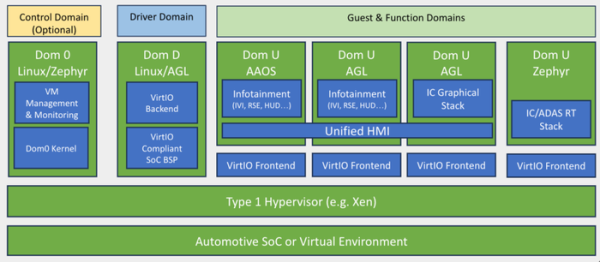
The AGL UCB distribution is based on developments from the Tizen, GENIVI, and Yocto projects. The graphical environment is based on Qt, Wayland, and the Weston IVI Shell project. Demonstration builds of the platform have been created for QEMU, Renesas H3 boards, Intel Up², Raspberry Pi 4, and Raspberry Pi 5. Companies such as Toyota, Ford, Nissan, Honda, Jaguar Land Rover, Mazda, Mitsubishi, and Subaru are contributing to the development of the distribution.
AGL UCB can be used by automakers as a framework for creating final solutions, after conducting the necessary adaptation for the hardware and customizing the interface. The platform allows focusing primarily on the development of applications and personal methods of organizing user work, without worrying about the low-level infrastructure and minimizing maintenance costs. The project is completely open — all components are available under free licenses.
A set of working prototypes of typical applications has been provided, developed using HTML5 and Qt technologies. For example, there is an implementation of a home screen, web browser, dashboard, navigation system (using Google Maps), climate control, a multimedia player with DLNA support, an interface for configuring the sound system, and a news reading app. Features for voice control, information searches, smartphone interaction via Bluetooth, and connections to the CAN network for sensor access and data exchange between vehicle nodes are also offered.
Among the changes in the new version of AGL UCB:
- Synchronization with Yocto platform components 5.0.16 has been implemented;
- The Flutter Embedder and Workspace Automation toolkits have been updated, improving performance, resolving rendering issues, and introducing new user interface capabilities. The versions of Flutter SDK 3.38.3 and Dart language 3.10.1 have also been updated.
- The Qt 6.8 library has been utilized.
- The VSS (Vehicle Signal Specification) specification has been updated to version 6.0.
- The Distributed Display Framework has transitioned to using the gRPC protocol.
- The BSP (Board Support Package) layers have been updated: meta-arm, meta-freescale, meta-freescale-3rdparty, meta-raspberrypi, meta-renesas, meta-riscv, meta-rockchip, meta-tegra, meta-ti.
- The following layers have been updated: meta-aws, meta-clang, meta-flutter, meta-openembedded, meta-selinux, meta-virtualization, meta-python-ai, meta-qt6.
Source: opennet.ru
