

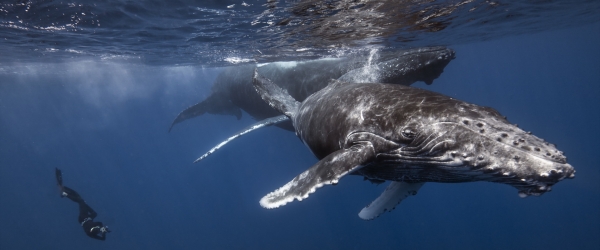
It's hard to argue with the statement that nature has the brightest imagination. Each representative of flora and fauna has its own unique and sometimes downright strange characteristics that often baffle us. Take, for example, the mantis shrimp. This predatory creature can strike its prey or adversary with its powerful claws at a speed of 83 km/h, and its visual system is one of the most complex ever studied by humans. Mantis shrimps, while fierce, are not particularly large—growing up to 35 cm in length. The largest creature of the seas and oceans, as well as the entire planet, is the blue whale. This mammal can reach lengths of over 30 meters and weigh up to 150 tons. Despite its imposing size, blue whales can hardly be called fearsome hunters, as they prefer plankton.
The anatomy of blue whales has always intrigued scientists who wish to better understand how such a massive organism and its organs function. Despite us knowing about the existence of blue whales for several hundred years (since 1694, to be precise), these giants have not revealed all their secrets. Today, we will learn about a study in which a group of researchers from Stanford University developed a device that captured the first recordings of a blue whale's heartbeat. How does the heart of the ruler of the seas work, what discoveries have the scientists made, and why can there be no organism larger than the blue whale? We will find out from the research group's report. Let's go.
Hero of the study
The blue whale is the largest mammal, the biggest inhabitant of the seas and oceans, the largest animal, the largest whale. What can I say, the blue whale truly stands out in terms of size—33 meters long and weighing 150 tons. These figures are approximate, but no less impressive for that.
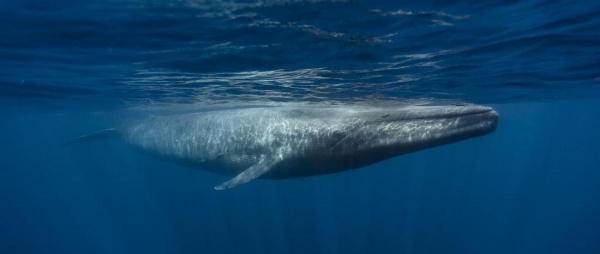
Even the head of this giant deserves a separate line in the Guinness Book of Records, as it accounts for about 27% of its overall body length. Interestingly, blue whales have relatively small eyes, no bigger than a grapefruit. If you find it difficult to spot a whale's eyes, you'll definitely notice its mouth. A blue whale's mouth can hold up to 100 people (a grim example, but blue whales don't eat people, at least not intentionally). The large size of the mouth is due to dietary preferences: whales consume plankton by gulping huge amounts of water, which they later expel through a filtering system, separating the food. Under sufficiently favorable circumstances, a blue whale consumes about 6 tons of plankton a day.
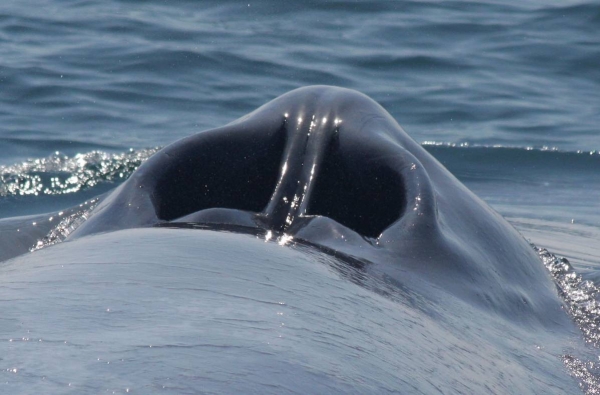
Another important feature of blue whales is their lungs. They can hold their breath for up to 1 hour and dive to depths of up to 100 meters. However, like other marine mammals, blue whales periodically surface to breathe. Upon surfacing, whales use their blowholes — two large openings (nostrils) located on the back of their heads. A whale's exhalation through its blowhole often results in a vertical spray of water that can reach heights of up to 10 meters. Given the characteristics of their habitat, blue whales' lungs operate significantly more efficiently than ours — a whale's lungs absorb 80-90% of the oxygen, while ours only absorb about 15%. The lung capacity is about 3,000 liters, whereas that of a human ranges from 3 to 6 liters.
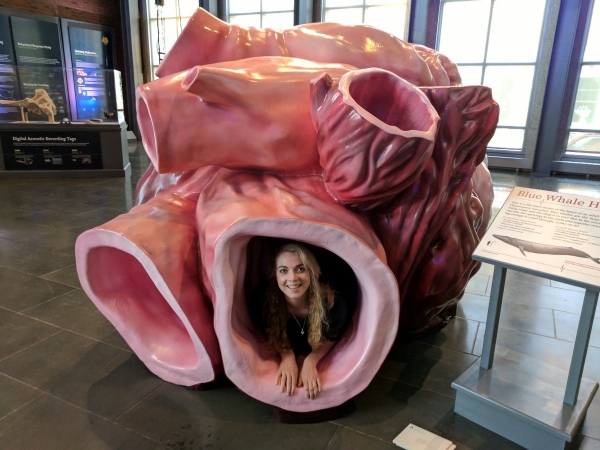
The model of a blue whale's heart at a museum in New Bedford, USA.
The circulatory system of a blue whale is also filled with record parameters. For example, their blood vessels are enormous, with the diameter of just the aorta being around 40 centimeters. The heart of blue whales is considered the largest heart in the world and weighs about a ton. With such a large heart, a whale also has a lot of blood — over 8,000 liters in an adult.
And so we have smoothly approached the essence of the study itself. The heart of a blue whale is large, as we've already understood, but it beats quite slowly. It was previously thought that the pulse ranges from about 5 to 10 beats per minute, occasionally reaching up to 20. However, no precise measurements had been taken until now.
Scientists from Stanford University claim that scale in biology is of immense importance, especially when it comes to determining the functional features of organs in living beings. Studying various organisms, from mice to whales, allows for the identification of size constraints that a living organism cannot exceed. The heart and the cardiovascular system as a whole are significant attributes of such studies.
In marine mammals, whose physiology has fully adapted to their way of life, adaptations related to diving and breath-holding play an important role. It has been established that in many such creatures, during dives, the heart rate decreases to levels below the resting state. Upon surfacing, the heart rate becomes more rapid.
The reduced heart rate during dives is necessary to slow the delivery of oxygen to tissues and cells, thereby slowing the process of depleting oxygen reserves in the blood and reducing oxygen consumption by the heart itself.
There is a hypothesis that exercise (i.e., increased physical activity) modulates the dive response and increases heart rates during diving. This hypothesis is particularly important for studying blue whales, as due to their unique feeding method (a sharp lunge to gulp water), their metabolic rate should theoretically exceed baseline values (resting state) by 50 times. It is assumed that such lunges accelerate oxygen depletion, thereby reducing dive duration.
Increased heart rate and enhanced oxygen transfer from the blood to muscles during lunging may play an important role due to the metabolic costs associated with such physical activity. Additionally, one should consider the low concentration of myoglobin* (Mb) in blue whales (5-10 times lower than in other marine mammals: 0.8 g Mb per 100 g-1 muscle in blue whales and 1.8-10 g Mb in other marine mammals.
Myoglobin* is an oxygen-binding protein found in skeletal muscles and the heart muscle.
In conclusion, physical activity, dive depth, and voluntary control alter heart rates during diving through the autonomic nervous system.
Another factor that may decrease heart rate is the compression/expansion of the lungs during diving/ascending.
Thus, the heart rate during diving and while at the surface is directly related to arterial hemodynamics.
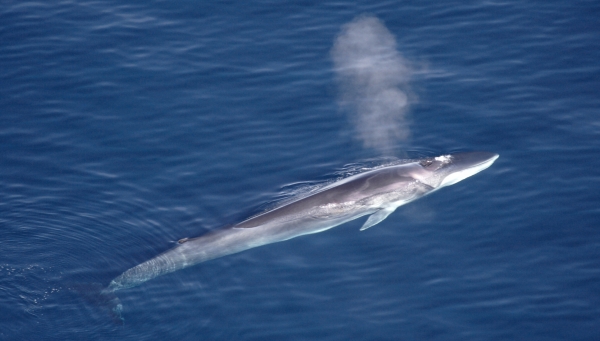
Fin whale
A previously conducted study on the biomechanical properties and dimensions of the aortic walls in fin whales (Balaenoptera physalus) showed that during dives, when the heart rate is ≤10 beats/min, the aortic arch exhibits a Windkessel effect (Windkessel effect), which maintains blood flow during lengthy diastolic periods* between heartbeats and reduces pulsation of blood flow into the rigid distal aorta.
Diastole* (diastolic period) — the period of relaxation of the heart between beats.
All the hypotheses, theories, and conclusions described above must have material evidence, meaning they need to be confirmed or disproven in practice. However, to do this, an electrocardiogram must be performed on a freely moving blue whale. Simple methods will not work here, so researchers have developed their own device for electrocardiography.

A video in which researchers briefly discuss their work.
The ECG of the whale was recorded using a custom-made ECG recorder embedded in a special capsule with 4 suction cups. Surface ECG electrodes were integrated into two of the suction cups. The researchers traveled by boat to Monterey Bay (Pacific Ocean, near California). When the scientists finally encountered the blue whale surfacing, they attached the ECG recorder to its body (near the left flipper). According to previously collected data, this whale is a 15-year-old male. It is important to note that this device is non-invasive, meaning it does not require any sensors or electrodes to be implanted into the animal's skin. Thus, this procedure is completely painless for the whale and minimizes stress from human contact, which is also crucial given that heart rate readings could be distorted due to stress. As a result, an 8.5-hour ECG recording was obtained, allowing the scientists to construct a heart rate profile (image below).
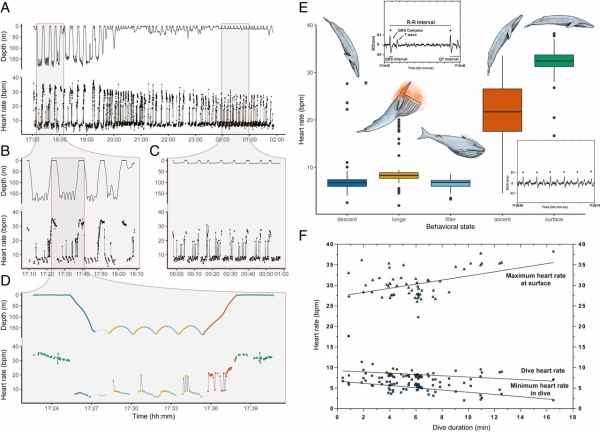
Image #1: heart rate profile of the blue whale.
The shape of the ECG signal was similar to that recorded from smaller whales in captivity using the same device. The whale's behavior during foraging was quite typical for its species: dives lasting 16.5 minutes to a depth of 184 m and surface intervals ranging from 1 to 4 minutes.
The heart rate profile, in accordance with the cardiovascular response to diving, showed that the heart rate ranged from 4 to 8 beats per minute, prevailing in the lower phase of dives while foraging, regardless of dive duration or maximum depth. The heart rate during diving (calculated over the entire duration of the dive) and the minimum instantaneous heart rate during the dive decreased with dive duration, while the maximum surface heart rate after diving increased with dive duration. In other words, the longer the whale remained underwater, the slower its heart rate was during the dive and the faster it was after surfacing.
Allometric equations for mammals suggest that a whale weighing 70,000 kg has a heart weighing 319 kg, and its stroke volume (the amount of blood ejected per beat) is about 80 liters, thus, the resting heart rate should be 15 beats/min.
During the lower phases of dives, the instantaneous heart rate ranged from 1/3 to 1/2 of the predicted resting heart rate. However, the heart rate increased during the ascent phase. At surface intervals, the heart rate was approximately double the predicted resting heart rate, predominantly varying from 30 to 37 beats per minute after deep dives (> 125 meters deep) and from 20 to 30 beats per minute after shallower dives.
This observation may indicate that an acceleration of heart rate is necessary to achieve the required respiratory gas exchange and reperfusion (restoration of blood flow) of tissues between deep dives.
Shallow, short nighttime dives were associated with rest and thus were more characteristic of a less active state. Typical heart rates observed during a 5-minute nighttime dive (8 beats per minute) and the accompanying 2-minute surface interval (25 beats per minute) could collectively result in a heart rate of about 13 beats per minute. This figure, as we can see, is remarkably close to the calculated predictions of allometric models.
Furthermore, researchers constructed profiles of heart rate, depth, and relative lung volume for 4 individual dives, the analysis of which allowed for the study of the potential impact of physical activity and depth on heart rate regulation.
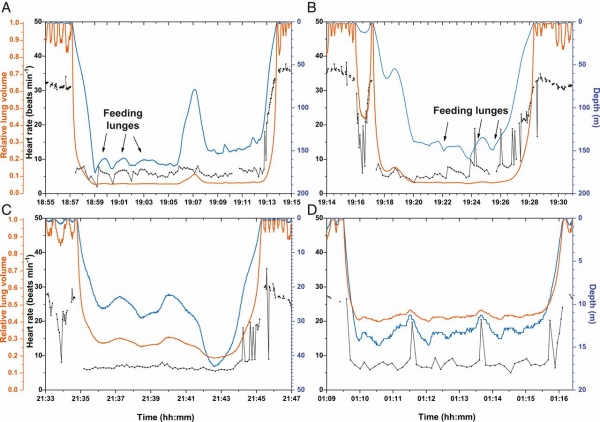
Image No. 2: profiles of heart rate, depth, and relative lung volume for 4 individual dives.
When feeding at great depths, the whale performs a specific maneuver called a lunge — it suddenly opens its mouth to gulp water with plankton, then filters out its food. It has been observed that the heart rate during the act of gulping water is 2.5 times higher than during filtering. This clearly indicates a dependence of heart rhythm on physical activity.
As for the lungs, their influence on heart rhythm is highly unlikely, as no significant changes in lung volume were noted during the dives in question.
In the lower phases of shallow dives, a brief increase in heart rate was associated with changes in lung volume and could have been triggered by the activation of lung stretch receptors.
Summarizing the observations described above, scientists concluded that during feeding at great depths, there is a brief increase in heart rate by 2.5 times. However, the average peak heart rate during lunges for feeding was still only half of the predicted resting value. This data is consistent with the hypothesis that the flexible aortic arches of large whales implement a reservoir effect during slow heart rates while diving. Additionally, the range of higher heart rates during the post-dive period confirmed the hypothesis that aortic impedance and heart load decrease during the surface interval due to the disruptive interference of outgoing and reflected pressure waves in the aorta.
The significant bradycardia observed by researchers can be considered an unexpected result of the study, given the enormous energy expenditure of the whale during the lunge maneuver while gulping water with plankton. However, the metabolic costs of this maneuver may not correlate with the heart rate or convective transport of oxygen, partly due to the short duration of feeding and possible engagement of glycolytic, fast-twitch muscle fibers.
During a dive, blue whales accelerate to high speeds and engulf volumes of water that can exceed their own body size. Scientists suggest that the high resistance and energy required to maneuver quickly deplete the total oxygen reserves in their bodies, thus limiting dive time. The mechanical force needed to take in such large volumes of water likely far exceeds aerobic metabolic power. This is why, during such maneuvers, the heart rate increases, albeit for a very brief period.
For a more detailed understanding of the nuances of the research, I recommend checking out the .
Epilogue
One of the key findings is that for gas exchange and reperfusion during short surface intervals, blue whales require nearly maximal heart rates, regardless of the nature of oxygen depletion in their blood and muscles during dives. Considering that larger blue whale individuals must exert more effort to feed in shorter time frames (according to allometric hypotheses), they inevitably face several physiological constraints both during dives and while surfacing. This means that evolutionarily, their body size is limited because if it were larger, the process of obtaining food would be too costly and not compensated by the food acquired. The researchers themselves believe that the heart of a blue whale operates at its limit.
In the future, scientists plan to enhance their device's capabilities, including adding an accelerometer to better understand the impact of different physical activities on heart rate. They also intend to apply their ECG sensor to other marine inhabitants.
This study shows that being the largest creature with the biggest heart is not so easy. Regardless of the size of marine inhabitants or their dietary habits, we must understand that the water column used by humans for fishing, harvesting, and transport remains their home. We are merely guests, and therefore must conduct ourselves accordingly.
Friday off-topic:

Rare footage showing a blue whale demonstrating the capacity of its mouth.

Another giant of the seas is the sperm whale. In this video, scientists captured footage of a curious sperm whale at a depth of 598 meters using the remotely operated ROV Hercules.
Thank you for your attention, stay curious, and have a great weekend, everyone! 🙂
Thank you for staying with us. Do you enjoy our articles? Want to see more interesting content? Support us by placing an order or recommending us to your friends, , 30% discount for Habr users on a unique entry-level server designed by us for you: (options available with RAID1 and RAID10, up to 24 cores and up to 40GB DDR4).
Dell R730xd for half the price? Only with us in the Netherlands! Dell R420 — 2x E5-2430 2.2GHz 6C 128GB DDR3 2x960GB SSD 1Gbps 100TB — from $99! Read about how
Source: habr.com
