

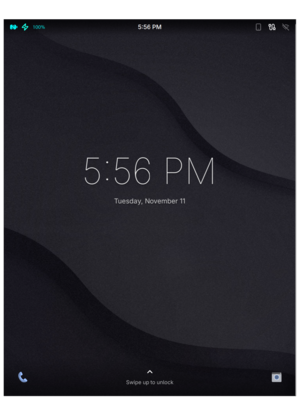
The Marathon OS project has been unveiled, developing a Linux distribution for mobile devices, combining elements from the PostmarketOS distribution with the Marathon Shell graphical interface. The user environment is created using Qt and QML and is based on its own composite server that utilizes the Wayland protocol, replicating the gesture control model found in the BlackBerry 10 operating system. The project's code is written in C++ and QML and is distributed under the MIT license. It can be installed on devices supported by PostmarketOS, with the OnePlus 6 (Snapdragon 845) declared as the fully tested reference platform.
The system environment is based on the package base of PostmarketOS and Alpine Linux. The Linux kernel is built with the PREEMPT_RT option, ensuring real-time operation. The root partition is mounted in read-only mode. For operation on devices supported by the Android platform, a libhybris layer is used, allowing Android drivers to work in user space.
To protect data, full-disk encryption is used, and for application isolation, the Landlock mechanism is implemented. The system also incorporates a permission management mechanism (Permission portal) that allows restricting the capabilities of each application, such as prohibiting or selectively allowing access to the network, location services, camera, microphone, contacts, storage, Bluetooth, and the telephony stack.
Marathon OS supports the execution of programs written using its own Qt/QML-based tools, as well as any Linux applications that can operate in a Wayland-based environment. In the near future, it is also expected to utilize the Waydroid package for running Android applications. An application catalog, Marathon Store, is being developed for the distribution and organization of application installation.
The basic software package includes an application manager, web browser, calendar, calculator, camera application, photo gallery, maps, messenger, notes, multimedia player, configurator, and terminal emulator. Standard programs such as Firefox, GIMP, and LibreOffice are also available for installation. A proprietary format for delivering software is used (zip archive + metadata + digital signature), but installation of packages in Flatpak and Snap formats is also supported. There is a layer to ensure compatibility with GTK-based applications and GNOME technologies.
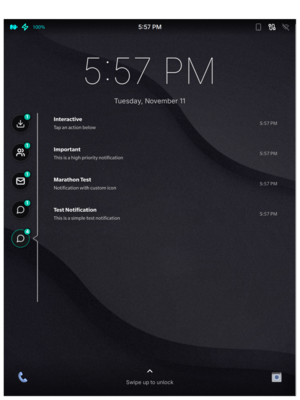
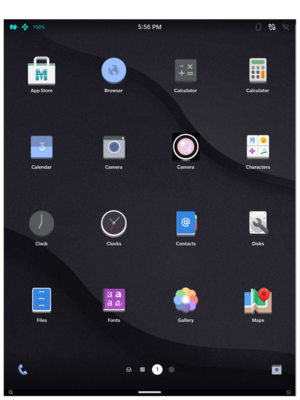
Marathon Shell uses a gesture-based screen navigation system similar to BlackBerry 10, without a navigation bar. For instance, an upward swipe brings up the application list, a downward swipe reveals the quick settings panel, and a right swipe from the edge displays the notification and message list. The interface is reported to have touch responsiveness at the level of 10-15 ms.
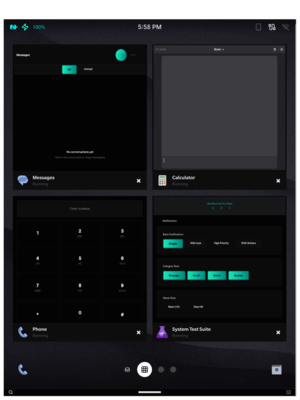
A unified interface for viewing notifications and messages is offered, allowing users to see content in chronological order, perform full-text searches across all messages, and quickly launch common actions. In the application switcher, thumbnails are displayed in real-time and reflect the current state of each running program. Rendering is accelerated using the GPU.
Network and hardware capabilities are managed and configured using system services: NetworkManager (WiFi and network access), ModemManager (telephony and SMS), UPower (power management and battery profiles), and BlueZ (Bluetooth, device pairing). Services are also available for managing output, sound, and notifications.
At this stage of development, basic functionalities are already operational, with ongoing efforts to finalize tools for camera and multimedia use. Video output at a rate of 60 frames per second has been enabled on the OnePlus 6 smartphone. Plans include the production of a proprietary smartphone, Marathon EV 1, designed in a form factor similar to the BlackBerry Passport with a sliding keyboard, and dimensions close to that of a passport. The plans also highlight support for GTK and KDE theme designs, a 10-year support cycle, and the creation of builds for the OnePlus 6T and Poco F1 devices.
Source: opennet.ru
