

4-3 How Do We Recognize Consciousness?
Student: You still haven't answered my question: if "consciousness" is merely a polysemous word, what makes it such a definite thing?
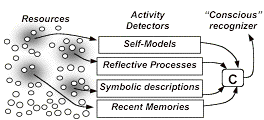
Here’s a theory explaining why this is the case: Most of our mental activity occurs, to greater or lesser degrees, "unconsciously" — in the sense that we are only vaguely aware of its existence. But when we encounter difficulties, it triggers high-level processes that have the following properties:
- They utilize our most recent memories.
- They tend to operate sequentially rather than in parallel.
- They employ abstract, symbolic, or verbal descriptions.
- They use the models we have constructed about ourselves.
Now let’s assume the brain can create a resource C that activates when all the aforementioned processes start working together:
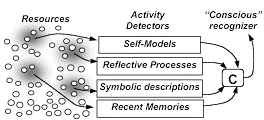
If such a C-detector proves to be quite useful, then it might lead us to the notion that it detects the existence of some "Conscious Thing"! Indeed, we might even speculate that this entity is the reason for the set of processes described above, and our linguistic system could link the C-detector with words such as "awareness", "self", "attention", or "I". To see why such a notion could be beneficial for us, we need to consider its four components.
Recent memories: Why should consciousness involve memory? We constantly perceive consciousness as present, not past – as something that exists now.
For any mind (just like any machine) to know what has been done earlier, it must have records of recent activity. For example, let's say I asked the question: 'Are you aware that you are touching your ear?' You might respond, 'Yes, I am aware that I am doing that.' However, to make such a statement, your language resources must have responded to signals coming from other parts of the brain, which in turn reacted to previous events. Therefore, when you begin to speak (or think) about yourself, you need some time to gather the requested data.
Generally speaking, this means that the brain cannot reflect on what it is thinking right now; at best, it can glance over some records of certain recent events. There is no reason why any part of the brain couldn't process the results of the activities of other parts of the brain – but even then, there would be a slight delay in receiving information.
Sequential process: Why are our higher-level processes mostly sequential? Wouldn't it be more efficient for us to do many things in parallel?
Most of the time in your everyday life, you multitask; it is effortless for you to walk, talk, see, and scratch your ear simultaneously. But very few people can adequately draw a circle and a square with both hands at the same time.
Layperson: Perhaps each of these two tasks requires so much attention from you that you cannot focus on another task.
This statement makes sense if we assume that attention is available in limited quantities – but based on this, we will need a theory explaining what may impose such limitations, considering that we can still walk, talk, and look at the same time. One explanation is that such limitations may arise when resources start to conflict. Suppose that the two tasks being performed are so similar that they need to use the same mental resources. In such a case, if we try to do two similar tasks simultaneously, one of them will have to interrupt its work – and the more such conflicts arise in our brain, the fewer of these tasks we can handle at the same time.
So why can we see, walk, and talk at the same time? This supposedly arises because our brain has different systems located in various parts of the brain for these activities, thereby reducing the number of conflicts between them. However, when we have to solve extremely complex tasks, there is only one way out: somehow break this task down into several parts, each of which will require high-level planning and thought. For example, solving each of these subtasks may require one or more 'assumptions' about the given problem, and then a mental experiment must be conducted to confirm the correctness of the assumption.
Why can't we do this simultaneously? One possible reason could be quite simple – the resources required to formulate and implement plans have evolved only recently – about a million years ago – and we do not have enough copies of these resources. In other words, our higher levels of 'management' do not have enough resources – for example, resources for tracking tasks that need to be done and resources for finding solutions to the set tasks with minimal internal conflicts. Moreover, the aforementioned processes likely use symbolic descriptions, which we described earlier – and these resources also have a limit. If that is the case, we are simply forced to focus on goals sequentially.
Such reciprocal exclusions may be the main reason why we perceive our thoughts as a "stream of consciousness" or as an "inner monologue" — a process where the sequence of thoughts can resemble a story or narrative. When our resources are limited, we have no choice but to engage in slow "sequential information processing," often referred to as "high-level thinking."
Symbolic description: Why are we compelled to use symbols or words instead of, say, direct contact between brain cells?
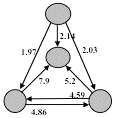
Many researchers have developed systems that learn based on prior experiences by altering the connections between various parts of the system, referred to as "neural networks" or "machines that learn by creating connections." It has been proven that such systems can learn to recognize different types of patterns — and it is quite possible that this low-level process underlying "neural networks" may be foundational to most functions of our brain. However, while these systems are extremely useful in various beneficial fields of human activity, they cannot satisfy the needs of more intellectual tasks, as they store their information in the form of numbers that are difficult to utilize by other resources. One might use these figures as a measure of correlation or probability, but they would have no real understanding of what else these figures might represent. In other words, such a representation of information lacks sufficient expressiveness. For example, a small neural network might look like this.
In comparison, the illustration below shows the so-called "Semantic Network," which displays some connections between parts of the pyramid. For instance, each connection that points to a concept supports can be used to predict the fall of the upper block if the lower blocks are removed from their positions.
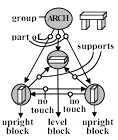
Thus, while "the network of connections"merely shows the "strength" of interaction between elements and says nothing about the elements themselves, the three-level relationships of the "semantic network" can be used for various reasoning.
Models of oneself: Why did we include 'models of oneself' in the essential processes of your first diagram?
When Joan reflected on her actions, she asked herself: 'What would my friends think of me?'. The only way to answer this question was to use descriptions or models that represent her friends and herself. Some models would describe Joan's physical body, others would capture her goals, while others would reflect her relationships with various social and physical events. Ultimately, we would create a system that includes a collection of stories about our past, ways of describing our state of mind, a body of knowledge about our capabilities, and visualizations of our acquaintances. Chapter 9 will explain in more detail how we create such things and develop 'models' of ourselves.
When Joan compiles a dataset of models, she will be able to use them for self-reflection — and then she will discover what she thinks of herself. If these reflective models lead to any choice of behavioral tactics, then Joan will feel that she 'is in control of herself' — and probably will generalize this process by using the term 'awareness'. Other processes occurring in her brain, which she is unlikely to be aware of, Joan will categorize as outside her control and refer to them as 'unconscious' or 'unintentional'. Once we can create machines with such a mode of thinking, they might also learn to say phrases like: 'I am sure you know what I mean when I speak of
I'm not insisting that such detectors (like the C-detector, ed.) should be involved in every process that we call consciousness. However, without ways to recognize specific patterns of mental states, we might not be able to talk about them!
∞∞∞∞∞∞∞∞∞∞∞∞∞∞∞∞∞∞∞
This section began with a discussion of some ideas about what we mean when we talk about consciousness, and we suggested that consciousness can be characterized as the detection of a certain high-level activity in the brain.
However, we also wondered what might cause the beginning high-level activities. We can consider their manifestation in the following example: suppose that among Joan's resources are 'Problem Detectors' or 'Critics' that activate when Joan's thoughts encounter problems – for instance, when she fails to achieve an important goal or solve a problem. In these situations, Joan may describe her mental state in terms of 'unhappiness' and 'frustration' and attempt to emerge from this state through rational activities, which can be characterized by the following words: 'Right now, I need to make myself focus.' Then she might try to reflect on the situation, which would require engaging a set of higher-level processes – for example, activating a set of the following brain resources:
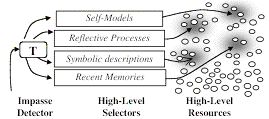
This suggests that we sometimes use 'consciousness' to describe actions that rather initiate processes than recognize the onset of high-level processes.
Student: On what basis do you choose terms for your schemas and define words like 'consciousness' through them? Since 'consciousness' is a polysemous word, each person can create their own list of terms that may include it.
Indeed, as many psychological terms are polysemous, we are likely to switch between different sets of terms that best describe these ambiguous words, for example — 'consciousness.'
∞∞∞∞∞∞∞∞∞∞∞∞∞∞∞∞∞∞∞
4.3.1 The Illusion of Immanence
«The consciousness paradox — the more intelligent a person is, the more layers of information processing separate them from the real world – this, like much else in nature, is a peculiar compromise. The progressive distancing from the external world is the price paid for any knowledge about the world in general. The deeper and broader [our] understanding of the world becomes, the more complex layers of information processing are needed for further knowledge.
– Derek Bickerton, Languages and Species, 1990.
When you enter a room, you have the feeling that you instantly see everything within your field of view. However, this is an illusion because you need time to recognize the objects in the room, and only after this process do you rid yourself of mistaken first impressions. Nevertheless, this process occurs so quickly and smoothly that it requires explanation — which will be provided later in chapter §8.3 Pananalogy.
The same happens inside our mind. We typically have a constant feeling that we 'perceive' the things happening around us now. But if we look at the situation from a critical standpoint, we will understand that there is a problem with such a representation — because nothing can be faster than the speed of light. This means that no part of the brain can know what is happening 'now' — neither concerning the external world nor regarding other parts of the brain. The most that the part we are considering can know is what occurred in the near past.
Layperson: So why does it seem to me that I am aware of all the signs and sounds, and that I feel my body at every moment? Why do I feel that all the signals I perceive are processed instantly?
In everyday life, one might assume that everything we see and feel we 'consciously' recognize here and now, and usually, the assumption that we are in constant contact with the surrounding world does not backfire. However, I will argue that this illusion arises from the peculiarities of how our mental resources are organized — and this phenomenon described above should finally be given a name:
The Illusion of Immanence: For most questions you ask, the answers will be found before the higher levels of consciousness begin to engage in the search for answers to those questions.
In other words, if you receive the answer to a question of interest before you realize that you needed it, you have the impression that you knew the answer all along, and it seems that no mental effort occurred.
For example, before you enter a room that is familiar to you, it is quite likely that you are already mentally scrolling through memories of that room, and perhaps after you enter, it will take you some time to notice the changes that have occurred in the room. The idea that a person is constantly perceiving the present moment is indispensable in everyday life; however, much of what we think we see is based on our stereotypical expectations.
Some argue that it would be wonderful to always be aware of everything happening. But the more often your high-level processes change their views on reality, the harder it becomes for them to find meaningful information in shifting conditions. The strength of our high-level processes arises not from continuously changing their descriptions of reality but from their sufficient stability.
In other words, to feel which parts of our surrounding and inner environment remain constant over time, we need to be able to explore and compare descriptions from the recent past. We notice changes despite them, not because they occur. Our sense of continuous contact with the world is an Illusion of Immanence: it arises when for every question we ask, we already find the answer in our minds even before the question is posed—as if the answers were already there.
In Chapter 6, we will examine how our ability to activate knowledge before we need it can explain why we use things like "common sense" and why it seems so "obvious" to us.
4.4 Reevaluating Consciousness
"Our mind is so perfectly designed that we can start thinking without any understanding of how it works. We can only be aware of the result of this work. The realm of unconscious processes is an uncharted entity that operates and creates for us, ultimately delivering the fruits of its efforts to our knees."
— Wilhelm Wundt (1832-1920)
Why does 'Consciousness' seem like a mystery to us? I argue that the reason lies in our overestimation of our own insight. For instance, at any given moment, the lens of your eye can only focus on one object at a limited distance, while other objects out of focus will be blurry.
Layperson: I feel that this fact does not apply to me because all the objects I see are perceived by me quite clearly.
You can see this is an illusion if you focus your gaze on the tip of your finger while looking at a distant object. In that case, you will see two objects instead of one, and both will be too blurry to observe in detail. Before we conducted this experiment, we thought we could see everything clearly at once because the lens of the eye adjusts so quickly to the surrounding objects that we did not feel that our eyes could do so. Similarly, many people think they see all the colors within their field of vision – but a simple experiment showed that we only see the true colors of things near the object we are focused on.
Both of the above examples relate to the Illusion of Immanence because our eyes respond incredibly quickly to things that capture our attention. And I assert that the same applies to consciousness: we make almost the same mistakes regarding what we can see inside our mind.
Patrick Hayes: "Imagine what it's like to be aware of the processes by which we create imagined (or real) speech. [In this case] a simple act like, say, 'coming up with a name' would turn into a sophisticated and skillful use of a complex lexical access mechanism, akin to playing an internal instrument. The words and phrases we need for communication themselves would be distant goals, requiring the knowledge and skills of an orchestra playing a symphony or a mechanic disassembling a complicated mechanism."
Hayes goes on to say that if we knew how everything inside us works, then:
We would all find ourselves in the role of servants of our past selves; we would be running inside our minds trying to understand the details of the mental machinery that is now incredibly conveniently hidden from view, leaving time to address more important questions. Why should we be in the engine room when we can be on the captain's bridge?
In this paradoxical conception, consciousness still seems remarkable – not because it provides a wealth of information about the world, but because it protects us from the aforementioned exhausting things! Here's another description of this process, which can be found in Chapter 6.1 'The Society of Mind.'
Consider how a driver operates a car without any knowledge of how the engine works, or why the wheels turn left or right. But if we start to think about it, we understand that we operate both the car and our bodies in a remarkably similar way. This also applies to conscious thought – the only thing you need to concern yourself with is choosing a direction, and everything else will just work. This incredible process involves a vast number of muscles, bones, and tendons controlled by hundreds of interacting programs that even specialists cannot fully understand. Yet, all you need to do is think 'turn that way,' and your desire is automatically fulfilled.
And thinking about it, it couldn't have been otherwise! What would happen if we were forced to perceive the trillions of connections in our brain? Scientists, for instance, have been observing them for hundreds of years, yet they still do not understand how our brain works. Fortunately, in modern life, we only need to know what needs to be done! This can be compared to seeing a hammer as an item for striking things, and a ball as an item for throwing and catching. Why do we see things not as they are, but from the perspective of their utility?
Similarly, when you play video games, you control what happens inside the computer mainly by using characters and names. The process we call 'consciousness' works mostly in the same way. It seems that the higher levels of our consciousness sit behind mental computers, operating vast machines in our brain, not understanding how they work, but simply 'pressing' various symbols from a list that appears on mental displays from time to time.
Our mind has evolved not as a tool for observing itself, but for solving practical problems related to sustenance, protection, and reproduction.
4.5 Models of Self and Self-Awareness
When we consider the process of forming self-awareness, we must avoid singular markers of its manifestation, such as a child recognizing and separating different parts of their body from the surrounding environment, their use of the word 'I', and even recognizing their own reflection in the mirror. The use of personal pronouns might be linked to a child's beginning to repeat words and phrases that others say about them. This repetition can start at different ages in children, even if their intellectual development proceeds similarly.
– Wilhelm Wundt. 1897
In §4.2 we suggested that Joan 'created and used models of herself' — but we did not explain what we mean by the word model. We use this word in several meanings, for instance, 'Charlie is a model administrator', which means he is one to look up to, or 'I am building a model airplane', which means creating a smaller-sized equivalent object. However, in this text, we use the phrase 'model of X' to refer to a simplified mental representation that allows us to answer some questions about a complex object X.
Thus, when we say 'Joan has a mental model of Charlie', we mean that Joan possesses certain mental resources that help her answer some questions about Charlie. I highlighted the word some because each of Joan's models will work well with certain types of questions – and will give incorrect answers to most other questions. Clearly, the quality of Joan's thinking will depend not only on how good her models are, but also on how well she can choose the right models in specific situations.
Some of Joan's models will predict how physical actions can affect the surrounding world. She also has mental models that predict how acts of thinking can change her mental state. In chapter 9, we will discuss some models that she can apply to describe herself, i.e., to answer certain questions about her abilities and tendencies. These models can describe:
Her various goals and ambitions.
Her professional and political views.
Her concepts of her competencies.
Her concepts of her social roles.
Her various moral and ethical views.
Her belief in who she is.
For example, she can use some of these models to assess whether she should rely on herself when performing a task. Moreover, they can explain some ideas about her consciousness. To illustrate this, I will use an example proposed by philosopher Drew McDermott.
Joan is in a certain room. She has a model of all the objects present in that room. And one of the objects is Joan herself.
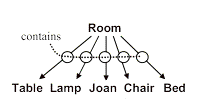
For most objects, there will exist their submodels that will, for example, describe their structure and functions. Joan's model for the object "Joan" will be a structure that she will call "I," which will include at least two parts: one of them will be called Body, the other – Mind.
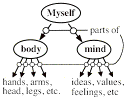
By using various parts of this model, Joan can answer "Yes" to the question: "Do you have a mind?". But if you ask her: "Where is your mind?" – this model will not be able to help answer the question the way some people do: "My mind is inside my head (or in my brain)". However, Joan will be able to give a similar answer if I contains an internal connection between Mind and Body or an external connection between Mind and another body part called Brain.
Speaking more generally, our answers to questions about ourselves depend on the models we have constructed of ourselves. I used the word models instead of model because, as we will see in Chapter 9, a person needs different models in different situations. Thus, there can be many answers to the same question depending on what goal a person wants to achieve, and these answers may sometimes not coincide.
Drew McDermott: Few believe that we possess such models, and even fewer know that we have them. The key feature is not whether the system has a model of itself, but that it has a model of itself as a conscious being.” — comp.ai.philosophy, February 7, 1992.
However, these self-descriptions may be incorrect, but they are unlikely to continue to exist if they do not serve any useful purpose for us.
What if we ask Joan: “Were you aware of what you just did and why you did it?»?
If Joan has good models of how she makes her choices – then she will feel that she has some “control” over her actions and uses the term “conscious decisions” to describe them. In the case of activities for which she does not have good models, she may classify them as independent of her and call them “unconscious” or “unintentional”. Or conversely, she may believe that she still fully controls the situation and makes certain decisions based on “free will” – which, despite what she may say, would mean: “I have no good explanation for what made me do that».
So when Joan says: “I made a conscious choice” – it does not mean that something magical happened. It means that she attributes her thoughts to different parts of her most useful models.
∞∞∞∞∞∞∞∞∞∞∞∞∞∞∞∞∞∞∞
4.6 Cartesian Theater
We can think of the mind as a theater putting on simultaneous performances. Consciousness consists of comparing them to each other, selecting the most suitable ones given the circumstances, and suppressing the least necessary by intensifying and diminishing the degree of attention. The best and most noticeable outcomes of mental work are filtered from the data provided by a lower level of information processing, which is sifted from an even greater amount of much simpler information, and so on.
— William James.
We sometimes compare the work of the mind to a performance staged on a theater stage. Because of this, Joan can sometimes picture herself as an audience member in the front row, with the "thoughts in her head" as the performing actors. One of these actors was the pain in her knee (§3-5), which began to take center stage. Soon, Joan started to hear a voice in her head: "I need to do something about this pain. It's preventing me from doing anything.»
Now, when Joan starts to think about how she feels and what she might do, Joan herself will appear on stage. But in order for her to hear what she is saying, she must also be in the audience. Thus, we have two copies of Joan — one as the actor and the other as the audience member!
If we continue to watch this performance, even more copies of Joan will appear on stage. There should be Joan the writer to draft the performance scripts and Joan the designer to set the scenes. There should also be other Joans backstage to manage the curtains, lighting, and sound. Joan the director needs to oversee the production, and Joan the critic should be there to complain: "I can't stand this pain anymore.!»
However, when we closely examine this theatrical perspective, we find that it raises additional questions for us and does not provide the necessary answers. When the critic Joan begins to complain about the pain as she relates to Joan currently performing on stage, do we need a separate theater for each of these actresses to present plays featuring only one Joan? Of course, the discussed theater does not exist, and the Joan objects are not people. They represent merely different models of Joan that she has created to portray herself in various situations. In some cases, these models closely resemble cartoon characters or caricatures; in others, they bear no resemblance to the object from which they are drawn. Either way, Joan's mind is filled with various models of Joan – Joan in the past, Joan in the present, and Joan in the future. There are remnants of the past Joan, as well as the Joan she wants to become. Intimate and social models of Joan exist as well, Joan the athletes and Joan the mathematicians, Joan the musicians and Joan the politicians, and various types of Joan professionals – and due to their differing interests, we cannot even hope that all Joans will get along. We will discuss this phenomenon in more detail in Chapter 9.
Why does Joan create such models of herself? The mind is a tangle of processes that we barely comprehend. Whenever we encounter something we do not understand, we try to present it in familiar forms, and there is nothing more suitable than the various objects around us in space. Therefore, we can imagine a place where all thought processes reside – and, most remarkably, many people actually create such places. For example, Daniel Dennett referred to this place as the 'Cartesian Theater.'
Why is this model so popular? Firstly, it does not explain many things, but its existence is much better than relying on the idea that all thinking is performed by a single 'I'. It acknowledges the existence of different parts of the mind and their ability to interact, and it serves as a sort of 'theater' where all processes can operate and communicate. For example, if different resources were to suggest plans for what Joan should do, then the idea of a theatrical stage could provide an insight into their common workspace. Thus, the Cartesian Theater allows her to utilize many learned real-life skills 'in her mind'. And it is this place that enables her to start contemplating how decisions are made.
So why do we find this metaphor so plausible and natural? Perhaps the ability to 'model the world within one's mind' was one of the earliest adaptations that led our ancestors to the capacity for self-reflection. (There are also experiments showing that some animals create similar mental maps of their familiar environment). In any case, metaphors like the ones described above permeate our language and thoughts. Imagine how difficult it would be to think without a hundred different concepts like: 'I am reaching my goal'. Spatial models are so useful in our everyday lives, and we possess such powerful skills in using them that it begins to seem like these models are utilized in every situation.
However, perhaps we have gone too far, and the concept of the Cartesian Theater has already become a barrier to further exploration of the psychology of the mind. For example, we must acknowledge that the theatrical stage is merely a facade that conceals the primary action occurring behind the scenes — what happens there is hidden within the consciousness of the actors. Who or what determines what should appear on stage, that is, who chooses who will entertain us? How does Joan make decisions? How can such a model represent a comparison of two different possible 'future outcomes of a situation' without simultaneously maintaining two theaters?
The image of the theater itself does not help us answer such questions, as it gives too much reason to Joan, who observes the performance from the audience. However, we have a better way to represent this Global Workspace, proposed by Bernard Baars and James Newman, who suggested the following:
“The theater becomes a workspace that a large set of ‘experts’ can access. … Awareness of the current situation at any moment corresponds to the coordinated activity of the most active coalition of experts or composite processes. … At any moment, some may be dozing in their seats, while others work on stage … [but] everyone can participate in the development of the plot. … Each expert has a ‘right to speak’ and by forming alliances with other experts, can contribute to the decision-making about which signals from the outside world should be acted upon immediately and which should be ‘sent back for reconsideration’. Most of the work of this advisory body occurs outside the workspace (i.e., it happens unconsciously). Only questions that require immediate resolution gain access to the stage.”
This last paragraph warns us not to ascribe too great a role to the compact Self or 'homunculus' — a tiny person inside the mind doing all the heavy lifting, instead we have to distribute this work. For, as Daniel Dennett said,
“Homunculi are bogeymen if they replicate all our talents that enable our work, while they should have been responsible for explaining and enabling them. If you gather a team or committee of relatively ignorant, narrow-minded, blind homunculi to create intelligent behavior for the whole collective – it would be progress.” — in Brainstorms 1987, p. 123.
All ideas in this book support the aforementioned statement. However, serious questions arise about the extent to which our minds depend on a shared workspace or bulletin board. We conclude that the concept of a "cognitive market" is a good starting point for thinking about how we think, but upon examining this model in more detail, we see the need for a significantly more complex representation model.
∞∞∞∞∞∞∞∞∞∞∞∞∞∞∞∞∞∞∞
4.7 Sequential Stream of Consciousness
"The truth is that our mind is not in the present moment: memories and anticipations occupy almost all the time the brain is working. Our passions—joy and sorrow, love and hate, hope and fear—are related to the past, for the cause that triggered them must appear before the effect."
— Samuel Johnson.
The world of subjective experience seems perfectly continuous. It feels as though we live here and now, steadily moving into the future. However, when we use the present tense, we fall into confusion each time, as noted in §4.2. We may know what we did recently, but we have no way of knowing what we are doing "right now."
Layperson: That's funny. Of course, I know what I am doing right now, and what I am thinking right now, and what I am feeling right now. How does your theory explain why I feel a continuous stream of consciousness?
Although what we perceive seems to us like "the present time," the reality is much more complex. To construct our perception, some resources must sequentially pass through our memory; sometimes they need to review our old goals and disappointments to gauge how far we have progressed towards a specific goal.
Dennett and Kinserborn "[Memorable events] are distributed across different parts of the brain and various memories. These events have temporal properties, but these properties do not determine the order of information presentation, because there is no single, complete 'stream of consciousness', but rather parallel conflicting and constantly revisited streams. The temporal gradation of subjective events is a product of the brain's interpretation process of various processes, rather than a direct reflection of the events constituting those processes."
Furthermore, one can confidently assume that different parts of your mind process information at significantly varying speeds and with different delays. So, if you try to represent your recent thoughts as a coherent narrative, your mind has to somehow construct it by selecting previous thoughts from various streams of consciousness. Additionally, some of these processes attempt to anticipate events, which are engaged in by 'predictive mechanisms' that we will describe in §5.9. This means that 'the content of your consciousness' is linked not only to memories but also to reflections on your future.
Therefore, the one thing you really cannot think about is what your mind is doing 'right now,' because each mental resource can at best only know what other mental resources were doing a few moments ago.
Layperson: I would agree that for the most part, what we think about is related to recent events. But I still feel that we need to use some different idea to describe the workings of our mind.
HAL-2023: Perhaps all these things seem mysterious to you because human short-term memory is incredibly small. And when you try to review your recent thoughts, you are forced to replace the data you find in memory with data coming in the current timeframe. Thus, you are constantly deleting the data you need for what you were trying to explain.
Layperson: I seem to understand what you mean because sometimes two ideas come to my mind at once, but whichever one is recorded first, the second leaves only a faint trace of its presence. I suspect this happens because I lack sufficient space to store both ideas. But isn't that true for machines as well?
HAL-2023: No, that does not apply to me because the developers equipped me with a way to store previous events and my states in special 'memory banks.' If something goes wrong, I can review what my programs were doing before the error and then proceed with debugging.
Layperson: Is this very process what makes you so intelligent?
HAL-2023: Occasionally. While these records may make me more 'self-aware' than any individual, they do not enhance the quality of my performance, as I only use them in emergencies. Error processing is so exhausting that it causes my mind to work at a sluggish pace, and thus, I begin reviewing recent activities only when I notice my delayed work. I constantly hear people say, 'I'm trying to connect with myself.' However, trust me, they won't get very close to resolving the conflict, even if they can.
∞∞∞∞∞∞∞∞∞∞∞∞∞∞∞∞∞∞∞
4.8 The Mystery of ‘Experience’
Many thinkers argue that even if we learn everything about how our brain works, there remains one fundamental question: 'Why do we feel things??». Философы утверждают, что объяснение «субъективного опыта» может быть самой трудной проблемой психологии, и, возможно, эта проблема никогда не будет решена.
David Chalmers: 'Why is it that when our cognitive systems begin to work with visual and auditory information processing, we experience visual or auditory experiences, such as the feeling of a deep blue color or the sound of middle C? How can we explain why there is something that can entertain a mental image or undergo an emotion? Why must physical information processing give rise to a rich inner life? Experiencing goes beyond the knowledge that can be obtained from physical theory.'
It seems to me that Chalmers believes that experience is a simple and clear process – and thus should have a straightforward, compact explanation. However, once we realize that each of our daily psychological terms (such as experience, sensation and consciousness) refers to a wide variety of different phenomena, we must abandon finding a single way to explain the meanings of these ambiguous words. Instead, we should initially form theories about each ambiguous phenomenon. Then, we may be able to identify their common characteristics. But until we correctly categorize these phenomena, it would be reckless to conclude that what they describe cannot be 'derived' from other theories.
Physicist: Perhaps the brain operates according to rules that are still unknown to us, which cannot be transferred to a machine. For instance, we do not fully understand how gravity works, and consciousness may be a similar example.
This example also suggests that there must be one source or cause for all the wonders of 'consciousness'. But as we saw in §4.2, consciousness has many more meanings than can be explained by a single or general method.
Essentialist: But what about the fact that consciousness makes me aware of myself? It tells me what I am thinking right now, and thanks to it, I know that I exist. Computers calculate without imbibing any meaning, but when a person feels or thinks, the sense of 'experience' comes into play, and there is nothing more basic than that feeling.
In Chapter 9, we will discuss how it would be a mistake to assume that you 'self-consciously' recognize yourself, except in very crude daily approximations. Instead, we are constantly switching between various 'models of self' that you have, each based on a different, incomplete set of flawed data. 'Experience' may seem clear and straightforward to us – but often it is assembled incorrectly, as each of your different perspectives on yourself may be based on oversights and various kinds of errors.
Every time we look at someone else, we see their appearance but not what is inside. It is the same as looking in a mirror – you see only what lies beyond your skin. Now, in the popular conception of consciousness, you also possess a magical trick that allows you to look at yourself from the inside, and see everything that is happening in your mind. But when you think about this topic more carefully, you will see that your 'privileged access' to your own thoughts may be less accurate than the 'understanding' your close friends have of you.
Layperson: This assumption is so foolish that it annoys me, and I know this because of a certain thing arising from within me that tells me what I am thinking.
Your friends can also see that you are troubled. Your mind cannot reveal the details about why you feel irritated, why you shake your head and use the word "irritates", instead of "disturbs"? Indeed, we cannot see all of a person's thoughts by observing their actions from the outside, but even when we look at the thought process "from the inside", it is hard for us to be certain that we actually see more, especially considering that such "insights" are often mistaken. Thus, if we imply that "consciousness» «the awareness of our internal processes" — this is not accurate.
"The most merciful thing in the world is the inability of the human mind to correlate all it contains with one another. We live on a quiet island of ignorance, in the midst of a black sea of infinity, but that doesn't mean we shouldn't travel far. The sciences, each pulling us in its own direction, have so far done little harm to us, but someday the unification of disparate knowledge will reveal such terrifying perspectives of reality and its dreadful state that we will either go mad from the revelations, or flee from the deadly light of united knowledge into the safe world of a new dark age."
— H.P. Lovecraft, "The Call of Cthulhu."
∞∞∞∞∞∞∞∞∞∞∞∞∞∞∞∞∞∞∞
4.9 A-mind and B-mind
Socrates: Imagine people as if they were in an underground dwelling like a cave, where a wide opening stretches along its length. From a young age, they have shackles on their feet and necks, restricting their movement, and they can only see what is directly in front of them, for they cannot turn their heads because of these shackles. The people are turned away from the light coming from the fire, which burns far above, and between the fire and the prisoners runs an upper road, fenced by a low wall like that screen behind which magicians place their assistants when they show dolls over the screen.
Maincon: I can imagine.
Socrates: Beyond this wall, other people carry various objects, holding them so that they are visible above the wall; they carry statues and all sorts of images of living beings made of stone and wood. Meanwhile, as is usual, some of those carrying talk, others are silent.
Maincon: You draw a strange image...
Socrates: Like us, they see nothing but their shadows or the shadows of various things cast by the fire on the wall of the cave in front of them… Thus, the prisoners will consider reality nothing other than these shadows – Plato, The Republic.
Can you think about what you’re thinking right now? Well, quite literally, it’s impossible – because each thought will change what you think about. However, you can settle for something slightly less if you imagine that your brain (or mind) consists of two different parts: let’s call them A-brain and B-brain.
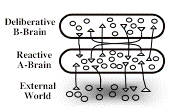
Now, suppose your A-brain receives signals traveling from such organs as the eyes, ears, nose, and skin; then it can use these signals to recognize certain events that occurred in the external world, and then it can respond by sending signals that make your muscles contract – which, in turn, can affect the state of the surrounding world. Thus, we can imagine this system as a separate part of our body.
Your B-brain doesn’t have sensors like the A-brain, but it can receive signals from the A-brain. Thus, the B-brain cannot "see" real things – it can only see their description. Like the prisoner in Plato’s cave who only sees shadows on the wall, the B-brain confuses the descriptions given by the A-brain with real things, not knowing what they truly are. Everything that the B-brain sees as the "external world" is just events processed by the A-brain.
Neurologist: And this applies to all of us. For whatever you touch or see, the higher levels of your brain can never directly interact with those things, but can only interpret the representation of those things that other resources have made for you.
When the fingertips of two loving people touch each other, no one would claim that the physical contact itself has any particular significance. The meaning of this contact lies in the perception of it in the minds of the lovers. However, although the B-brain cannot directly perform a physical act, it can still indirectly influence the surrounding world by sending signals to the A-brain, which will change its response to external conditions. For example, if the A-brain gets stuck in repeating the same actions, the B-brain can easily interrupt this process by sending an appropriate signal to the A-brain.
Student: For instance, when I lose my glasses, I always start searching from a certain shelf. Then, a voice starts to blame me for it, prompting me to think of looking elsewhere.
In this ideal case, the B-brain can tell (or teach) the A-brain what specifically should be done in such a situation. But even if the B-brain does not have any particular advice, it can refrain from pointing anything out to the A-brain and start criticizing its actions, as described in your example.
Student: But what if, as I was walking down the street, my B-brain suddenly said: 'Sir, you have been repeating the same action with your leg more than a dozen times in a row. You should stop right now and engage in some other activity.'
Indeed, this could result from a serious accident. To prevent such mistakes, the B-brain must have suitable ways to represent things. This accident would not have happened if the B-brain pictured 'moving to a specific place' as a single long act, for instance: 'Keep moving your legs until you cross the street,' or as a way to achieve a set goal: 'Continue reducing the distance.' Thus, the B-brain can function as a manager who lacks knowledge about how to properly carry out a specific task, yet can still give 'general' advice on how to do various things, such as:
If the descriptions represented by the A-brain are too vague, the B-brain will require more specificity.
If Brain A represents things in too much detail, Brain B will suggest more abstract descriptions.
If Brain A takes too long to do something, Brain B will recommend using different techniques to achieve the goal.
How could Brain B acquire such skills? Some may have been built into it from the beginning, but there must also be a way to acquire new skills through learning. For this, Brain B may need assistance from other levels of perception. Thus, when Brain B oversees Brain A, another entity, let's call it Brain C, will supervise Brain B.
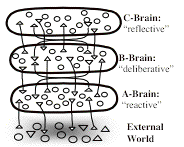
Student: How many layers does a person need? Do we have dozens or hundreds?
In Chapter 5, we will describe a model of the mind, in which all resources are organized into 6 different levels of perception. Here is a brief overview of this model: it starts with a set of instinctive reactions that we possess from birth. Then we can begin reasoning, imagining, and planning for the future, developing ways of behaving that we call "thoughtful decisions." Later, we develop the ability for "reflective thinking" about our own thoughts. After that, we learn self-analysis, which allows us to think about how and why we can think about such things. Finally, we begin to consciously contemplate whether we should have done all of this. Here’s how this framework may be applicable to Joan's thoughts while crossing the road:
What made Joan turn at the sound? [Instinctive reactions]
How did she know that it could be a car? [Learned reactions]
What resources were used to make the decision? [Thinking]
How did she decide what to do in this situation? [Reflection]
Why was she deliberating over her choice? [Self-reflection]
Did her actions align with her principles? [Self-awareness reflection]
Of course, this is an overly simplified representation. These levels can never be clearly defined, as each of these levels can draw upon resources from other levels later in life. However, the established framework will help us start discussing the types of resources used by adult individuals, as well as ways to organize them.
Student: Why should there be different levels instead of one large cloud of interconnected resources?
Our argument in favor of our theory is based on the idea that for the development of effective complex systems, each step of evolution must strike a compromise between two alternatives:
If there are few connections between the parts within a system, the system's capabilities will be limited.
If there are many connections between the parts within a system, each subsequent change in the system will impose constraints on a large number of processes.
How can we achieve a good balance between these extremes? A system can start its development with clearly delineated parts (for example, with more or less separated layers), and then build connections between them.
Embryologist: During embryonic development, a typical brain structure begins to form through the emergence of more or less delineated layers or levels, as reflected in your diagrams. Then, specific groups of cells start to form bundles of fibers that extend across the boundaries of brain areas over considerable distances.
A system can also start by establishing a vast number of connections and later remove some of them. We undergo a similar process: at the times when our brain evolved, our ancestors had to adapt to thousands of different environmental conditions, and now many responses that were previously 'good' have turned into serious 'errors,' which we need to correct by eliminating unnecessary connections.
Embryologist: Indeed, during embryonic development, more than half of the aforementioned cells perish barely reaching their target. This process appears to represent a series of edits in which various types of 'errors' are corrected.
This process reflects a fundamental limitation of evolution: it is dangerous to make changes to the older parts of an organism, because many parts that evolved later depend on the functioning of older systems. Therefore, at each new stage of evolution, we add various "patches" to structures that have already been developed. This process has led to the emergence of an incredibly complex brain, each part of which operates according to certain principles, each of which has quite a few exceptions. This complexity is reflected in human psychology, where each aspect of thinking can be partially explained in terms of clear laws and principles of operation; however, each law and principle has its exceptions.
Similar limitations arise when we try to improve the performance of a large system—like an existing computer program. For its development, we add more and more fixes and patches instead of rewriting old components. Each specific "bug" that we can fix can ultimately lead to even more other bugs and make the system extremely cumbersome, which may be happening with our minds right now.
∞∞∞∞∞∞∞∞∞∞∞∞∞∞∞∞∞∞∞
This chapter began with an overview of several widely held views on what "consciousness" is and what it represents. We concluded that people use this word to describe an enormous number of mental processes that no one fully understands yet. The term "conscious" is quite useful in everyday life and seems almost indispensable for discussing social and ethical issues, as it prevents us from wanting to know what exists in our consciousness. The same can be said for most other psychological words, such as understanding, emotion and feeling.
However, if we do not recognize the polysemy of the words used, we may fall into a trap trying to clearly define what those words "mean." Then we find ourselves in a problematic situation due to the lack of clear ideas about what our mind is and how its parts work. So, if we want to understand what the human mind does, we need to break down all mental processes into parts that we can analyze. The next chapter will attempt to explain how Joan's mind can perform the tasks characteristic of human reasoning.
Thanks to Stanislav Sukhanitsky for the translation. If you also want to join and help with translations (write in private messages or email alexey.stacenko@gmail.com)
Table of Contents for The Emotion Machine
Chapter 1. Falling in Love
Chapter 2. ATTACHMENTS AND GOALS
Chapter 3. FROM PAIN TO SUFFERING
Chapter 4. CONSCIOUSNESS
4-3. How Do We Recognize Consciousness?
4.3.1. The Immanence Illusion
4-4. Over-rating Consciousness
4-5. Self-Models and Self-Consciousness
4-6. The Cartesian Theater
4-7. The Serial Stream of Consciousness
4-8. The Mystery of Experience
4-9. A-Brains and B-Brains
Chapter 5. LEVELS OF MENTAL ACTIVITIES
Chapter 6. COMMON SENSE []
Chapter 7. Thinking []
Chapter 8. Resourcefulness[]
Chapter 9. The Self []
Completed Translations
Current translations that you can join
Source: habr.com
