

8.1 Creative Approach
"Although such a machine could do many things as well as, and perhaps better than, we can, in other respects it would inevitably be deficient, and it would turn out that it acts not consciously, but merely by the arrangement of its organs."
— Descartes. Discourse on Method. 1637.
We are accustomed to using machines that are stronger and faster than people. But before the advent of the first computers, no one suspected that a machine could do anything beyond a limited number of different actions. Perhaps that is why Descartes insisted that no machine could be as inventive as a human.
"For while the mind is a universal tool that can serve in the most varied circumstances, the organs of a machine require special arrangements for each individual action. Hence, it is unthinkable that a machine could have so many different arrangements that it could act in all the circumstances of life as our mind compels us to act." — Descartes. Discourse on Method. 1637.
In the same way, it was previously believed that there is an insurmountable chasm between humans and animals. In "The Origin of Man," Darwin notes: "Many authors insisted that humans are separated by an insurmountable barrier from lower animals with regard to mental faculties.". But then he clarifies that this difference "is quantitative, not qualitative.".
Charles Darwin: "I now believe it to be quite evident that humans and higher animals, especially primates... have the same feelings, impulses, and sensations; all have the same passions, attachments, and emotions — even the most complex ones, such as jealousy, suspicion, competition, gratitude, and generosity;... possess, though to varying degrees, the abilities for imitation, attention, reasoning, and choice; have memory, imagination, association of ideas, and intellect."
Furthermore, Darwin notes that "individuals of the same species display all ranges, from utter stupidity to great intellect." and claims that even the highest forms of human thought could have developed from such variations — for he sees no insurmountable obstacles to this.
"One cannot deny, at least, the possibilities of this development, as we see daily examples of the evolution of these abilities in every child and could trace a completely gradual transition from a mind full of idiocy... to the mind of Newton.".
Many people still find it hard to envision the transitional steps from animal to human intellect. In the past, this viewpoint was excusable — few considered that just a few small structural changes could significantly enhance the capabilities of machines.However, in 1936, mathematician Alan Turing demonstrated how to create a 'universal' machine that can read the instructions of other machines and then, by switching between these instructions, can perform everything those machines can do.
All modern computers use this technique, allowing us today to organize meetings, edit texts, or send messages to friends from a single device. Moreover, once we store these instructions inside the machine, programs can change so that the machine can expand its own capabilities. This proves that the limitations observed by Descartes were not inherent to machines but were a result of our old-fashioned ways of building or programming them. For every machine we constructed in the past, there was only one way to perform each specific task, whereas a human, when encountering difficulties in solving a problem, has alternative options.
Nevertheless, many thinkers still argue that machines will never reach such heights as composing great theories or symphonies. Instead, they prefer to attribute these abilities to inexplicable 'talents' or 'gifts.' However, these abilities will become less mysterious once we see that our ingenuity could arise from various ways of thinking. Indeed, each previous chapter of this book has shown how our mind offers such alternatives:
§1. We are born with multiple alternatives.
§2. We learn from Imprimers and friends.
§3. We also learn what not to do.
§4. We are capable of reflection.
§5. We can predict the consequences of imagined actions.
§6. We utilize vast reserves of common sense knowledge.
§7. We can switch between different ways of thinking.
This chapter discusses the additional features that make the human mind so versatile.
§8-2. We look at things from different perspectives.
§8-3. We have ways to quickly switch between them.
§8-4. We are capable of rapid learning.
§8-5. We can effectively recognize relevant knowledge.
§8-6. We have various ways of representing things.
At the beginning of this book, we noted that perceiving ourselves as machines is difficult, as no existing machine understands meaning but only executes the simplest commands. Some philosophers argue that this is how it should be, because machines are material, whereas meaning exists in the realm of ideas, an area beyond the physical world. However, in the first chapter, we suggested that we limit machines by defining meanings so narrowly that we cannot express their diversity:
"If you ‘understand’ something only one way, you hardly understand it at all—because when something goes wrong, you hit a wall. But if you can imagine something in different ways, there is always a way out. You can look at things from various angles until you find your solution!"
The following examples demonstrate how this diversity makes the human mind so flexible. Let's start with estimating distances to objects.
8.2 Estimating Distance
Do you want a microscope instead of an eye?
But you aren’t a mosquito or a microbe.
Why should we look, just think about it,
At the aphid, disregarding the heavens.
— A. Pope. An Essay on Man. (trans. V. Mikushevich)
When you feel thirsty, you look for something to drink, and if you see a mug nearby, you can simply take it. But if the mug is far enough away, you have to approach it. But how do you know how far you can reach? A naive person sees no problem here: "You just look at the thing and see where it is.". But when Joan noticed the approaching car in chapter 4-2 or grabbed the book in 6-1, how did she know the distance to them?
In primitive times, people needed to assess how close a predator was. Today, we mostly need to evaluate whether we have enough time to cross the street — nevertheless, our lives depend on this. Fortunately, we have various ways to estimate the distance to objects.
For example, a regular cup is about the size of a hand. So, if the cup occupies the same space as your outstretched hand! , then you can reach out and grab it. You can also estimate how far away a chair is since you know its approximate size.
Even if you don't know an object's size, you can still gauge the distance to it. For instance, if one of two similarly sized objects appears smaller, it means it is further away. This assumption can be misleading if the object is a model or a toy. If objects overlap each other, regardless of their relative sizes, the one in front is closer.
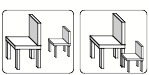
You can also gain spatial information about how surfaces are lit or shadowed, as well as about the perspective and surroundings of an object. Again, such cues can sometimes be deceptive; the images of the two blocks below are identical, yet the context suggests they are of different sizes.

If you assume that two objects lie on the same surface, the one that is higher is further away. Finer textures appear more distant, as do blurred objects.


You can estimate the distance to an object by comparing different images from each eye, using the angle between these images or by the slight 'stereoscopic' differences between them.


The closer an object is to you, the faster it moves. You can also estimate sizes by how quickly your focus shifts.


Finally, aside from all these perceptual methods, you can assess distance without using sight at all — if you have seen the object before, you remember its location.
Student: Why so many methods when two or three would suffice?
Every minute we are awake, we make hundreds of distance estimations, yet we rarely fall down stairs or walk into doors. Each method of distance estimation has its drawbacks. Focus works only on close objects—some people cannot focus their sight at all. Binocular vision works at longer distances, but some cannot reconcile images from each eye. Other methods fail when the horizon or texture is not visible, and blur is not accessible. Knowledge applies only to familiar objects, but an object can have an unusual size—yet we rarely make fatal errors since we have many ways to estimate distance.
If each method has its pros and cons, whom should we trust? In the following chapters, we will discuss several ideas on how we can quickly switch between different ways of thinking.
Thank you for the translation. katifa sh. If you also want to join and help with translations, please reach out via personal message or email at alexey.stacenko@gmail.com.
Table of Contents for The Emotion Machine
Chapter 1. Falling in Love
Chapter 2. ATTACHMENTS AND GOALS
Chapter 3. FROM PAIN TO SUFFERING
Chapter 4. CONSCIOUSNESS
Chapter 5. LEVELS OF MENTAL ACTIVITIES
Chapter 6. COMMON SENSE []
Chapter 7. Thinking []
Chapter 8. Resourcefulness
8‑3. Panalogy
8‑4. How Does Human Learning Work
8‑5. Credit-Assignment
8‑6. Creativity and Genius
8‑7. Memories and RepresentationsChapter 9. The Self []
Completed Translations
Current translations that you can join
Source: habr.com
