

Microsoft has introduced a port of the Coreutils utility suite for the Windows platform. It includes several dozen utilities, such as sort, cat, chmod, chown, cp, find, sleep, tee, echo, uptime, and ls. This toolkit allows for direct use of standard utilities available in Linux and macOS on Windows, without the need for a WSL layer. The goal of the project is to simplify transitions between Unix-like systems, WSL, containers, and Windows, providing a unified set of commands, flags, and methods to carry existing scripts from other systems without rewriting them. The code is written in Rust and PowerShell, and is distributed under the MIT license.
The implementation is based on the code from the uutils project (Rust Coreutils), which develops a Rust variant of GNU Coreutils, as well as implementations of the find and grep utilities in Rust. The utilities are packaged as a single executable file "C:\Program Files\coreutils\coreutils.exe", with individual commands linked via hard links in NTFS.
Due to conflicts with existing native Windows utilities or ties to specific capabilities, the following utilities have been excluded from the release: dd, dir, dircolors, shred, sync, uname, expand, kill, more, paste, timeout, and whoami. Utilities tied to POSIX concepts not supported in Windows have also been excluded: chcon, chgrp, chmod, chown, chroot, groups, hostid, id, install, logname, mkfifo, mknod, nice, nohup, pathchk, pinky, runcon, stdbuf, stty, tty, users, and who.
Among the limitations and features, it is noted that NUL must be used instead of /dev/null, signals (SIGHUP, SIGPIPE, SIGUSR) are not supported, symbolic links can only be created after enabling developer mode, and some access rights operations are not available. When working with directories, both paths with the '/' character and those with '\' are accepted.
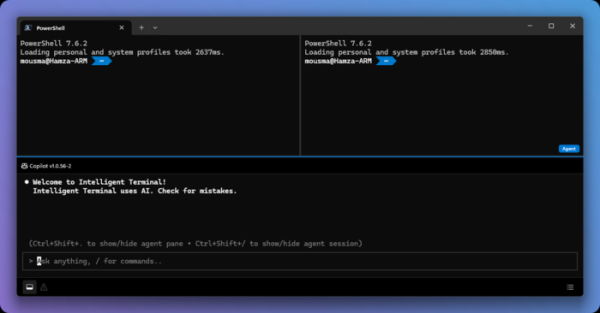
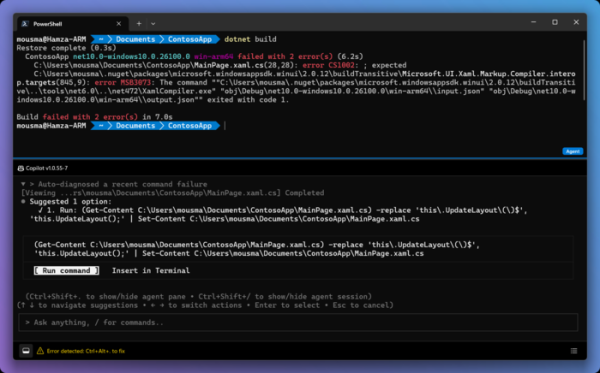
Simultaneously, the first release of the Intelligent Terminal emulator has been introduced, which is a fork of Windows Terminal with an integrated AI agent. It supports the connection of AI agents that comply with the ACP (Agent Client Protocol), such as GitHub Copilot, Claude, Codex, and Gemini. The terminal code is written in C++ and Rust, and is open under the MIT license.
The terminal is functionally similar to Windows Terminal and also supports tabs, themes, profiles, keyboard shortcuts, and screen splitting into separate areas. Notable differences include a dedicated status bar displaying the state of the AI agent and a context-specific pinned panel for interaction with the AI agent. It allows viewing the history of AI agent actions and switching between different AI agents. There is also a mention of telemetry being sent to Microsoft with information about program usage.
Additionally, a project has been announced to create a system for running Linux containers on Windows, implemented on the basis of the WSL (Windows Subsystem for Linux) layer. The toolkit provides a standard command-line interface, wslc, and an API for creating, deploying, and running Linux-based containers from the Windows environment, as well as for accessing running containers from Windows. The first preview version of WSL containers is expected to be released in the coming months as part of an update for WSL. Since WSL is an open project, development can already be tracked on GitHub.
Source: opennet.ru
