

A brief guide for beginners on why modular UPS systems are better and how this came to be.
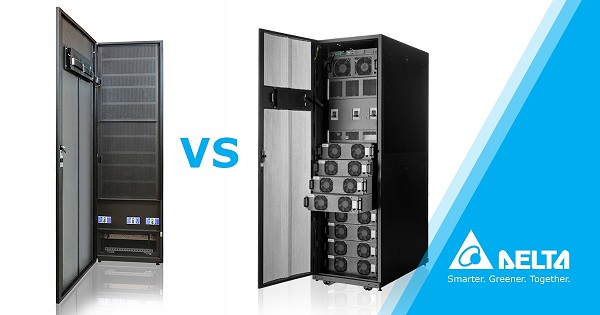
Uninterruptible power supplies for data centers are divided into two main categories based on their architecture: monoblock and modular. The former belongs to the traditional type of UPS, while the latter is a relatively new and more advanced option.
What distinguishes monoblock and modular UPS systems
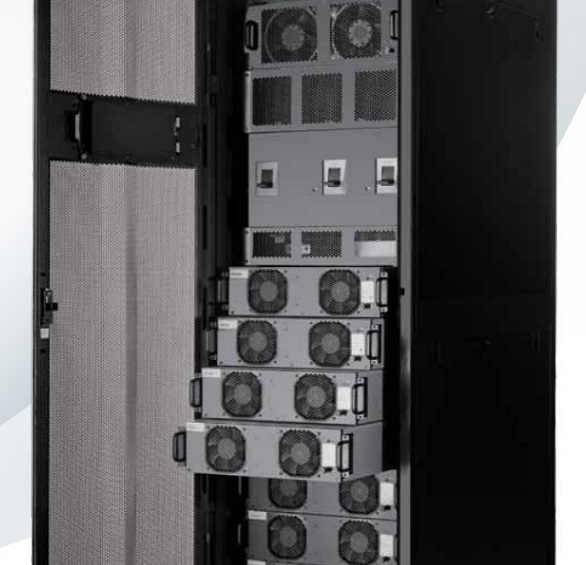
In monoblock uninterruptible power supplies, the output power is provided by a single power module. In modular UPS systems, the main components are made up of separate modules that are housed in standardized cabinets and work together. Each of these modules is equipped with a control processor, a charger, an inverter, and a rectifier, and constitutes a complete power section of the UPS.
Let's explain this with a simple example. If we take two uninterruptible power supplies—a monoblock and a modular—both rated at 40 kVA, the former will have one power module with a capacity of 40 kVA, while the latter will consist, for example, of four power modules each rated at 10 kVA.
Scalability options
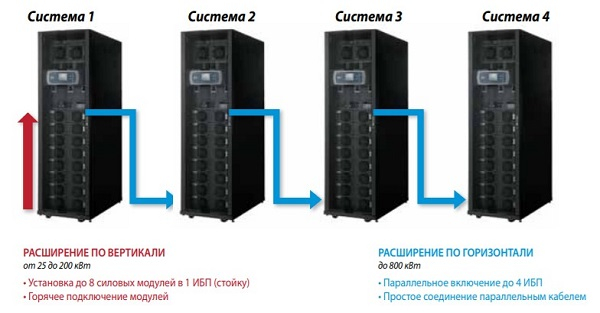
When using monoblock UPS systems, as the demand for power increases, it is necessary to connect an additional full module of the same capacity in parallel to the existing one. This is quite a complicated process.
Modular solutions offer greater design flexibility. In this case, one or more modules can be added to an already operating unit. This is a relatively simple procedure that can be done in a short time.
Gradual power increase options
Gradually increasing power is important during the initial phase of a data center's operation. It’s logical that in the first months it will be loaded to about 30-40%. It is more practical and economical to use uninterruptible power supplies that are designed for this capacity. As the client base grows, the load on the data center will increase, and with it, the need for additional power.
UPS power can be increased incrementally alongside the technical infrastructure. When using monoblock uninterruptible power supplies, gradual power increase is virtually impossible. With modular UPS systems, it can be easily implemented.
Reliability of UPS
When discussing reliability, we will operate with two concepts: Mean Time Between Failures (MTBF) and Mean Time To Repair (MTTR).
MTBF is a probabilistic measure. The value of the Mean Time Between Failures is based on the following postulate: the reliability of a system decreases as the number of its components increases.
In this regard, monolithic UPSs have an advantage. The reason is simple: modular uninterruptible power supplies have more structural elements and connector joints, each of which is considered a potential failure point. Consequently, the theoretical chance of failure is higher here.
However, for uninterruptible power supplies used in data centers, the actual failure is not as important as how long the UPS will remain down. This parameter is defined by the Mean Time To Repair (MTTR).
Here, the advantage is already on the side of modular units. They have a low MTTR because any module can be quickly replaced without interruption in power supply. For this, a spare module must be available, and one technician should be able to perform the disassembly and installation. In fact, this takes no more than 30 minutes.
The situation with monolithic uninterruptible power supplies is significantly more complex. Their repair cannot be completed as quickly. This process can take anywhere from several hours to several days.
To determine the fault tolerance of a system, another parameter can be used—availability or operability. This indicator is higher the greater the Mean Time Between Failures (MTBF) and the lower the Mean Time To Repair (MTTR). The corresponding formula looks as follows:
average availability (operability) =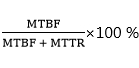
In relation to modular UPSs, the situation is as follows: their MTBF value is less than that of monolithic systems, but at the same time, they have a significantly lower MTTR value. As a result, the operability of modular uninterruptible power supplies turns out to be higher.
Power consumption
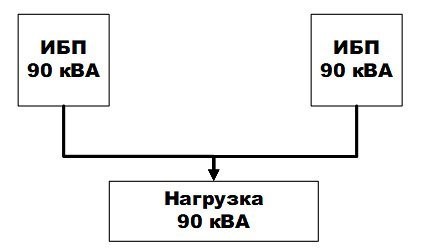
The monoblock system requires significantly higher energy consumption because it is redundant. Let's explain this using the example of the N+1 redundancy scheme. N is the amount of load required for the operation of the data center equipment. In our case, we will take it as 90 kVA. The N+1 scheme means that there is one unused backup element left in the system until failure.
When using a monoblock uninterruptible power supply with a capacity of 90 kVA to implement the N+1 scheme, another identical unit will need to be used. As a result, the overall redundancy of the system will amount to 90 kVA.
The situation is different when using modular UPS units with a capacity of 30 kVA. With the same load, another identical module will be needed to implement the N+1 scheme. Consequently, the overall redundancy of the system will no longer be 90 kVA, but only 30 kVA.
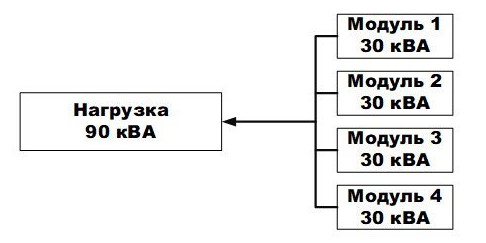
From this, we conclude that using modular power sources helps reduce the overall energy consumption of the data center.
Economics
If two uninterruptible power supplies of the same capacity are compared, the monoblock is cheaper than the modular one. For this reason, monoblock UPS units remain popular. However, increasing the output power will double the cost of the system, as another identical block will have to be added to the existing one. In addition, there will be a need to install switch panels and distribution boards, as well as to lay new cable lines.
Using modular uninterruptible power supplies allows for smooth scaling of the system’s power. Thus, the expense will only be for purchasing the number of modules sufficient to meet the existing power requirements, without unnecessary reserve.
Conclusion
Monoblock uninterruptible power supplies are characterized by low prices, simplicity in setup and operation. However, they increase the energy consumption of the data center and are difficult to scale. These systems are convenient and efficient where small capacities are needed and no expansion is anticipated.
Modular UPS units are characterized by easy scalability, minimal recovery time, high reliability, and performance. Such systems are optimal for increasing the data center’s power to any extent with minimal costs.
Source: habr.com
