

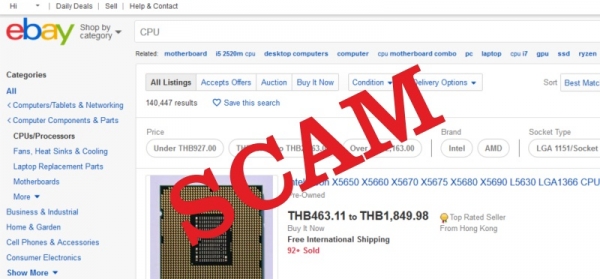
Disclaimer: this article doesn't quite fit for Habr and it's not clear which hub to place it in; it's also not a complaint, I believe the community will find it useful to know how one can lose money when selling computer hardware on eBay.
A week ago, a friend of mine approached me for advice; he was selling his old hardware on eBay and encountered a scam from the buyer.
He had listed a used Intel Core i7-4790K processor for sale, with an average price on eBay. The listing was standard, with a photo of the processor showing the serial number and indicating that it was used, without any accessories.
A buyer quickly found the processor, from Canada, with an eBay account established in 2008 and 100% positive feedback from a large number of purchases.
After the successful transfer of funds, my friend went to the post office and, at his own expense, sent the processor (he decided to make the delivery free). The package arrived in about 10 days, the buyer received it and even left a short review – 'Great!' and five stars. It seemed everything was good and he could celebrate successfully getting rid of his old hardware, but no.
A few days after receiving the package, the buyer opened a 'Return request' with the following complaint: 'Everything is great, but the processor you sent me does not match the description in the listing; I bought an Intel Core i7-4790K, but received an Intel Core i5-4690K.' To which my friend naturally replied that this couldn't be true; he personally packed the package and is absolutely certain he sent what was stated (and he never had any i5s).
At the same time, eBay offered three options: a full refund, a partial refund, and a refund with the return of the item at the seller's expense. The partial refund option required intervention from eBay support. My friend suggested a return of $1 to draw the support attention to the request, with a text indicating that the buyer was trying to scam the seller.
The buyer refused the return and the matter was referred to eBay's technical support. From which my acquaintance received a response that he has 4 days to arrange the return of the item at his own expense (paying the buyer the shipping cost to his PayPal account). It's clear that in this case, the buyer would simply return the i5-4690K at the seller's expense. Naturally, a detailed response outlining the situation was provided to technical support. However, technical support was completely on the side of the buyer in this case. After another template response regarding the return of the item, my acquaintance decided to stop wasting his nerves and made the return without sending the item back.
The buyer received a free upgrade, got his money back, and retained his old processor.
After a quick Google search and reading forums about scams on eBay, it turned out that this is a common practice.
The scheme is simple:
- An active account with positive reviews that has been around for a long time is purchased, or those reviews are collected from a large number of purchases for $1-2.
- Used hardware is purchased from the account, and after receiving the package, a return is requested. If a return is requested for the item, the seller receives something other than what he sold. Accounts are banned after a while following several complaints, but since there are no issues creating/purchasing new accounts, the scheme continues to thrive.
Unofficial advice from eBay is as follows: video record the unpacking of packages, make an inventory at the post office with confirmation of the contents (is it possible to do this at our post office, for example?). But it’s clear that such a number of actions per package is not productive at all. And it is unclear whether eBay will accept them as proof.
If anyone has encountered anything similar, please share your experience and how you solved these problems.
Source: habr.com
