

Even for those distant from physics, it is known that the maximum possible speed of data transmission for any signal is equal to the speed of light in a vacuum. It is denoted by the letter "c", and this is nearly 300 thousand kilometers per second. The speed of light in a vacuum is one of the fundamental physical constants. The impossibility of achieving speeds greater than the speed of light in three-dimensional space is a conclusion derived from Einstein's Special Theory of Relativity (STR).
Typically, when it is stated that the STR prohibits the transmission of information faster than light, there is an implicit assumption that there is no other way to 'tie information' to a photon and transmit it. However, there is another method. A well-known physical hypothesis — the holographic principle (a contemporary and widely utilized tool in theoretical physics) points to an interesting phenomenon: 'Events occurring in three-dimensional space can be projected onto a distant 'screen' without loss of information' — Leonard Susskind 'The World as a Hologram'[p. 3].
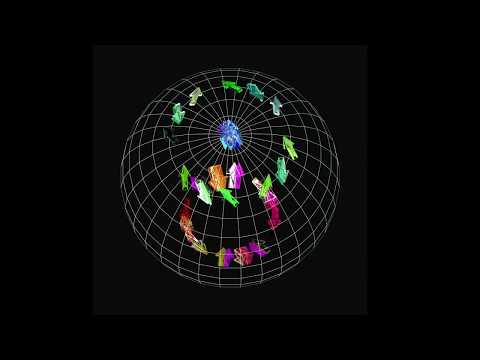
"Without loss of information" means that a speculative projection operation is unnecessary if we understand that our informational Universe really exists only on a 2D surface of the holographic horizon (screen) with a single time coordinate, while the fundamental laws of physics are a natural way of coding information with losses. Then a conclusion suggests itself: if we understand the extremely simple holographic code of the Universe — the natural mechanism for encoding and transferring information on the screen — one of the new possibilities may arise — we could discover a mechanism for transmitting and receiving information without being limited by distance and the speed of light. As for generating the holographic code of the Universe, the idea behind its search is to utilize the fundamental property of holograms: every minimal section of a hologram contains information about the entire object. Based on this fact, we postulate a very simple formula for coherent oscillations of any point in three-dimensional space and load it into a typical computer dynamics simulator (even software like 3D MAX will suffice). On a regular computer screen, in isometry, we can observe the dynamics of projections and numerous properties of elementary particles of the Standard Model across two halves of one emerging spherical surface. One parametric formula generates the dynamics of projections for three generations — an entire menagerie of elementary particles: 48 fermions and 12 bosons. The method of visualizing scientific data allows us to view the invisible on a regular computer — one cycle of coherent oscillations of a single point, which is identified with its radius vector:
On this fundamental, promising 'holographic background,' the emergence of an electromechatronic device — a fundamentally new type of astatic gyroscope with rigid parameters — seems natural, as it indeed utilizes the very same basic properties of holograms: coherence, interference, and the same formula for coherent oscillations of rotor points. If the hypothesis of a holographic Universe ever evolves into a working theory, it will only do so if its predictions are repeatedly confirmed in experiments, and even better, in its practical applications. With the establishment of an experimental basis — the pinnacle of the physics pyramid, the hypothesis, which is in fact part of the theory, is temporarily exempted from criticism until the moment of practical implementation of the experiment and the conducting of measurements.
The design of the unusual gyroscope is as follows: a spherical rotor with magnets levitates inside a vacuum-sealed spherical cavity of a stator with electromagnets. The rotor can be forcibly rotated in any of 64 directions under the control of a computer system around a single fixed point of the center of mass and simultaneously around three axes per cycle.
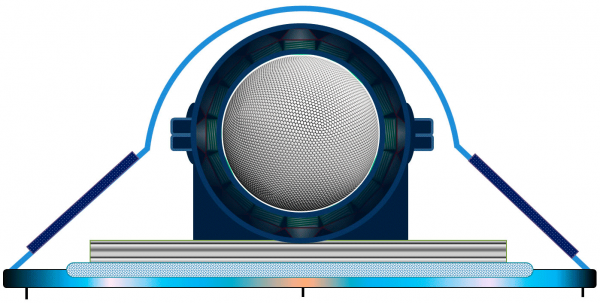
In a conventional astatic gyroscope, the rotor completes one rotation around one axis in one cycle, whereas in the unusual gyroscope, the rotor makes a full rotation in the same time around three stationary axes of Cartesian coordinates, linked with an accelerated observer. The elements of the rotor's mass (with this rotation algorithm) produce coherent oscillations, and the accelerations are associated with the direction of the semi-axes. The peaks and nodes of the accelerations create a stationary interference pattern of six identical and diametrically opposed groups.
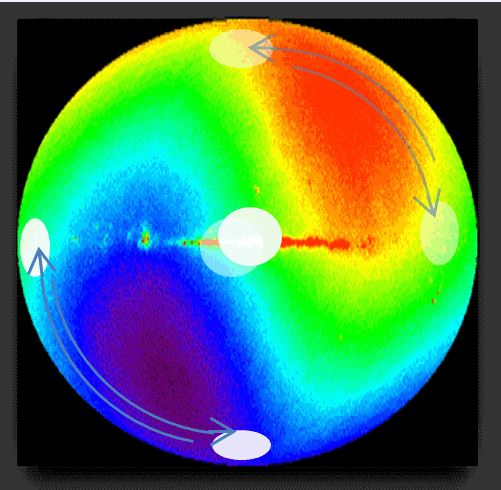
We have six groups of rotational accelerations that, according to the holographic principle, can be projected onto six opposite sides of a spherical 2D screen without loss of information, being invisible to the observer; we conditionally show them in the photo as six white circles. Using the rotor motion control computer system, we can change directions and move projections in pairs (any four of six), but now they are represented by the very information that moves across the screen with a unified time coordinate and without limitation in distance and the speed of light.
The holographic principle links bits of information with entropy and temperature on the spherical screen. Thus, it becomes possible to simultaneously transmit information while also receiving it; it is sufficient to measure the entropy force that will be applied to the center of mass of the rotor relative to the stationary stator. The entropy force arises from the interaction of the stationary gradients of temperature of the spherical holographic screen and the gradients of entropy caused by a directed jerk (the first derivative of the acceleration of matter).
Fentr = ΔTΔS;
where Fentr – entropy force ∆T — temperature gradient on the screen, ∆S — entropy gradient associated with the controlled jerk of mass elements.
If the expected uncompensated entropy force manifests itself in a closed system on a holographic screen, it means that the holographic theory is valid, and all observers, receivers, and transmitters of information are on a single surface with a unified temporal coordinate. Technically, a holographic exchange of information can be realized between them. This means we need to consider the immediate practical implementation of an unusual gyroscope. An unusual gyroscope, as an experimental setup, could answer the question: "Is the holographic principle true, whereby the physics of our '3D+1' dimensional spacetime is equivalent to the physics on a hypersurface with a dimensionality of '2D+1'?" In other words, it addresses the 'demarcation' problem of the holographic hypothesis.
In conclusion, it can be suggested that the solution to the Fermi paradox lies in the fact that if there are intelligent civilizations in our holographic universe, they will use the holographic screen as a communication channel. This, as we assume, allows them to exchange information without the limitations of distance and the speed of light.
Source: habr.com
