

The beginning of work on the openSUSE Leap 16.0 distribution has been announced, built on the technologies of the next significant branch of the commercial distribution SLES 16, transitioning to the new SLFO (SUSE Linux Framework One) platform, previously known as ALP (Adaptable Linux Platform). It is noted that the openSUSE Leap 16.0 branch attempts to combine the traditional capabilities of the distribution with new SLFO technologies. The new branch is positioned as a traditional distribution delivered in a fundamentally new form and using packages from SLES 16 and the community-supported Factory repository.
The release of openSUSE Leap 16.0 is scheduled for October 2025. The release of openSUSE Leap 15.6 published in June will be the last release in the 15.x branch, and access to package updates from SLES 15 SP7 will be provided through the Package HUB. Builds of the preliminary alpha version of openSUSE Leap 16.0 have been formed for testing. Three installation modes are offered: basic, GNOME, and KDE. The new Agama installer is used for installation.
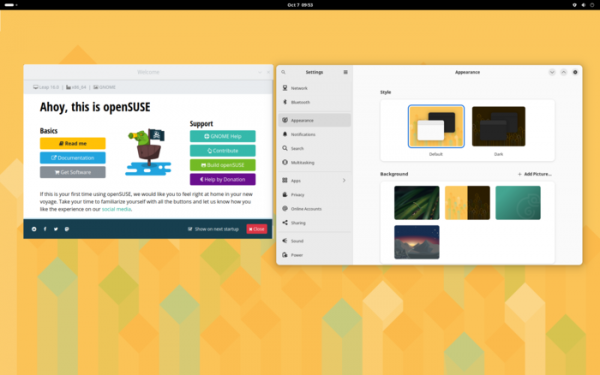
The SLFO platform is positioned as a continuation of the SUSE Linux Enterprise distribution development and is characterized by the separation of the distribution's core into parts. The core of SUSE 16 distribution will be a minimal 'host OS' environment, including only the components minimally necessary to run on the hardware and manage it. All applications and user-space components will run not in a mixed environment, but in separate containers or in virtual machines, executed over the 'host OS' and isolated from each other.
Among the features of the SLFO system environment is the default use of full disk encryption (FDE) with the possibility of storing keys in TPM. The root partition is mounted in read-only mode and is not modified during operation. The environment employs an atomic update installation mechanism based on the built-in package manager and snapshot mechanism in Btrfs. A customizable automatic update installation mode is provided. To maintain system resiliency (self-healing), the last stable state is captured using Btrfs snapshots (in case of anomalies detected after applying updates or changing settings, the system automatically reverts to the previous state).
The platform uses a multi-version software stack — by utilizing containers, it is possible to run different versions of tools and applications simultaneously. For instance, applications using different versions of Python, Java, and Node.js can run while separating incompatible dependencies. The basic dependencies are provided in the form of BCI (Base Container Images). Users can create, update, and delete software stacks without affecting other environments.
Source: opennet.ru
