

Carbon nanotubes have found yet another application. A few days ago, an article was published in the journal Nature Scientific Reports, for the first time discussing the possibility of using multi-walled carbon nanotubes (MWCNT) in magnetic recording on hard drives. These are various complex CNT structures resembling 'matryoshka dolls', 'scrolls', and other configurations. The objective in all cases boils down to one thing—stuffing each of these complex carbon nanotubes with magnetic nanoparticles. Individual magnetic nanoparticles will not provide data recording effects. The magnetization can only be altered by the entire tube, but this will still be denser than recording on a conventional magnetic disk HDD. domain Much denser.
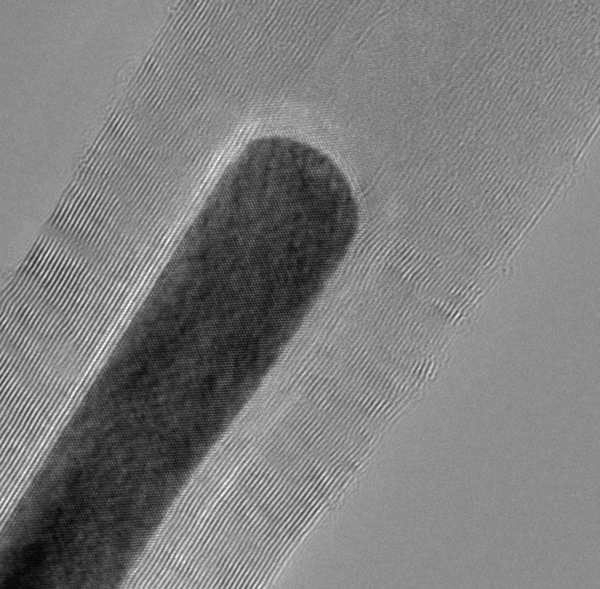
The research on magnetic recording using MWCNT was conducted by scientists from the University of Alaska (Fairbanks) and several other research institutions in the USA and the Czech Republic. One of the project leaders was Czech scientist Gunther Kletetschka. The specialist notes that existing methods for increasing recording density on HDDs no longer meet the speed of data growth. To curb data growth, storage density on hard drives needs to increase by 40% each year, while in recent years it has only grown by 10-15% annually. Recording using carbon magnetic tubes could be the answer to the challenges of the information age, but a colossal amount of research work still lies ahead.
The essence of the opening is that carbon nanotubes with magnetic nanoparticles inside were exposed to an electromagnetic field of varying amplitude and frequency. The production of nanoparticle-filled carbon tubes, by the way, was carried out using gas-phase deposition — nothing new. When a magnetic field was applied at frequencies up to 10 kHz, nothing happened (the surface conductivity effect of carbon nanotubes was at play), but as the frequency increased above 10 kHz and the amplitude of the field decreased, the effect of magnetization of the carbon nanotube with magnetic nanoparticles emerged. Scientists believe that the external field matched the magnetic field of individual particles, allowing the nanotube to acquire stable magnetization in a specified direction.
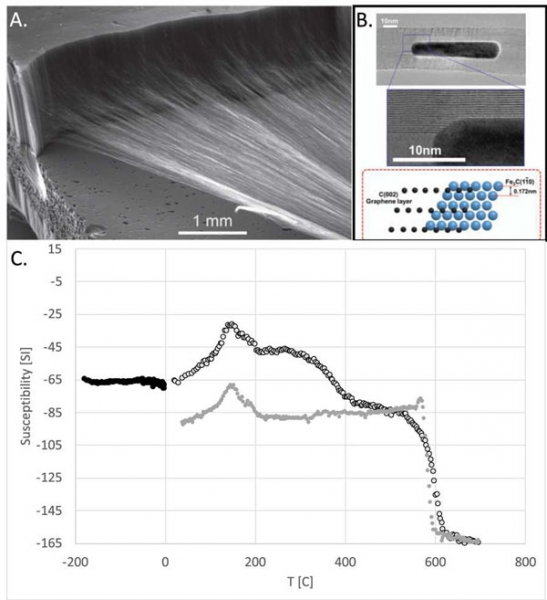
Scientists currently have no proposals on how to create recording and reading mechanisms for storing data on an array of carbon nanotubes, but they promise to work diligently in this area, as data is not going to decrease over time.
Source: 3dnews.ru
